
Lighting a rugby field might seem straightforward at first glance, but anyone who’s been to an evening match knows that good lighting can make or break the experience. Too dim, and players struggle to track the ball; too harsh, and it blinds them. Getting the lighting right isn’t just about putting up a few floodlights—it’s about planning, standards, and careful placement. Let’s walk through what goes into lighting a rugby field properly.
What Are the Rugby Field Lighting Standards?
Rugby is one of those games that moves fast and doesn’t wait for anyone. Players sprint across the pitch, balls fly high in the air, and tackles happen in a blink. With that kind of action, good lighting isn’t just nice to have—it really makes a difference. A poorly lit field can make it hard for players to judge distances, track the ball, and even see their teammates clearly.
Understanding Illuminance for Rugby
When we talk about lighting a rugby field, illuminance is the main term you need to know. Illuminance is measured in lux, which basically tells you how much light actually hits the ground. For a standard training field, most clubs aim for around 300 lux, which is bright enough for drills, practice games, and casual evening matches. But when you step up to competitive or televised games, the numbers jump significantly. Professional stadiums often target anywhere from 500 to 750 lux, with some high-end broadcast venues pushing close to 1,000 lux in certain areas.
That might sound like just a number, but in practice, it affects everything from the way a fly-half kicks the ball to how clearly referees can spot offside positions. In fact, a field with 1,000 lux in one corner and only 200 lux in another can feel patchy and uneven, which is frustrating for both players and spectators.
Why Uniformity Matters
It’s not just about how bright the lights are—it’s about even coverage across the entire pitch. This is where terms like uniformity ratio come in. Uniformity is a way of measuring how evenly light spreads on the field. For rugby, most competitive matches aim for a uniformity ratio between 0.6 and 0.7, meaning the dimmest spots should be at least 60-70% as bright as the brightest areas. Poor uniformity can make high balls tricky to catch and sideline passes harder to judge. Even with enough lux on paper, uneven lighting can feel like playing in a patchy shadow zone, which nobody wants during a fast-paced match.
Color Temperature and Glare
Another piece of the puzzle is color temperature, measured in Kelvins (K). Rugby fields usually stick to neutral white light, around 4000K to 5000K. This color temperature feels natural to the human eye and helps players and referees make accurate judgments. It also makes the field look better on camera, which matters if your games are streamed or televised. Too warm, and the light looks yellowish and can distort ball color; too cool, and it can feel harsh and uninviting.
Glare is another factor connected to lighting standards. With bright floodlights, placement and angle matter just as much as wattage. Poles that are too low or lights pointed directly at players can create blinding spots, while lights angled well across the field minimize harsh shadows and glare. A well-planned lighting setup balances brightness, uniformity, and direction to make sure the pitch is easy on the eyes from every angle.
Spotlight on Broadcast Requirements
If the field is ever going to be used for live broadcasts, the lighting standards get even stricter. TV cameras need higher lux levels—often 700-1,000 lux, with excellent uniformity and minimal flicker. That’s why professional stadiums use multiple high-powered LED floodlights on tall poles, sometimes as high as 25 meters, to cover every angle. In these setups, even a small drop in lux or a shadow can show up on camera, so designers often run detailed simulations before even installing the first light.
Lighting Consideration
Lighting a rugby field is way more than just hanging some giant lamps around the pitch. There’s a lot to think about—how many lights you actually need, where to put them, how tall the poles should be, and even how much the whole setup will cost. Getting these right can make the difference between a field that feels bright and welcoming at night, or one that leaves players squinting and chasing shadows.
How Many Lights Do You Actually Need?
The number of lights depends on the size of the field and what level of play it’s hosting. A standard rugby pitch is roughly 100 meters long and 70 meters wide, plus an extra 10 meters at each end for the in-goal areas. For small, community or amateur fields, 6 to 8 high-powered LED floodlights usually do the trick, getting the field to a comfortable 200-300 lux for training sessions or casual games.
For professional or semi-professional matches, things ramp up. To hit 500-750 lux, you’ll often need 12 to 16 floodlights, each ranging from 1000W to 2000W. In stadiums used for televised games, some setups even push the lux higher in key zones like the halfway line and goal areas to make sure cameras capture every tackle clearly.
Placement matters just as much as the number of lights. Floodlights are usually mounted around the perimeter of the field, angled carefully to avoid glare while covering every square meter. If lights are too close together, you can get harsh, blinding spots; too far apart, and shadows appear in high-traffic zones. Planning angles and distances carefully pays off far more than just adding extra lights.
How Many Light Poles Do You Need?
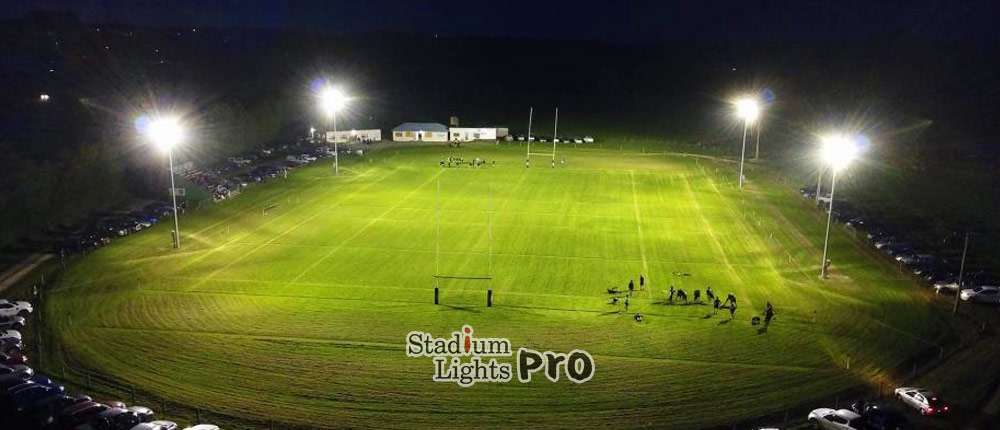
Most rugby fields work best with 4 to 6 poles, though larger stadiums might use even more. Small community pitches can often get away with four poles at each corner, while bigger venues sometimes add extra poles along the sidelines to reduce dark spots and improve coverage.
How you space poles affects how many lights go on each one. Some stadiums mount two or three floodlights per pole, while others rely on a single, higher-output light on taller poles. There’s no magic formula—it really depends on the field dimensions, the lux you’re targeting, and the level of uniformity you need. A little planning here avoids under-lighting, over-lighting, and wasted electricity.
How Tall Should the Poles Be?
Pole height plays a big role in how evenly light spreads. For most rugby fields, poles sit between 18 and 25 meters tall, with taller poles used in stadiums that host televised or professional matches. The higher the pole, the wider the beam spreads, which reduces shadows and makes the lighting feel natural across the whole field.
But taller poles aren’t free—they raise both installation and maintenance costs. Sometimes going a meter or two taller adds thousands to the project budget, so it’s all about finding that balance between coverage and cost.
How Much Will It Cost to Light a Rugby Field?
Cost is a big factor for clubs, schools, and stadium managers. For a standard community field, a full LED setup—including poles, floodlights, wiring, and labor—usually falls somewhere between $30,000 and $80,000. Professional stadiums, especially those aiming for broadcast-quality lighting with high uniformity ratios, can easily hit $150,000 to $250,000.
LEDs are more expensive upfront than older metal-halide lamps, but they save money in the long run. Most high-powered LED systems cut electricity use by 30-50%, and they last longer, which reduces maintenance costs. Over five or ten years, those savings can make a huge difference, not to mention the more consistent, flicker-free light they provide during games.
Even small design choices, like whether to go with angled floodlights versus vertical arrays, can influence cost and performance. It’s worth spending time on layout simulations or consulting with lighting designers to get the best results without overspending.
| Aspect | Value/Range |
|---|---|
| Rugby field size | 100 × 70 m (+10 m in-goal) |
| Lux for training/community | 200–300 lux |
| Lux for professional/TV | 500–750 lux |
| Number of floodlights (amateur) | 6–8 |
| Number of floodlights (pro/semi-pro) | 12–16 |
| Floodlight power | 1000–2000 W |
| Number of light poles | 4–6 |
| Pole height | 18–25 m |
| Cost (community field) | $30,000–$80,000 |
| Cost (professional stadium) | $150,000–$250,000 |
| LED energy savings | 30–50% |
Making the Field Look Even and Bright
It’s one thing to meet lux numbers on paper, but the goal is for the field to look and feel evenly lit. Shadowy corners or blinding glares near goalposts ruin the experience for players and referees alike. Proper placement, pole height, and overlapping light beams ensure that every part of the field—from try line to halfway—is bright, clear, and safe for fast-paced rugby action.
Tips to Have a Bright and Uniform Rugby Field
Once you’ve figured out the number of lights, poles, and the budget, the next step is making sure the field actually looks great and plays well at night. A well-lit rugby pitch isn’t just brighter—it feels safer, faster, and more enjoyable for everyone on it.
Think About Light Distribution
How you angle the lights can completely change the feel of a pitch. Instead of pointing floodlights straight down the sidelines, angle them slightly toward the center of the field. This helps reduce harsh shadows and makes sure every part of the pitch—from the try line to halfway—is clearly visible. On a standard 100×70 meter rugby field, even a small misalignment of a few degrees can create dark spots along the edges, which can throw off passes and high-ball catches.
Make Lights Overlap
Overlapping light beams is another subtle trick that makes a big difference. If the lights just barely reach each other’s coverage, you’ll end up with dim corners or streaky brightness across the field. Ideally, the beams from adjacent poles or floodlights should overlap by at least 10-20%, which ensures no area falls below your target lux. Even a corner that drops from 500 lux to 250 lux is noticeable during fast gameplay, especially when tracking a spinning rugby ball in the air.
Use Reflective Surfaces
Some stadiums get creative with reflective surfaces to help boost perceived brightness. Light-colored goalposts, bright field markings, or even slightly reflective sideline barriers can bounce light around and make the field feel brighter without cranking up wattage. While these tricks don’t replace actual floodlights, they help maintain visual clarity and make the pitch feel more evenly lit.
Regular Maintenance
Lighting isn’t a set-it-and-forget-it deal. Dirt, dust, and even bird droppings can reduce light output by 10-20% over time. That means a field that once reached 500 lux could drop below 400 lux if fixtures aren’t cleaned regularly. Scheduling quarterly or semi-annual cleaning keeps the field consistently lit and avoids having to use higher wattage to compensate for dirty lamps.
Modern LED Technology and Adjustable Intensity
Modern LED systems have changed the game for rugby lighting. Dimmable LEDs let you adjust the lux depending on the event. Training sessions might only need 200-300 lux, while a night-time league game could go up to 600-750 lux. Dimmable lights save energy, extend the life of the equipment, and let you create the right lighting atmosphere for different occasions. Some advanced setups even allow remote control via apps, so clubs can adjust brightness or turn zones on and off depending on the drill or match.
Extra Tips for Uniform Brightness
If you want your field to look like a professional stadium, consider mixing pole heights or adding extra lights in key areas like the goal zones. Shadows tend to appear where tall posts block the beams or where the ball is kicked high near the try line. Adding a few strategically placed lights, or slightly tilting existing ones, can eliminate these problem spots.
A well-planned, evenly lit rugby field not only looks great but also helps players react faster, see the ball clearly, and reduces eye strain during fast-paced evening games. When all these elements come together—distribution, overlap, reflective surfaces, maintenance, and smart LED use—you get a field that feels just as lively at night as it does under the afternoon sun.
Seeing the Field Clearly at Night
Lighting a rugby field is more than just installing a few floodlights. It’s about understanding the standards, planning the number and placement of lights, considering pole height and cost, and tweaking everything to get even, bright coverage. When done well, evening matches feel just as vibrant as daytime games, and everyone—from players to referees to spectators—can enjoy the game without squinting or chasing shadows.
With some careful planning and the right choices, a rugby field can shine brilliantly under the night sky, making every try, tackle, and kick easy to follow and exciting to watch.