Understanding Sports Dome Lighting
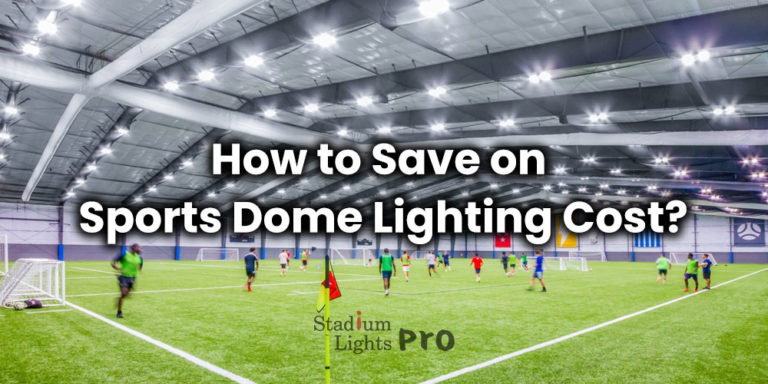
Sports dome lighting has its own personality. Unlike open stadiums, domes trap light inside a controlled envelope. That can be a huge advantage, but it also means mistakes are harder to hide. Glare, uneven brightness, or poorly aimed fixtures will be noticed immediately by players and spectators.
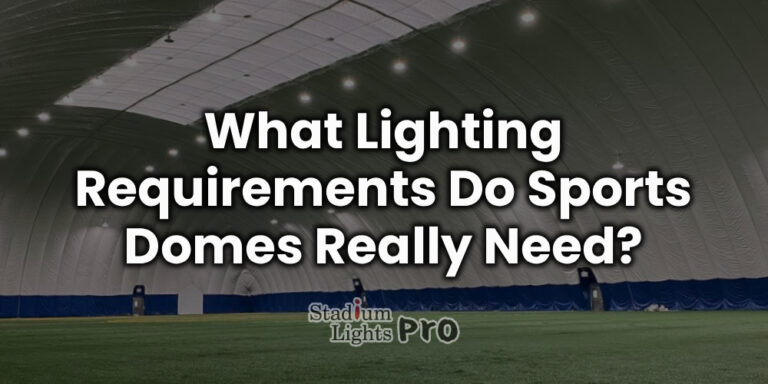
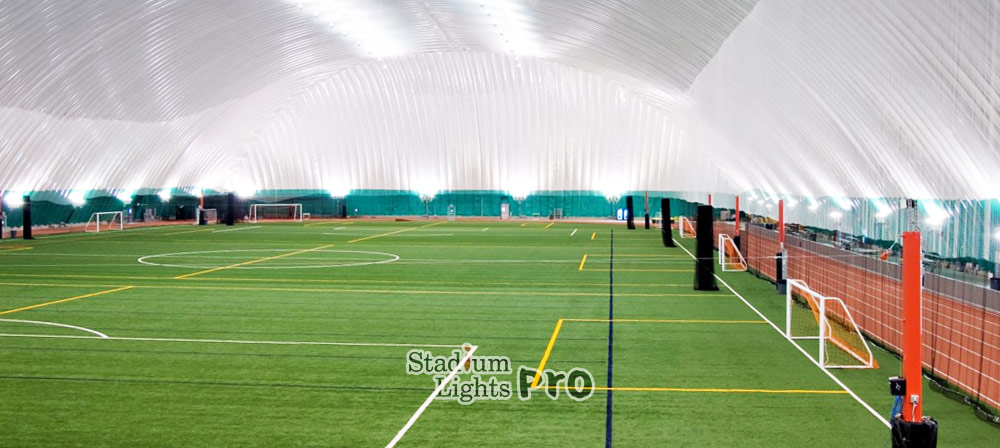
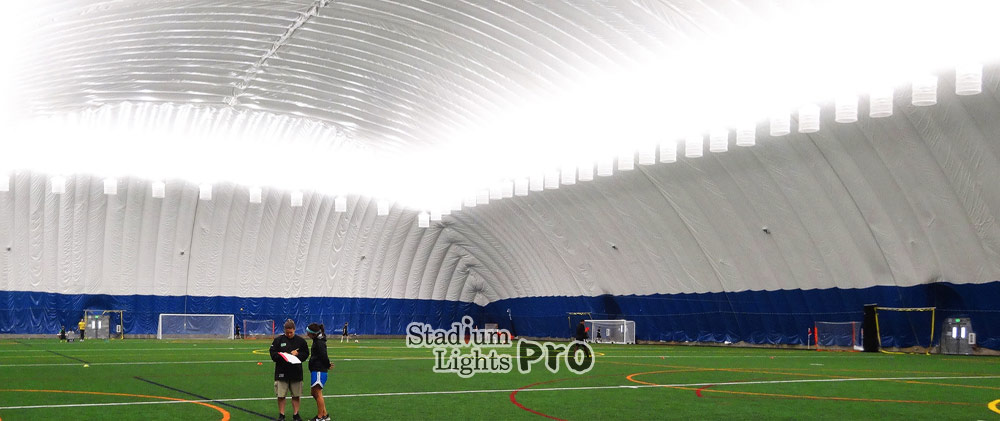
Most sports domes use high ceilings ranging from 12 meters to over 30 meters, depending on the sport and structure type. Air-supported domes, in particular, rely on lightweight materials and internal air pressure, which limits how and where luminaires can be mounted. Fabric surfaces also reflect light differently than concrete or steel, so designers need to account for higher reflectance and potential hotspots.
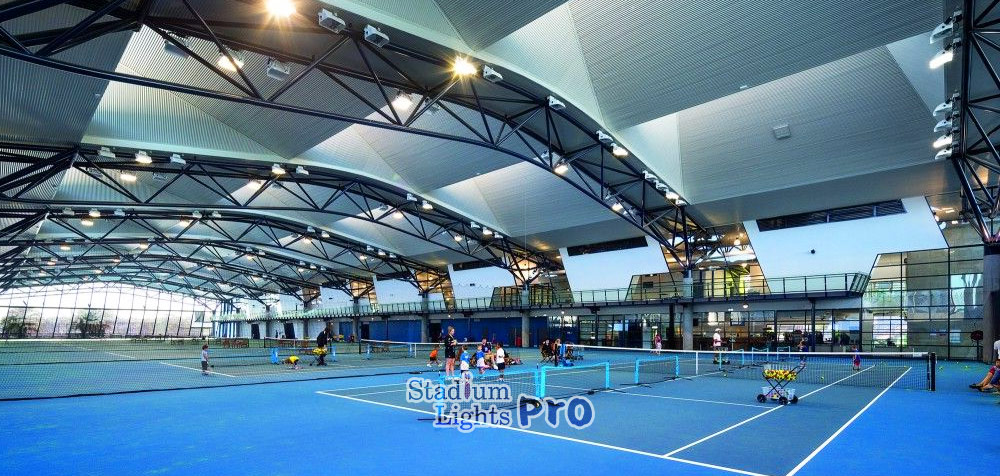
Another factor is versatility. Many domes host multiple sports, community events, training sessions, and even exhibitions. Lighting needs to adapt to different layouts and usage patterns. A soccer setup may need wide, uniform coverage, while tennis or baseball training requires more directional control. This is where thoughtful lighting planning makes a real difference.
Key Lighting Requirements for Sports Domes
Lighting inside a sports dome isn’t just about hitting a brightness number on paper. Because everything happens indoors and under one roof, lighting directly shapes how the space feels, how well athletes perform, and how usable the venue is for different levels of play. From training sessions to competitive matches and even live broadcasts, the lighting system needs to handle a wide range of demands without making the space uncomfortable or visually tiring.
Illumination Levels and Lux / Foot-Candle Requirements
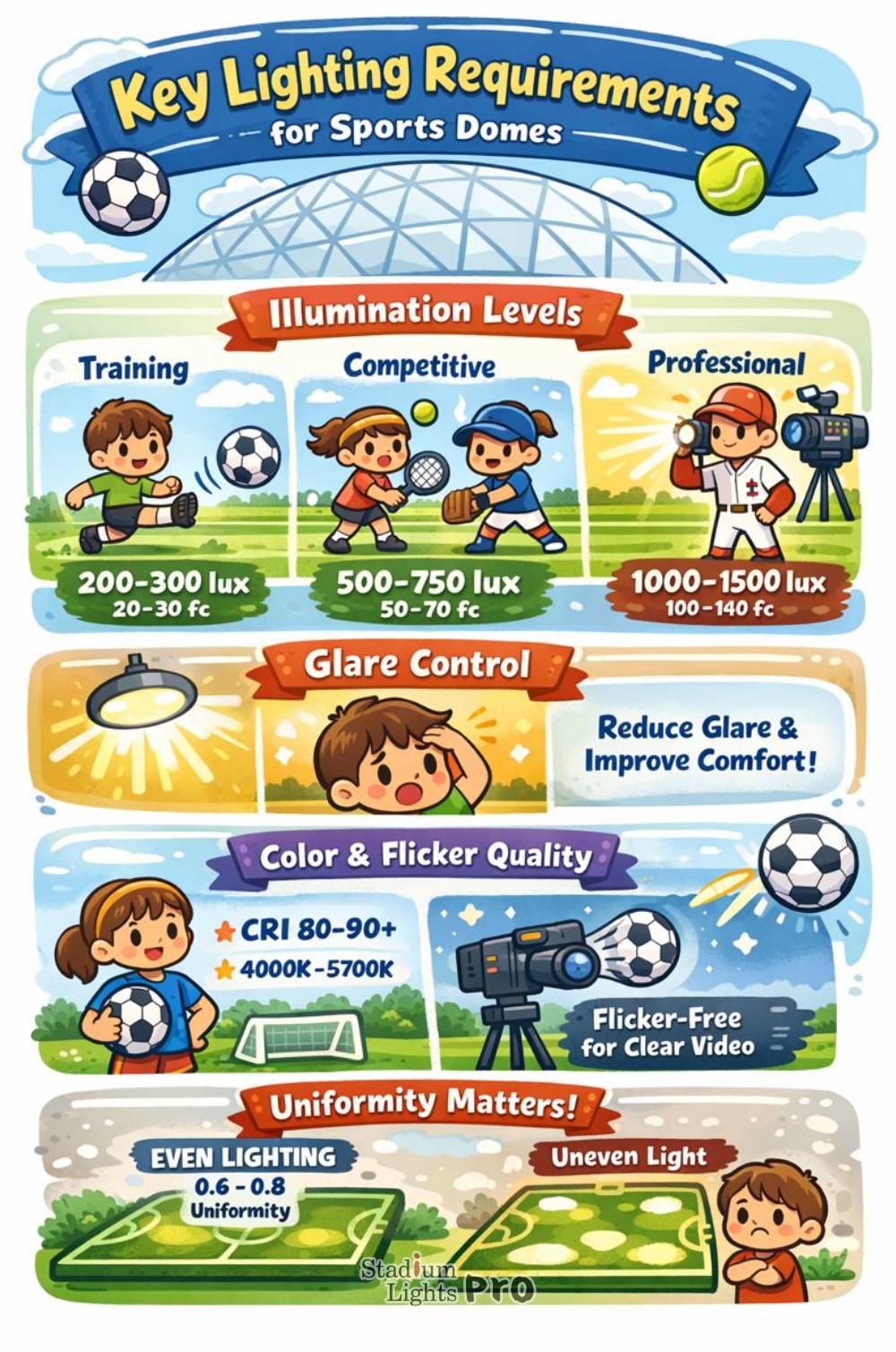
Illumination levels in sports domes are typically measured in lux or foot-candles, and the right range depends heavily on how the facility is being used. For recreational training, community sports, or school-level activities, lighting levels usually fall between 200 and 300 lux, which is roughly 20 to 30 foot-candles. At this level, players can see clearly enough for drills, warm-ups, and casual games without the space feeling overly bright or harsh.
Once you move into competitive amateur sports, expectations rise quickly. Most dome facilities designed for league play or regional competitions aim for 500 to 750 lux, or about 50 to 70 foot-candles. This range supports faster ball movement, sharper reactions, and better depth perception, especially in sports like soccer, futsal, tennis, and field hockey. Athletes tend to feel more confident at these levels because visual cues are clearer and more consistent across the playing surface.
For professional-level games or broadcast-ready venues, lighting becomes even more demanding. It’s common to see target levels of 1,000 lux or higher, with some facilities pushing up to 1,500 lux, which is close to 140 foot-candles. These higher levels help cameras capture crisp images without motion blur, even during high-speed action. They also support slow-motion replay and high-definition streaming, which are now standard expectations for televised sports.
Brightness alone doesn’t tell the whole story, though. Lighting uniformity plays a huge role in how usable the space actually feels. A well-designed sports dome usually targets a uniformity ratio between 0.6 and 0.8, meaning the darkest areas are still relatively close in brightness to the brightest spots. When uniformity drops too low, players notice it immediately. Sudden changes in light levels can throw off timing, depth judgment, and overall comfort, especially during long matches or back-to-back training sessions.
Glare Control and Visual Comfort
Because a sports dome encloses all light within a single space, glare can become an issue very quickly if the lighting isn’t handled carefully. High-angle glare is especially noticeable in sports where athletes frequently look upward, such as soccer, baseball training, badminton, or volleyball. A badly placed luminaire can sit right in a player’s line of sight, making it harder to track the ball or judge distance.
Good glare control comes down to smart decisions around mounting height, beam angles, and optical design. Modern LED sports lights use precision lenses and reflectors that shape the light exactly where it’s needed. Compared to older metal halide systems, which tended to spill light in all directions, LEDs offer much tighter control. That means fewer harsh hotspots and less wasted light bouncing around the dome.
Cutoff angles also make a noticeable difference. Fixtures designed with proper shielding help keep light out of direct sightlines while still delivering strong horizontal and vertical illumination on the playing surface. When glare is kept under control, athletes report less eye strain, and spectators find the space more comfortable to watch games for extended periods.
Color Quality, Color Temperature, and Flicker Performance
Color quality often doesn’t get much attention until it’s done poorly. In a sports dome, color rendering index (CRI) affects how clearly players see the ball, boundary lines, uniforms, and even facial expressions. Most modern domes aim for a CRI of 80 or higher, which is more than adequate for training and competitive play. Professional venues and broadcast environments sometimes push toward CRI 90+, where color accuracy becomes even more noticeable on camera.
Color temperature also shapes the atmosphere of the dome. Many facilities choose a range between 4,000K and 5,700K, which delivers a bright, neutral, daylight-like appearance. Lower temperatures can feel a bit dull or yellow, while extremely high temperatures may feel too cold or clinical. Staying within this range tends to strike a good balance between alertness and comfort for both players and spectators.
Flicker is another topic that’s gained attention in recent years. With the rise of high-speed cameras, live streaming, and social media clips, lighting systems need to perform well even under slow-motion playback. Poor-quality drivers can introduce flicker that’s invisible to the naked eye but obvious on camera. High-quality LED sports lighting is designed to be flicker-free, even at high frame rates, which protects visual comfort and ensures clean video output.
Lighting Design Considerations for Sports Domes
Designing lighting for a sports dome is a bit like solving a three-dimensional puzzle. The space isn’t flat, the ceiling isn’t uniform, and the way light behaves inside an enclosed structure is very different from outdoor fields or standard indoor halls. A solid lighting design takes into account geometry, materials, usage patterns, and long-term operation, not just how many fixtures are installed.
| Lighting Aspect | Typical Values / Ranges |
|---|---|
| Dome ceiling height | 15–30 m (typical sports domes) |
| Fabric surface reflectance | Up to 70%+ |
| Training lighting level | 300–500 lux |
| Match / competition lighting level | 750 lux or higher |
| Energy savings with smart controls | 20–40% |
| LED fixture lifespan | 50,000–100,000 hours |
Fixture Placement and Dome Geometry
Everything starts with the shape of the dome. Curved ceilings, varying roof heights, sloped sidewalls, and tensioned fabric surfaces all influence how light spreads across the playing area. Unlike rectangular gymnasiums, sports domes rarely offer straight lines or consistent mounting planes, so fixture placement has to be planned carefully from the start.
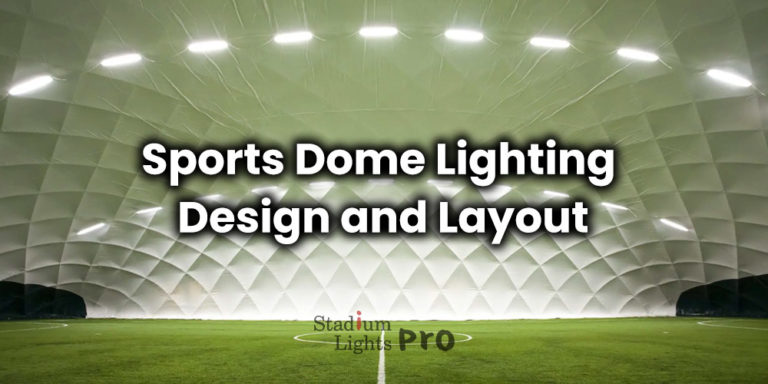
In many domes, luminaires are mounted along the perimeter ring or attached to structural ribs where load limits allow. Air-supported domes, in particular, have strict weight restrictions, which means every fixture’s size and mounting method matters. The challenge is to position lights high enough to cover large areas evenly, while still keeping beam angles under control so light lands where athletes actually need it.
To get this right, designers rely heavily on lighting simulation software. These digital models replicate the dome’s geometry, surface reflectance, and mounting heights, allowing designers to test different layouts before anything is installed. By adjusting beam spreads, aiming angles, and fixture spacing on screen, it’s possible to fine-tune uniformity and reduce glare long before the first luminaire goes up. In many cases, simulation can reveal that fewer well-placed fixtures perform better than a larger number of poorly aimed ones.
Indirect Lighting and Reflected Light
Indirect lighting often becomes a quiet hero in sports dome design. Instead of aiming every fixture directly at the playing surface, some of the light is allowed to bounce off the dome’s interior surfaces. This reflected light helps soften shadows and smooth out brightness differences across the field.
Fabric domes are especially suited to this approach because their inner surfaces can have reflectance values above 70 percent, meaning a large portion of light is redirected back into the space. When handled properly, indirect lighting makes the environment feel more open and visually comfortable, even at higher illumination levels. Players often describe these spaces as feeling “easier on the eyes,” especially during long training sessions.
That said, indirect lighting isn’t something you can guess your way through. Reflected light depends heavily on surface condition. Dust, aging fabric, or discoloration can reduce reflectance over time, leading to gradual light loss. Designers usually account for this by building in a maintenance factor and balancing indirect light with enough direct illumination to keep performance consistent year after year.
Vertical Illumination and Player Visibility
While horizontal light levels on the playing surface get most of the attention, vertical illumination is just as relevant in sports domes. Vertical light affects how well players see each other, track balls in the air, and react to fast movement. This is especially true for sports like soccer, baseball, tennis, and badminton, where a lot of action happens above eye level.
Good vertical illumination comes from thoughtful aiming and fixture distribution, not just higher brightness. Lights placed too steeply can flatten depth perception, while lights aimed too shallow may cause glare. A balanced design ensures faces, jerseys, and airborne objects are well lit from multiple angles, improving reaction time and overall gameplay quality. Broadcast environments rely heavily on strong vertical illumination to capture clear images without heavy shadows.
Surface Reflectance and Material Considerations
The materials inside a sports dome play a bigger role in lighting performance than many people expect. Fabric membranes, painted steel, flooring surfaces, and even wall padding all interact with light differently. Light-colored surfaces reflect more light and help improve uniformity, while darker finishes absorb light and can make a space feel dimmer, even when measured lux levels are technically high.
Designers often factor in average reflectance values during planning. For example, a dome with light-colored fabric and flooring may achieve the same perceived brightness using fewer luminaires compared to a dome with darker finishes. Over the life of the facility, this can translate into lower energy use and reduced operating costs. Regular cleaning and maintenance also help preserve these reflectance properties and keep lighting performance consistent.
Multi-Use Flexibility and Lighting Controls
Most sports domes aren’t built for a single activity. One day it’s youth training, the next it’s league competition, and on weekends it might host community events or exhibitions. Because of that, flexibility is baked into modern lighting design.
Zoned lighting allows different areas of the dome to operate at different brightness levels. Training sessions may only need part of the field lit to 300 or 500 lux, while a full match setup might push levels past 750 lux across the entire surface. Dimming systems and programmable lighting scenes make these transitions quick and simple, without manual switching or complicated setups.
Smart control systems take things a step further. By integrating scheduling software, occupancy sensors, or even daylight sensors near entrances, facilities can avoid running lights at full output when they’re not needed. Many operators report energy savings of 20 to 40 percent after adding intelligent controls, along with better consistency and easier day-to-day management.
When lighting design considers geometry, reflection, vertical visibility, materials, and flexibility together, the sports dome becomes easier to use and more efficient to operate. The space feels brighter without being harsh, adaptable without being complicated, and ready for whatever activity comes next.
Installation Challenges and Best Practices
Installing lighting inside a sports dome is very different from working in a standard indoor hall or outdoor stadium. The structure, materials, and operating conditions all add extra layers of complexity. A smooth installation usually comes down to planning ahead, understanding the dome’s limitations, and working with installers who have hands-on experience in this type of environment.
Access, Height, and Working Conditions
One of the first hurdles is simply getting to where the lights need to go. Sports domes often have ceiling heights ranging from 15 to 30 meters, and in some large training domes, even higher. Reaching those heights requires scissor lifts, boom lifts, suspended platforms, or custom rigging systems. In air-supported domes, access planning becomes even more delicate because heavy equipment can affect air pressure and membrane tension.
Installers often work during off-hours or planned shutdown periods to avoid disrupting daily operations. Every hour of downtime matters, especially for domes that run packed schedules from early morning to late evening. Experienced teams usually pre-assemble fixtures, brackets, and wiring on the ground to reduce time spent working at height, which improves safety and speeds up the overall process.
Structural Load Limits and Fixture Weight
Weight is a constant topic in sports dome projects. Many dome structures are engineered with very tight load tolerances, particularly fabric and air-supported systems. Every additional kilogram needs to be justified and approved. That’s one of the main reasons LED luminaires have become the standard choice for dome lighting.
Compared to older metal halide or high-pressure sodium fixtures, LED sports lights can weigh 40 to 60 percent less while delivering equal or higher lumen output. A single LED fixture might replace two or three legacy luminaires, reducing both weight and mounting points. Fewer fixtures also mean fewer penetrations or attachment points, which helps preserve the integrity of the dome structure.
Mounting hardware is just as important as the fixture itself. Brackets, cables, and safety chains all need to meet structural and safety requirements. Redundancy is common practice, especially in high-traffic areas, to ensure fixtures remain secure over the long term.
Thermal Management in Enclosed Dome Environments
Heat management often gets overlooked because LEDs are marketed as “cool” light sources. While it’s true that LEDs produce less radiant heat than traditional systems, they still generate heat at the fixture level. In a sports dome, where air circulation can be limited, that heat needs somewhere to go.
High-quality LED sports luminaires are designed with advanced heat sinks and thermal pathways to keep internal temperatures stable. This directly affects lifespan. Well-managed fixtures are commonly rated for 50,000 to 100,000 operating hours, even in demanding environments. Poor thermal design, on the other hand, can shorten lifespan significantly and lead to early lumen depreciation.
Installers also need to consider airflow patterns created by HVAC systems or dome pressurization. Placing fixtures where heat can dissipate naturally helps maintain consistent performance, especially during long operating hours or peak summer conditions.
Electrical Integration and Control Systems
Electrical work in a sports dome goes beyond simply powering the lights. Modern installations often include dimming drivers, control networks, and smart lighting systems. Cabling routes must be carefully planned to avoid interfering with structural elements, fabric membranes, or maintenance access points.
Control systems are usually tested in stages. Basic on-off functionality comes first, followed by dimming calibration, zoning, and scene programming. This staged approach helps identify issues early and avoids surprises once the facility is back in full operation. In many cases, commissioning includes light level measurements to confirm that target lux values and uniformity ratios are actually being achieved on the field.
Coordination with Other Building Systems
Lighting doesn’t exist in isolation. In a sports dome, it has to coexist with HVAC ducts, fire detection systems, sprinklers, scoreboards, sound systems, and sometimes retractable equipment. Good coordination between trades is what keeps installation timelines under control.
Experienced installers work closely with structural engineers, dome manufacturers, and facility managers to sequence tasks properly. For example, lighting installation may need to happen after certain structural inspections but before final HVAC balancing. Getting the order right reduces rework and keeps the dome usable as much as possible throughout the project.
Safety, Testing, and Long-Term Reliability
Safety is always front and center when working at height and around active sports facilities. Installers follow strict protocols, from fall protection to electrical lockout procedures. Once installation is complete, fixtures are tested under full load to confirm stability, aiming accuracy, and control performance.
Cost and Funding Considerations
When people start talking about sports dome lighting, cost is usually one of the first topics that comes up. And honestly, that’s fair. Lighting is a major system, and the numbers can look big at first glance. But once you break things down and look at the full lifecycle, the picture becomes a lot more reasonable and, in many cases, pretty convincing.
Upfront Investment and What Drives the Price
The cost of sports dome lighting can vary a lot depending on the size of the dome, ceiling height, target lux levels, and whether the facility is meant for casual use or competitive play. As a general reference, recreational LED lighting upgrades often start around USD 15 to 25 per square meter. These setups usually focus on training-level illumination, basic controls, and straightforward fixture layouts.
For domes designed for competitive matches or multi-purpose use, costs typically move higher. High-performance or broadcast-ready systems can reach USD 40 to 60 per square meter, and sometimes more. These systems usually include higher-output luminaires, tighter uniformity requirements, advanced optics, flicker-free drivers, and smart control infrastructure. Mounting complexity and installation access can also push costs up, especially in large or air-supported domes.
It’s also worth noting that fixture count alone doesn’t tell the whole story. A design using fewer, more powerful LED fixtures can sometimes cost less overall than a layout with many lower-quality lights that require more mounting points, wiring, and maintenance down the road.
Energy Consumption and Operating Cost Savings
This is where LED lighting really starts to show its value. Compared to older metal halide systems, LED sports lighting typically cuts energy use by 50 to 70 percent. That’s not a small difference, especially in a dome where lights may be on every day.
Take a mid-sized sports dome as an example. If it runs lighting 8 to 10 hours per day, six or seven days a week, energy savings can easily reach tens of thousands of dollars per year, depending on local electricity rates. In regions with higher energy costs, the savings are even more noticeable.
On top of that, LED systems don’t need warm-up time. Lights turn on instantly and can be dimmed or zoned without penalty. Facilities that actively use dimming and scheduling often see another layer of savings simply by not running lights at full output when they’re not needed.
Maintenance Costs and Long-Term Reliability
Maintenance is one of those hidden costs that doesn’t always show up in early budgeting discussions. Traditional HID lamps often need replacement every 2 to 3 years, sometimes sooner in demanding environments. Each replacement usually means lift rentals, labor costs, and partial shutdowns of the facility.
Modern LED sports luminaires are commonly rated for 50,000 to 100,000 hours of operation. In real-world terms, that can mean 10 years or more of use with minimal intervention. Fewer lamp changes translate directly into lower maintenance budgets and less disruption to daily schedules.
For dome operators, this reliability is a big deal. Not having to plan frequent access at height reduces safety risks and keeps the venue available for bookings. Over time, maintenance savings alone can cover a significant portion of the original lighting investment.
Funding, Rebates, and Incentive Programs
Funding options for sports dome lighting have expanded a lot in recent years. Many regions now offer energy-efficiency rebates or grant programs, especially for projects that replace older, inefficient lighting with high-efficiency LED systems. Depending on location and program structure, incentives may cover 10 to 30 percent of the total lighting cost.
Some facilities also take advantage of performance-based financing or leasing models. These allow the lighting upgrade to be paid for over time, often using the energy savings generated by the new system. For organizations that want to improve their facility without a large upfront capital expense, this approach can be very appealing.
Utilities and local authorities usually look for clear documentation. Projects that include energy models, before-and-after power consumption data, and realistic usage schedules tend to move through approval more smoothly.
Payback Periods and Decision-Making
When all the numbers are laid out, many sports dome lighting projects land in a payback range of 3 to 6 years. That timeline often resonates well with facility owners, schools, and municipal operators. After the payback period, the ongoing savings continue year after year, improving the overall financial performance of the venue.
Beyond pure numbers, better lighting can also support higher-quality events, improved user satisfaction, and stronger booking demand. While those benefits are harder to quantify, they often play a role in justifying the investment.
At the end of the day, sports dome lighting isn’t just a cost line on a spreadsheet. When planned carefully and paired with the right funding strategy, it becomes a long-term asset that supports both performance and financial sustainability.
A Practical Way Forward
Sports dome lighting is a blend of engineering, experience, and real-world use. When lighting levels are right, glare is managed, and the system is designed with flexibility in mind, the entire facility feels better to play in and easier to operate. Numbers like lux levels, energy savings, and lifespan hours matter, but so does how the space feels at 9 p.m. during a long training session.
If you’re planning a new dome, upgrading an older system, or just exploring what’s possible with modern lighting, working with a team that understands dome structures makes a noticeable difference. We’re always happy to share insights, run lighting simulations, or talk through budget and funding options. Feel free to reach out to us for a conversation or consultation tailored to your specific sports dome project.