
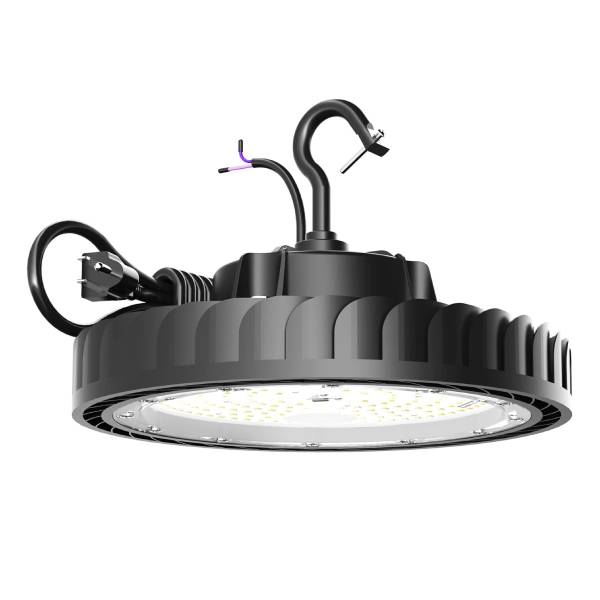
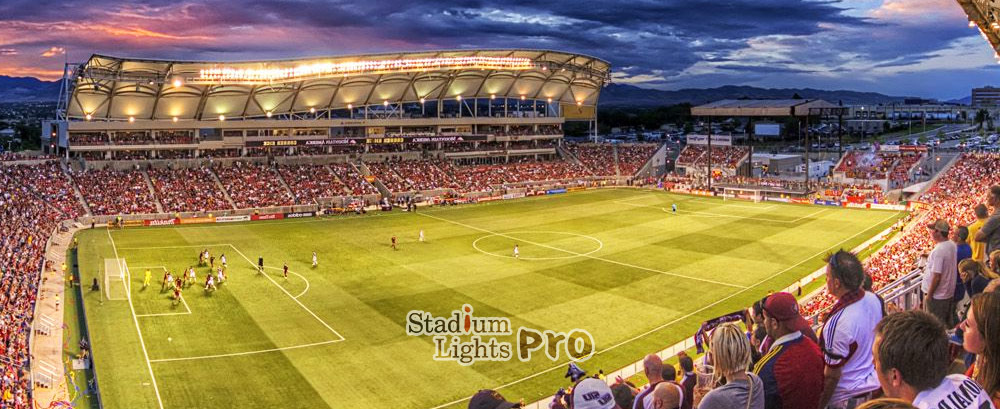
Soccer is no longer just a daytime sport. From local community pitches to massive stadiums hosting global tournaments, lighting now plays a huge role in how the game is played, watched, and even broadcast. Good lighting helps players track the ball smoothly, helps referees make accurate calls, and makes sure fans can actually enjoy the match without squinting into shadows or glare. Over the past 10–15 years, the shift toward LED systems and smarter lighting layouts has changed how fields are designed, how much energy they use, and how long they last.




Soccer Stadium Lighting Standards and Regulations
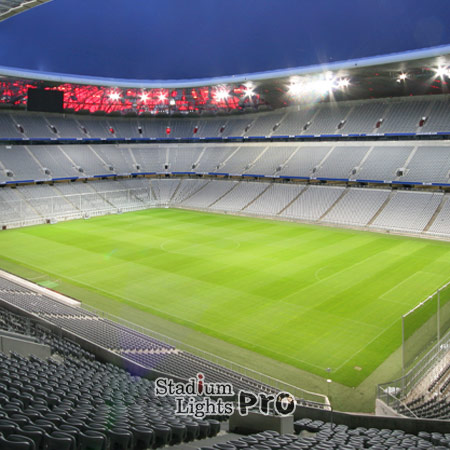 When it comes to soccer field lighting, most technical requirements come from organizations like FIFA and the European EN12193 sports lighting standard. These standards don’t just look at brightness; they cover things like uniformity ratio, glare control, color rendering, flicker level, and vertical illuminance performance. The goal is to make sure lighting supports player performance, referee accuracy, and broadcast quality at the same time.
In real-world projects, lighting standards also help engineers decide how many poles are needed, what mounting height works best, and how powerful each luminaire should be. Without these benchmarks, fields can easily end up either under-lit or wasting energy by over-lighting areas that don’t need it.
| Field Level / Use | Average Lux | Vertical Illuminance (Lux) | CRI | GR Value | Pole Height (m) |
|---|---|---|---|---|---|
| Recreational / Training | 75–200 | – | – | – | 12–16 |
| Amateur Competition | 200–300 | – | – | – | 16–20 |
| Semi-Professional / Regional | 300–500 | – | – | – | 18–24 |
| Professional / Broadcast | 800–2000 | 500–1000 | 80–90+ | 40–50 | 20–30+ |
| Ultra-HD / International Stadium | 2500+ | 800–1200 | 90+ | <40 | 25–35+ |
Lux Levels by Level of Play
Lighting levels vary depending on how the field is used. Basic recreational and training fields usually run between 75 and 200 lux average horizontal illuminance. This range is enough for casual play, school training sessions, and local community matches. At around 100 lux, players can move safely and track the ball comfortably, especially when LED uniformity is good.
Amateur competition fields usually step up to around 200–300 lux, which gives better visual clarity for faster gameplay. At this level, players can react more quickly to passes travelling at 50–70 km/h, and referees can judge offside lines more accurately.
Semi-professional and regional competition fields often target 300–500 lux, especially if evening matches attract spectators. Once lighting reaches the 400–500 lux range, player facial recognition, ball spin tracking, and depth perception all improve noticeably.
Professional and broadcast-level matches usually require 800 lux at minimum, with many modern stadiums operating between 1,000 and 2,000 lux. High-end international stadiums sometimes exceed 2,500 lux for ultra-HD broadcasting and slow-motion replay clarity. At these levels, cameras running at high frame rates can capture sharp images without motion blur.
What’s interesting is that increasing lux doesn’t just make things “brighter.” It improves contrast, shadow softness, and color consistency across the entire pitch.
Uniformity Ratios and Light Distribution
Uniformity is often where good lighting systems separate themselves from average ones. Even if a field averages 500 lux, it won’t feel comfortable to play on if certain zones drop below 200 lux.
Many professional guidelines require minimum brightness to be at least 50% of maximum brightness, and at least 60–70% of average brightness. That means if your field averages 500 lux, the darkest area should usually stay above 300 lux.
Higher-end stadiums sometimes push uniformity ratios even further. Some broadcast venues aim for 0.7 or higher minimum-to-average uniformity, which makes brightness look visually seamless across the entire playing area.
Good uniformity helps eliminate shadow zones around the penalty area, center circle, and sidelines. For players, this translates into more consistent visual tracking, especially during fast counterattacks or aerial play.
Glare Control and Player Visual Comfort
Glare is something players notice immediately. If a striker looks up for a high cross and sees a bright light source directly, reaction time drops and visual discomfort increases.
That’s why glare rating (GR value) is carefully controlled in professional lighting design. Many competition fields target GR values between 40 and 50, while elite stadiums sometimes push even lower.
Pole height, aiming angle, and luminaire shielding all influence glare. For example, mounting lights at 20–30 meters height allows beams to spread more naturally, reducing harsh direct light entering player eye lines.
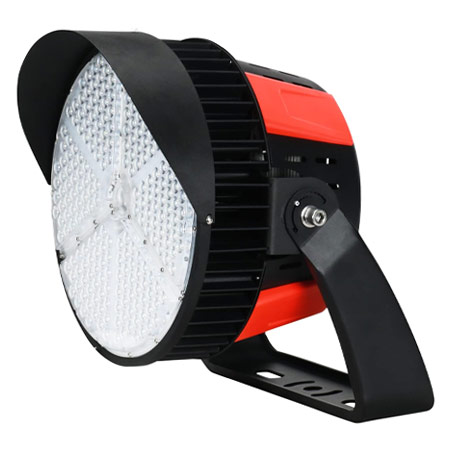
Modern LED fixtures also use anti-glare optics and visor systems to reduce stray light without reducing field brightness.
Color Rendering and Broadcast Quality
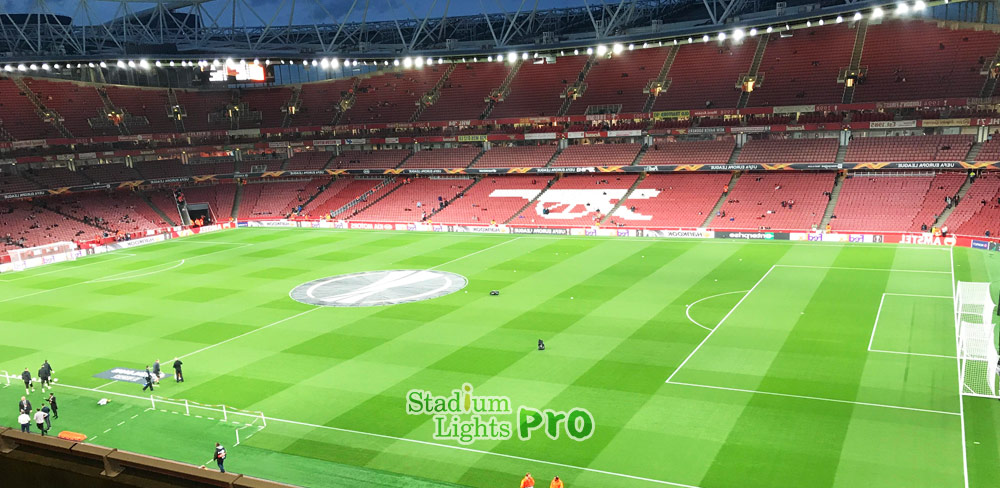
Color rendering index (CRI) measures how accurately colors appear under artificial lighting. For soccer fields, this affects how jerseys, grass, and sponsor logos look both to spectators and TV viewers.
Most competitive soccer lighting requires CRI 70–80 minimum, while broadcast stadiums usually target CRI 80–90 or higher. Higher CRI lighting makes colors appear more natural and helps cameras capture realistic footage without heavy post-processing.
Color temperature also plays a role. Most soccer stadium lighting sits around 5000K to 5700K, which is close to natural daylight. This helps players visually distinguish white lines, ball markings, and turf textures more easily.
Flicker Control for High-Speed Cameras
Modern broadcasting uses high-frame-rate cameras for slow-motion replays. If lighting flickers even slightly, it becomes very obvious on screen.
That’s why stadium LED drivers now operate at very high frequencies. Many broadcast-level systems maintain flicker percentages below 1–3%, which keeps slow-motion footage clean and stable.
This also helps players because low flicker lighting reduces visual fatigue during long evening matches.
Vertical Illuminance and Modern Broadcast Requirements
One of the biggest changes in stadium lighting design over the past decade is the shift toward vertical illuminance measurement. Traditionally, lighting design focused mainly on horizontal lux on the pitch surface.
Now, lighting designers measure how much light hits players from camera directions. Broadcast standards often require vertical illuminance between 500 and 1,000 lux, depending on camera angle and competition level.
This is why newer stadiums sometimes feel brighter even if the horizontal lux reading hasn’t increased dramatically. Light is coming from multiple directions, which reduces facial shadows and improves camera clarity.
Vertical lighting also improves player visibility during aerial play, since the ball and player body receive light from multiple angles instead of just from above.
Lighting Design and Layout
Lighting design is where theory finally meets real-world conditions. On paper, you can calculate lux levels and uniformity ratios, but once you’re dealing with wind loads, site space limits, nearby buildings, and budget constraints, the layout has to be carefully balanced. The number of poles, luminaires, mounting height, beam angle, and aiming direction all work together to shape how the field actually looks and feels at night.
A well-designed system doesn’t just make the field bright. It creates smooth, even light distribution across every playing zone, from corner flags to penalty spots. When lighting layout is done properly, players barely notice it at all. The pitch just feels natural, almost like playing in daylight conditions.
Pole Quantity and Layout Strategy
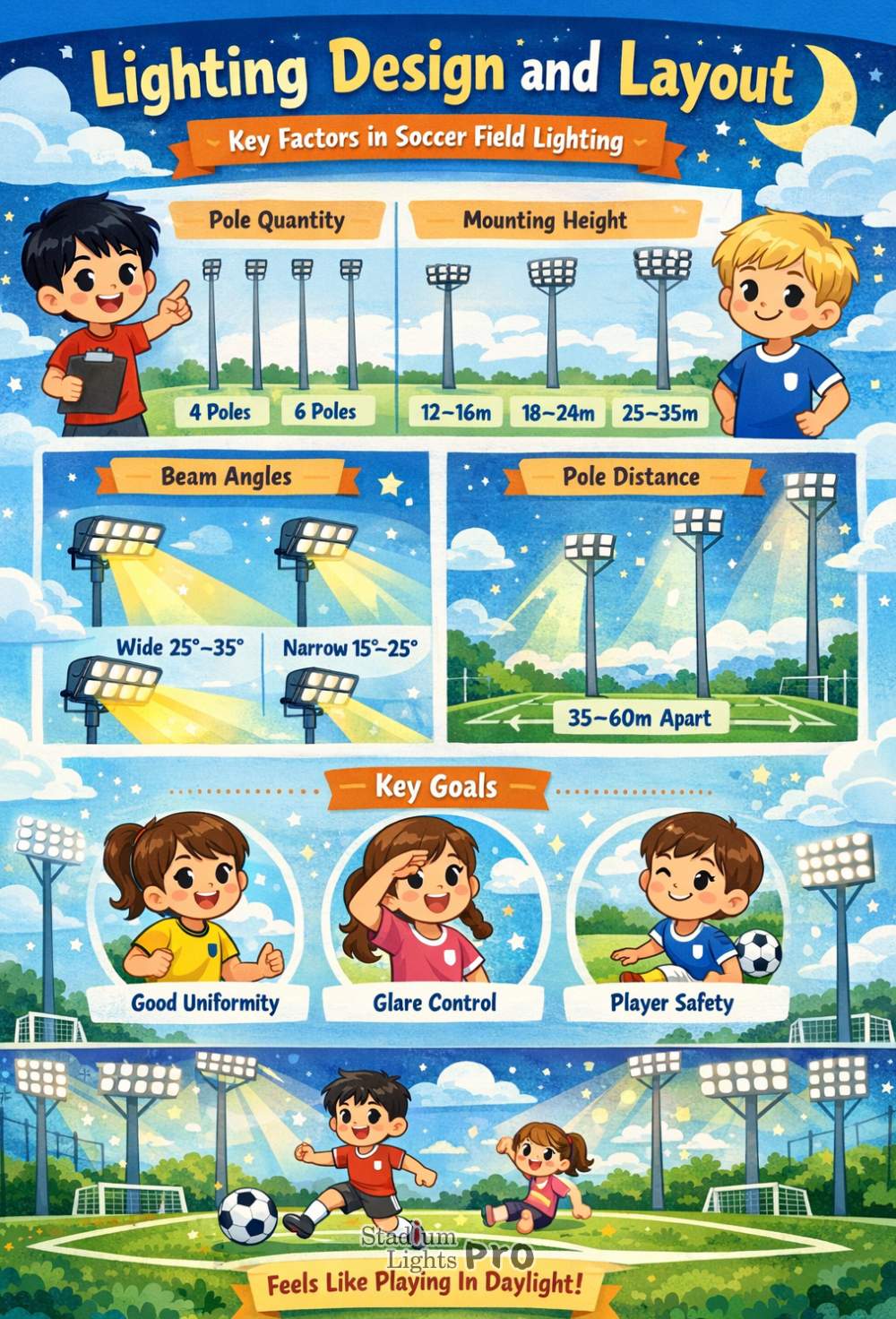
Most outdoor soccer fields use 4, 6, or 8 pole configurations, and each setup serves a slightly different purpose depending on field level and performance targets.
Four-pole layouts are usually found on training grounds, school pitches, or recreational fields. These systems are cost-efficient and relatively simple to install. A typical four-pole setup might use 4–8 luminaires per pole, giving a total fixture count between 16 and 32 luminaires. These systems often deliver around 100–250 lux average brightness, which is enough for training and casual competition.
Six-pole layouts are often considered the sweet spot for club-level competition and semi-professional fields. They provide better side-to-side uniformity and reduce shadow formation near touchlines. A typical six-pole system might use 6–12 luminaires per pole, meaning total fixture counts usually land between 36 and 72 luminaires, depending on brightness targets and pole height. These systems often operate between 300 and 750 lux depending on competition level.
Eight-pole layouts are common for stadiums or high-performance venues where uniformity targets are much tighter. These layouts allow light to be delivered from more angles, which improves both horizontal and vertical illuminance. Large stadiums can easily run 80–150+ luminaires total, especially when broadcast vertical lighting is required.
The spacing between poles also matters. Many layouts place poles roughly 35–60 meters apart, depending on field size and pole height. Proper spacing helps avoid dark zones between beam overlaps.
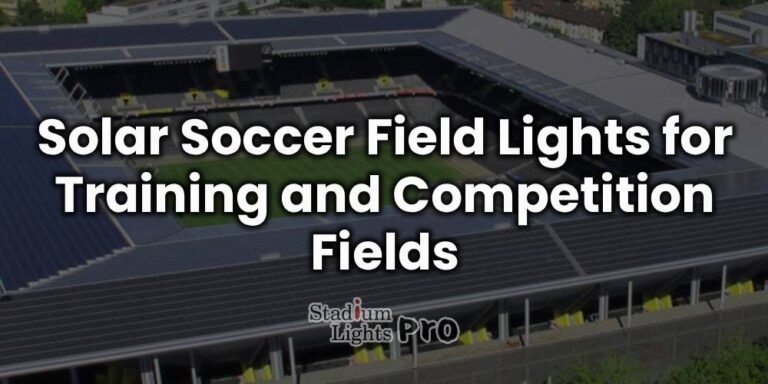
Solar-powered lighting systems are starting to be integrated into smaller fields and community venues. These systems usually combine high-efficiency solar panels with battery storage to power LED luminaires. While large stadiums still require grid power for ultra-high lux levels, solar lighting is ideal for training grounds or multi-use community fields that aim for sustainability and reduced operating costs.
Pole Height and Its Effect on Light Quality
Pole height usually ranges from 12 meters to over 30 meters, and this single design factor dramatically changes how lighting behaves.
Training fields often use poles around 12–16 meters, which keeps installation cost lower but produces tighter beam spread and slightly stronger shadow contrast. These systems work well when brightness targets stay below 300 lux.
Club competition fields usually use poles around 18–24 meters, which gives better beam blending across the pitch. At this height, light spreads wider, which improves uniformity and reduces glare when players look upward.
Professional stadiums often exceed 25–35 meters mounting height. Higher mounting positions allow wider optical distribution and smoother brightness transitions between zones. This is one reason why stadium lighting often looks visually “softer” even at higher lux levels.
Higher poles also help reduce glare because light approaches the field at a steeper downward angle rather than shining directly into player eye lines. The trade-off is cost. Taller poles require deeper foundations, heavier steel structures, and stronger wind resistance design.
Aiming Angles and Glare Control
Aiming angle is one of the most overlooked factors in soccer lighting design. Floodlights are usually aimed at less than 60 degrees tilt from vertical, which helps reduce direct glare toward players and spectators.
If aiming angles become too shallow, players may see direct light sources when tracking high balls. If angles are too steep, light coverage becomes uneven, especially near sidelines.
In some cases, fixtures located behind goal lines are positioned at angles greater than 60 degrees relative to the goal line viewing direction. This helps prevent glare directly into goalkeeper sight lines during shots and crosses.
Modern lighting simulation software now models player eye-level glare zones, which helps engineers optimize aiming positions before installation even begins.
Beam Angle Selection and Optical Control
Beam angle selection depends heavily on mounting height and lighting level targets. Beam angles determine how wide or narrow the light spreads across the field.
Training fields often use wider beams around 25–35 degrees, which helps cover larger surface areas using fewer fixtures. Wider beams are cost-efficient but produce lower peak intensity.
Professional installations often use narrower beams around 15–25 degrees, which helps push light further across long distances and maintain brightness at ground level. Narrow beams are especially useful for high mounting heights above 25 meters.
Some advanced stadium systems even combine multiple beam types, using narrow beams for long-throw lighting and medium beams for fill lighting between poles. This creates extremely smooth brightness blending across the pitch.
Typical Competition-Level Lighting Configuration
A typical Grade 1 competition layout might use 6 poles with around 8–12 luminaires per pole, mounted around 22–25 meters high. Systems like this can comfortably deliver 500–800 lux average brightness while maintaining strong uniformity ratios.
Higher-end competition fields aiming for broadcast readiness may increase luminaire counts per pole or use higher output fixtures to push brightness above 1,000 lux.
Each luminaire in these systems often produces between 80,000 and 160,000 lumens, depending on power rating and optical design.
Pole Placement Distance from the Field
Good layouts usually place poles around 10–15 meters outside the sideline boundary. This improves player safety by keeping structures away from play zones while also improving beam distribution angles.
If poles are placed too close to the field, light angles become too steep, which can increase glare and create stronger shadows. If poles are placed too far away, more powerful fixtures are needed to maintain brightness levels.
Shadow Control and Multi-Directional Lighting
Modern soccer lighting design focuses heavily on reducing shadow overlap. When light only comes from one direction, players can cast strong shadows that affect depth perception.
By using multiple pole positions and overlapping beam zones, designers can create multi-directional lighting, which softens shadows and improves player visibility during aerial play.
This is especially noticeable in penalty box areas and near goalmouth zones where lighting precision directly affects gameplay quality.
Real-World Site Factors That Influence Layout
Every site comes with its own constraints. Nearby residential areas may limit spill light levels. Soil type may affect foundation design. Existing electrical infrastructure may limit maximum power capacity.
Wind load is another real-world factor. Tall lighting poles must be designed to withstand wind speeds exceeding 120–160 km/h depending on local building codes.
Cable routing, maintenance access, and future upgrade planning also influence final layout decisions.
Why Good Lighting Layout Feels Invisible
The best lighting design is the one nobody notices. When layout, aiming, beam control, and mounting height all work together, players feel comfortable, referees see clearly, and spectators focus on the game instead of the environment.
That’s usually the sign of high-quality sports lighting engineering. The system blends into the background while delivering consistent performance across thousands of hours of operation.
Spectator Experience and Broadcasting Needs
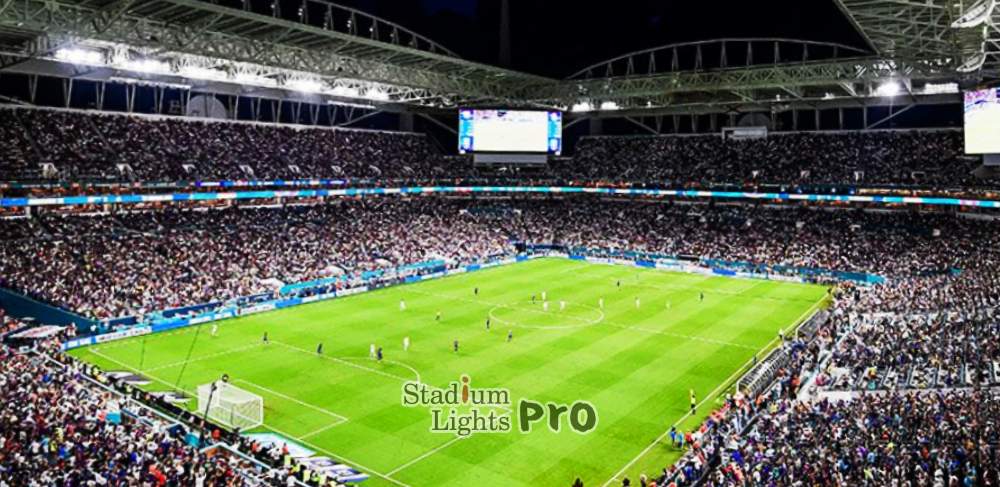
Most fans don’t walk into a stadium thinking about lighting, but they definitely notice when something feels off. If the ball disappears into a darker patch near the sideline, or if players look like they’re running through shadows, it breaks the viewing experience straight away. Good soccer lighting makes the pitch look clean, bright, and natural from every seat, whether someone is sitting 10 meters from the field or way up in the top tier.
From a visual comfort point of view, stadium lighting needs to balance brightness with glare control. If lighting is too harsh or poorly aimed, spectators can experience eye strain, especially during night matches that run 90+ minutes. Modern stadium lighting systems are designed to create smooth brightness gradients across the entire pitch, which makes tracking ball movement easier for the human eye.
Lighting also influences how the pitch looks overall. With proper color temperature around 5000K–5700K, grass appears more vibrant and line markings stand out more clearly. This might sound like a small detail, but visually rich pitch color actually helps spectators follow the game more naturally, especially during fast transitions or long passes.
Broadcast Lighting Performance Requirements
Broadcast requirements are much stricter than spectator viewing standards. Modern sports broadcasting uses ultra-slow-motion cameras running at hundreds or even thousands of frames per second. Any lighting flicker, brightness inconsistency, or color shift becomes extremely obvious at those speeds.
That’s why many broadcast-level stadiums use high-frequency LED drivers that operate well above standard mains frequency. Many modern sports lighting systems now maintain flicker levels below 1–3%, which keeps slow-motion replay footage clean and stable.
Color rendering also becomes more demanding for broadcast environments. Many professional stadiums now operate at CRI 80–90+, allowing cameras to capture jersey colors, sponsor logos, and turf tones accurately without heavy digital correction. Higher CRI lighting also helps reduce color banding effects on high-definition broadcasts.
Vertical Illuminance and Multi-Angle Player Lighting
One of the biggest changes in stadium lighting design over the last decade is the shift toward vertical illuminance measurement. In older lighting systems, most focus was placed on horizontal brightness across the pitch surface. Today, cameras need players to be lit from multiple angles.
Modern stadium lighting often targets vertical illuminance levels between 500 and 1000 lux toward primary camera positions. Some high-end stadiums push even higher depending on broadcast requirements.
This is why newer stadium lighting sometimes feels brighter, even if horizontal lux levels haven’t increased dramatically. Light is wrapping around players rather than only shining from above. This reduces harsh shadows on faces and helps cameras capture more detail in movement and expressions.
Vertical lighting also helps during aerial play. When a ball is 10–20 meters above ground, it still needs strong illumination so cameras and players can track movement accurately.
Atmosphere and Fan Engagement
Lighting isn’t just about visibility. It also shapes stadium atmosphere. Many modern stadiums now use dynamic lighting systems that can dim, brighten, or change intensity during player entrances, halftime shows, or goal celebrations.
Some stadiums can transition from 30% brightness warm-up mode to full match brightness in seconds. This flexibility improves energy efficiency while also enhancing fan engagement.
Even outside professional stadiums, good lighting helps community fields feel safer and more welcoming during evening matches. Well-lit entrances, pathways, and spectator areas all contribute to overall match experience.
Installation Considerations
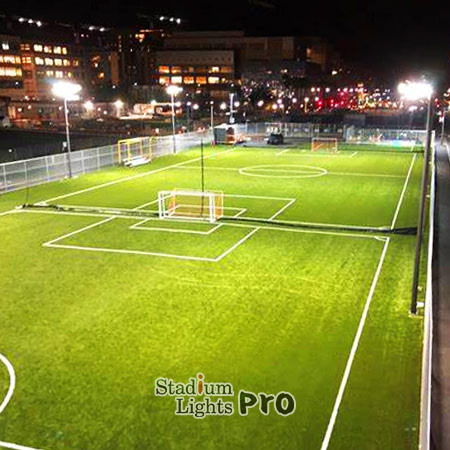 Installation is where lighting design meets real-world construction challenges. Every field site is different, which means installation planning must account for soil conditions, space limitations, electrical supply capacity, and local building regulations.
Even two fields with identical lighting designs can have very different installation requirements depending on site conditions. This is why pre-installation site surveys are usually part of serious lighting projects.
Foundation Engineering and Structural Support
Pole foundation depth typically ranges between 1.5 and 3 meters, depending on pole height, soil strength, and local wind load requirements. Taller poles need deeper reinforced concrete bases because wind force increases significantly with height.
For example, a 30-meter lighting pole can experience several tons of lateral wind force during storms. Foundations often include reinforced steel cages and high-strength concrete to handle these loads safely.
In softer soil conditions, foundation depths may increase or require specialized piling systems to maintain structural stability over time.
Electrical Infrastructure and Power Distribution
Lighting systems also depend heavily on electrical infrastructure. Smaller training fields might run comfortably on existing electrical supply, while stadium-level installations often require dedicated transformers and high-capacity distribution panels.
Cable routing must be carefully planned to protect underground wiring from water ingress and physical damage. Many installations now use armored underground cabling designed for 20+ year service life.
Voltage stability also matters. Poor power quality can shorten driver lifespan and affect light output consistency.
Smart Lighting Controls and Energy Optimization
New installations almost always include smart lighting control systems. These systems allow facility managers to run different lighting modes depending on usage.
Training sessions might run at 30–50% lighting output, while competitive matches run at full brightness. Some facilities also program automatic dimming schedules based on booking times.
These smart control systems can reduce total energy consumption by 30–50% annually, depending on field usage patterns.
Remote monitoring is also becoming more common. Facility managers can track fixture performance, driver temperature, and energy usage remotely, which helps predict maintenance needs before failures happen.
Retrofit and LED Conversion Projects
Retrofit projects are extremely common now, especially for fields still using metal halide or high-pressure sodium lighting.
Many retrofit projects replace 1000W metal halide fixtures with 600–800W LED luminaires while maintaining or improving brightness levels. Because LED systems deliver more usable directional light, lower wattage can still produce higher effective lux levels on the pitch.
Retrofits often reduce maintenance frequency because LED systems can operate 50,000–100,000 hours before major output degradation occurs.
Installation Timeline Expectations
Installation timelines vary depending on system size and site conditions. A small four-pole training field might be installed within 2–4 weeks, including foundation curing time and electrical connection.
Larger six or eight pole competition fields often take 4–8 weeks, depending on weather and construction complexity.
Full stadium lighting upgrades can take several months, especially if structural reinforcements, control systems, and electrical upgrades are required.
Weather Resistance and Long-Term Durability
Outdoor sports lighting systems need to survive harsh weather conditions for years. Fixtures are usually rated with IP protection levels such as IP65 or IP66, meaning they can resist heavy rain and dust ingress.
Temperature tolerance is also a big factor. Good sports lighting fixtures can operate reliably in temperatures ranging from -20°C to +45°C depending on design.
Corrosion resistance coatings help protect fixtures and poles from moisture, salt air, and pollution exposure, especially for coastal or industrial environments.
When installation planning, structural design, and product selection are done properly, lighting systems can operate reliably for well over a decade with minimal performance drop. That’s why good installation planning often pays off long-term, both in performance consistency and maintenance savings.
Cost Breakdown and Budget Planning
When people first look into soccer field lighting, the price range can feel all over the place. But once you break it down into equipment, installation, electrical work, and long-term operation, the cost patterns actually become pretty predictable. The total budget usually depends on brightness target (lux level), number of poles, mounting height, control systems, and whether it’s a new installation or retrofit.
For a basic community or training pitch, full installation costs typically sit somewhere around £40,000 to £120,000. These systems usually run between 100 and 250 lux, use 4 poles, and operate with around 20–32 LED luminaires. Electrical infrastructure is usually simpler, and foundation depth stays on the lower end unless soil conditions are poor.
Mid-level club fields usually land between £120,000 and £300,000 installed, especially if lighting levels target 300–500 lux. These projects often include 6-pole layouts, higher mounting heights around 18–24 meters, and smarter control systems. At this level, uniformity targets are tighter, which usually means more fixtures and more precise optical aiming.
Stadium-grade lighting systems can easily exceed £1 million, and in some cases go much higher depending on structure complexity, broadcast requirements, and smart control integration. These systems often operate above 1,000 lux, use 8 poles or roof-mounted systems, and may include dynamic lighting controls for events and broadcast transitions.
Equipment Cost vs Installation Cost Reality
A lot of people assume lighting cost is mainly about buying fixtures, but in many projects, installation can account for 30–50% of total project cost. Civil works like foundation construction, trenching for cabling, crane rental, and electrical upgrades add up quickly.
For example, a 25-meter lighting pole requires significantly more foundation reinforcement than a 15-meter pole. Foundation concrete volume alone can increase by 40–60% depending on soil and wind design requirements.
Electrical upgrades are another hidden cost area. If the existing site power supply isn’t strong enough, transformer upgrades or new distribution panels may be needed.
Energy Cost and Operating Savings
LED systems usually cost more upfront than older metal halide systems, but operating savings are where they really start to make financial sense. Most LED sports lighting systems reduce energy consumption by roughly 40–70%, depending on the system being replaced.
For example, replacing a system running at 80 kW total load with a modern LED system running at 40–50 kW can save thousands of pounds per year depending on usage hours and electricity pricing.
Maintenance savings also play a huge role. Traditional discharge lamps often required replacement every 6,000–15,000 hours, while LED fixtures typically last 50,000–100,000 hours before major light output reduction happens.
For fields running lighting around 1,200–1,800 hours per year, LED systems can realistically operate 10–20 years before major replacement cycles are needed.
Lifecycle Cost and Return on Investment
Looking only at installation cost can be misleading. Many facility owners now calculate total cost of ownership over 10–15 years instead of just upfront price.
Energy savings, reduced maintenance labor, and fewer replacement parts often make LED upgrades financially attractive long-term. Some LED conversion projects recover their cost through energy savings within 5–8 years, especially when replacing older high-wattage systems.
For schools and municipal facilities operating multiple fields, energy savings can sometimes offset installation financing costs over time.
Funding Sources and Financial Support Options
Funding for sports lighting projects often comes from multiple sources. Local sports grants, council funding programs, and club sponsorship agreements are all common funding routes.
Some clubs partner with local businesses for naming rights or sponsorship branding, which helps offset installation cost. In certain cases, energy efficiency incentive programs also help support LED conversion projects.
In community-level projects, phased installation is also sometimes used. For example, installing pole infrastructure first and adding full luminaire counts later as funding becomes available.
Common Mistakes to Avoid
Even well-funded projects can run into problems if design and planning steps are rushed. One of the most common mistakes is focusing too much on lux numbers alone while ignoring uniformity performance.
A field averaging 500 lux but dropping to 200 lux near corners or sidelines can feel visually uncomfortable to play on. Many players actually prefer slightly lower brightness if it comes with consistent light distribution across the entire pitch.
Overlooking Aiming Precision and Glare Control
Another mistake is underestimating aiming angle accuracy and glare control. Poor aiming can create bright hot spots directly under poles while leaving darker areas between pole coverage zones.
Glare can also affect player reaction time, especially for goalkeepers looking upward for crosses or defenders tracking long balls. Proper optical aiming and anti-glare shielding can make a huge difference in real match conditions.
Underestimating Installation Complexity
Some projects underestimate how much groundwork is required. Electrical supply upgrades, foundation engineering, and wind load calculations can add unexpected cost if not planned early.
For example, upgrading from a 4-pole to 6-pole layout after civil work has already started can significantly increase project cost and timeline.
Weather conditions can also impact installation timelines. Heavy rain can delay foundation curing and crane access for pole installation.
Choosing Fixtures Based Only on Purchase Price
Low-cost fixtures might look attractive initially, but lower-quality LEDs often degrade faster and may produce inconsistent color output over time. Some cheaper drivers also struggle with power stability, which can shorten lifespan.
High-quality sports lighting fixtures are usually tested for thermal performance, optical stability, and long-term lumen maintenance. Over years of operation, these factors usually matter more than small upfront cost differences.
Skipping Lighting Simulation and Professional Design
Skipping photometric simulation is one of the biggest risks in sports lighting projects. Lighting simulation software can predict lux levels, uniformity ratios, glare zones, and energy usage before installation even begins.
Simulation also helps optimize pole placement and luminaire aiming positions, which can sometimes reduce fixture count while maintaining performance targets.
Without simulation, projects often end up needing post-installation adjustments, which can increase labor cost and delay field usage.
Ignoring Future Expansion or Upgrade Planning
Some installations don’t leave room for future upgrades. Adding extra luminaires later can be difficult if poles, cabling, or electrical capacity weren’t designed for expansion.
Planning for future brightness upgrades or broadcast requirements can save money long-term, especially for clubs planning league promotion or stadium upgrades.
Q&A Section
1. How does lighting affect player performance and reaction time?
Lighting quality has a direct impact on how well players can process visual information during a match. Soccer is a fast-paced sport where players constantly track the ball, teammates, and opponents simultaneously. High-quality lighting improves visual clarity by increasing contrast between the ball, players, field markings, and grass surface. This enhanced contrast helps players make faster and more accurate decisions, especially during quick passes, aerial balls, and defensive reactions.
Consistent lighting across the entire pitch is equally important. If lighting levels vary significantly between different areas of the field, players may struggle to adjust their vision when moving from brighter zones to darker ones. This can delay reaction time by fractions of a second, which can be critical in competitive play. Additionally, flicker-free lighting is essential because even subtle flicker can cause eye strain, headaches, and reduced visual comfort over long training sessions or matches.
Shadow control is another major factor. Poorly positioned lights can create multiple overlapping shadows, which can distort a player’s perception of ball speed, height, and spin. Modern lighting systems are designed to minimize harsh shadows, creating a more natural visual environment that closely mimics daylight conditions.
From a sports science perspective, good lighting can reduce mental fatigue because players spend less effort compensating for poor visibility. Over the course of a 90-minute match or multiple training sessions per week, this can contribute to better overall performance and lower injury risk due to misjudged movements or late reactions.
2. What role does lighting play in spectator experience?
Lighting is a major part of how spectators perceive and enjoy a soccer match. Clear, uniform lighting allows fans to follow the ball easily across the field, especially during long passes or fast counterattacks. When lighting quality is poor, spectators may struggle to track play in certain parts of the pitch, which can reduce engagement and enjoyment.
For stadium environments, lighting also contributes to the emotional atmosphere. Bright, evenly distributed lighting enhances the visual intensity of matches and makes the venue feel more professional and exciting. In community and amateur venues, good lighting improves accessibility by allowing evening games, training sessions, and community events to take place safely.
Safety is another important factor. Well-lit spectator walkways, seating areas, and entrances help reduce trip hazards and improve security. For family-oriented venues and public facilities, this is especially important because it encourages higher attendance and community use.
For broadcast and digital media, lighting plays an even larger role. High-quality lighting ensures cameras can capture sharp, vibrant images without excessive shadows or color distortion. This improves viewing quality for online streams, television broadcasts, and social media clips, which is increasingly important for clubs building digital audiences.
3. How do modern lighting systems integrate with smart technology?
Modern soccer field lighting is increasingly becoming part of integrated smart facility systems. Instead of simple on/off switching, today’s lighting can be controlled through centralized software platforms. Facility managers can schedule lighting based on match times, training sessions, or maintenance work, reducing manual operation and improving efficiency.
Many systems include programmable lighting levels. For example, training sessions might use reduced lighting intensity, while competitive matches require full output. This flexibility helps reduce energy consumption and operating costs over time.
Remote monitoring is another major advancement. Smart systems can detect faults, monitor energy usage, and track fixture performance in real time. If a light fails or begins to degrade, maintenance teams can be notified immediately, reducing downtime and preventing unexpected outages during matches.
Some advanced installations integrate with weather data and daylight sensors. These systems can automatically adjust brightness levels based on ambient light conditions, cloud cover, or seasonal daylight changes. This ensures consistent lighting quality while minimizing wasted energy.
In the future, integration with broader stadium systems may allow lighting to synchronize with scoreboards, crowd effects, and event presentations, creating more immersive experiences during matches and events.
4. How does weather affect soccer field lighting design?
Weather conditions influence nearly every aspect of lighting system design, from structural engineering to fixture durability. In regions with heavy rain or high humidity, lighting fixtures must be sealed against moisture to prevent electrical failures and corrosion. Materials like marine-grade aluminum and specialized coatings are often used to extend lifespan in harsh environments.
Wind conditions are especially important for pole-mounted lighting systems. Tall lighting structures must be engineered to withstand strong gusts and storm conditions. This requires careful foundation design, pole strength calculations, and secure mounting systems to ensure long-term safety.
Cold climates create different challenges. Lighting fixtures must be capable of starting reliably in low temperatures and maintaining stable output without performance degradation. Some components may require special thermal management to operate efficiently in freezing conditions.
Fog and mist can also affect visibility. Certain lighting color temperatures and beam patterns perform better in low-visibility conditions by improving contrast and reducing light scattering. Designers may adjust fixture selection and aiming angles to maintain usable visibility during poor weather conditions.
Long-term weather exposure also affects maintenance planning. Facilities in harsh climates may schedule more frequent inspections to check seals, mounts, and electrical connections.
5. What environmental factors should be considered when installing field lighting?
Environmental responsibility is becoming increasingly important in sports facility design. One major consideration is light spill, which occurs when light extends beyond the field into surrounding neighborhoods. Excessive light spill can disturb residents and wildlife. Proper fixture aiming, shielding, and optical design can significantly reduce unwanted light.
Sky glow is another concern, particularly in areas near observatories or regions working to preserve dark skies. Using precise beam control and minimizing upward light emissions helps reduce environmental impact.
Wildlife can also be affected by artificial lighting, particularly nocturnal animals and migratory birds. Some facilities conduct environmental impact assessments before installation to minimize disruption to local ecosystems.
Energy efficiency is closely linked to environmental sustainability. Many facilities now monitor energy consumption and track carbon emissions associated with lighting operation. This data can be used for sustainability reporting, grant applications, or environmental certification programs.
Some modern projects also incorporate renewable energy sources or energy storage systems to offset lighting power consumption. As environmental regulations and community expectations continue to evolve, sustainable lighting design is becoming a standard requirement rather than an optional feature.
6. How long does a typical lighting installation project take from planning to operation?
The timeline for a soccer field lighting project can vary widely depending on the size of the facility, complexity of the lighting system, and local regulatory requirements. For smaller community or training pitches, the process often takes 3 to 6 months from initial design to operational use. This timeframe usually includes site surveys, photometric simulations, permitting, civil work for pole foundations, electrical installation, fixture mounting, and final commissioning. Even for these smaller projects, coordination with local utility companies for power supply approvals and safety inspections can be a critical step that requires careful scheduling.
Larger or more complex installations, such as stadiums or multi-field sports complexes, can extend the timeline to 9–18 months or even longer. These projects often involve structural engineering approvals for high-mounted poles or roof-mounted systems, custom steel fabrication for lighting towers, and integration with advanced control systems. Equipment lead times for high-output luminaires or specialized optics can also add weeks to the schedule.
Weather conditions and site-specific challenges, such as uneven terrain, high water tables, or restricted access, can further extend installation timelines. In addition, retrofitting older stadiums often requires temporary lighting solutions or phased work to avoid disrupting ongoing training or matches.
Early planning and close coordination with all stakeholders, including architects, civil engineers, electrical contractors, and local authorities, can significantly reduce delays. Using detailed project management and pre-fabricated components can also help keep larger projects on schedule while ensuring safety and long-term performance.
7. What is the difference between training lighting and match lighting?
Training lighting and match lighting differ primarily in brightness levels, uniformity requirements, and energy use. Training sessions typically don’t require extremely high brightness because drills often take place in specific areas of the field, and players can adapt to lower visibility in controlled conditions. A well-designed training setup might run at 100–250 lux, providing sufficient clarity for exercises without consuming excessive energy.
Match lighting, on the other hand, has to meet consistent lighting levels across the entire pitch to support player performance, referee accuracy, and spectator experience. Competitive matches often require 300–500 lux for amateur or semi-professional games, and professional stadiums can exceed 1,000 lux for broadcast-level matches. Uniformity becomes especially important for match lighting because uneven illumination can affect gameplay, ball tracking, and the visual quality for fans and cameras.
Many modern facilities implement multi-level lighting systems to serve both purposes. These systems allow operators to dim or increase brightness depending on usage. For example, a weekday training session might run at 40–50% power, while a weekend league match can operate at full brightness. This flexibility not only improves energy efficiency but also extends fixture lifespan by reducing continuous high-output operation.
8. How does lighting impact field maintenance and turf health?
Artificial lighting doesn’t replace natural sunlight, but it can subtly affect grass growth cycles when used extensively at night. Grass plants rely on photoperiods—day length and light intensity—to regulate growth, flowering, and dormancy. Excessive nighttime lighting can slightly disrupt these cycles, particularly in high-latitude regions or in turf types sensitive to prolonged exposure.
Groundskeepers usually manage this by scheduling lighting to coincide with active play only and avoiding continuous overnight illumination. For fields hosting frequent night matches, maintenance plans may include adjusting irrigation, fertilization, and mowing schedules to compensate for changes in growth patterns. For instance, nighttime lighting can sometimes increase leaf growth while reducing root development if exposure is too long, so watering patterns are modified to maintain soil moisture balance.
Some advanced installations even include light sensors and programmable timers that control illumination periods to minimize impact on the turf while providing adequate lighting for play. When these systems are combined with LED technology, the lower heat output and precise beam control reduce the risk of turf damage compared to older metal halide or high-pressure sodium systems.
9. Why is color rendering important in sports lighting?
Color rendering is a measure of how accurately artificial light displays colors compared to natural daylight. In soccer, this impacts player perception, referee decision-making, and spectator experience. High color rendering helps distinguish between team kits, identify field markings, and track ball color under fast-moving conditions. For example, a ball can appear slightly gray or washed out under low-quality lighting, which can slow reaction times and make passes or headers harder to judge.
Color rendering is particularly crucial for broadcasting. Cameras rely on consistent, accurate colors to produce high-definition footage that looks natural to viewers. Poor color rendering can make grass appear too yellow, jerseys look dull, or logos lose contrast, affecting both broadcast quality and fan engagement. Professional stadium lighting typically targets a CRI (Color Rendering Index) of 80–90 or higher, ensuring colors are vivid and true-to-life.
Even at community or training facilities, better color rendering can reduce eye strain and improve player comfort. Subtle differences in ball or marking contrast, especially during evening play, can be more easily noticed under lights with strong color fidelity.
10. What backup or emergency lighting systems are used in soccer facilities?
Backup lighting is essential for both safety and operational continuity. Most facilities incorporate emergency lighting that activates if the main system fails, allowing safe evacuation of spectators and staff. These systems often include battery-powered LED fixtures that provide temporary illumination on stairways, walkways, and exit points.
In larger stadiums, backup generators are common to keep essential field lighting and broadcasting systems running during power outages. These generators may power a subset of field luminaires at reduced brightness to maintain minimal playability for ongoing events or allow players and spectators to exit safely.
Emergency systems are particularly important for televised matches. Sudden darkness can compromise player safety and disrupt live broadcasts, causing regulatory or financial consequences. Facilities usually perform routine testing of backup systems to ensure reliability and compliance with local safety codes.
Some modern stadiums integrate backup systems with smart controls, allowing automatic switchover and remote monitoring. This ensures the backup system activates seamlessly without operator intervention, minimizing disruption during unexpected power failures.
Conclusion
Soccer lighting has moved way beyond just “putting lights on poles.” Today it’s about delivering player-friendly visibility, broadcast-ready performance, and long-term operating savings all at once. As technology improves, fields are becoming brighter, more efficient, and more comfortable to play and watch in.
If you’re planning a new field, upgrading an existing system, or just exploring options, it’s always worth talking with specialists who understand both the engineering and the real-world sports environment. If you’re looking for guidance on design, product selection, or cost planning, feel free to reach out to us for consultation — we’re always happy to help you find a setup that actually fits your project instead of just selling you hardware.