

Lighting measured in lux plays a decisive role in shaping how well a racecourse performs under nighttime conditions. The influence of lux extends far beyond just brightness—it affects perception, timing, safety, and even the psychological state of both jockeys and horses.
Most Suitable Lux Level for Different Kinds of Use
Lighting requirements on a racecourse vary widely based on how the space is used. From casual evening rides to highly competitive night races, each context demands a different range of lux levels to ensure visual comfort, safety, and performance consistency.
| Use Case | Lux Range | Purpose & Considerations |
|---|---|---|
| Recreational Training & Casual Riding | 100–200 lux | Basic visibility, rider safety, and general comfort. Prioritizes uniformity over brightness. |
| Intermediate Training & Schooling | 200–400 lux | Highlights horse biomechanics, posture, and pace. Enables better coaching and rider feedback. |
| Professional Competitions & Night Races | 500–1000 lux | Supports high-speed motion, camera clarity, and uniform brightness for peak performance. |
Recreational Training and Casual Riding
For non-competitive riding scenarios, where speed, precision, and broadcast quality are not priorities, lower lux values can suffice. Lux levels ranging from 100 to 200 offer enough brightness for basic visibility without over-illuminating the environment. These conditions are common during warm-ups, beginner lessons, or leisurely equestrian activities.
In such cases, lighting is primarily about maintaining general safety. Riders and horses are not operating under high-pressure conditions, so there’s less demand for fine visual detail. However, even in these relaxed settings, a lack of uniformity can still create shadows or blind spots that disrupt the rhythm of the horse or trigger minor behavioral issues.
Maintaining a smooth visual field without sharp transitions helps the horse stay focused and comfortable. Consistency in light spread is more valuable than sheer brightness at this stage.
Intermediate Training and Schooling Sessions
When training becomes more structured, the lux levels must increase to match the complexity of the movements and the precision required. For skill-building routines and simulated race preparation, the lighting must highlight both the track and the horse’s biomechanics. Lux values between 200 and 400 are ideal for these uses.
At this level, the light must be bright enough to allow coaches and riders to observe gait, stride length, and posture clearly. Subtle cues in horse movement, such as favoring one leg or uneven pacing, become more visible with improved lighting. These details would go unnoticed in a poorly lit arena, reducing the quality of training feedback.
Controlled brightness allows riders to navigate technical routes more efficiently, especially when preparing for higher-level competition. Riders can evaluate how well the horse responds to commands and adapts to speed variations, while also improving their own form and precision under more realistic conditions.
Professional Competitions and Night Races
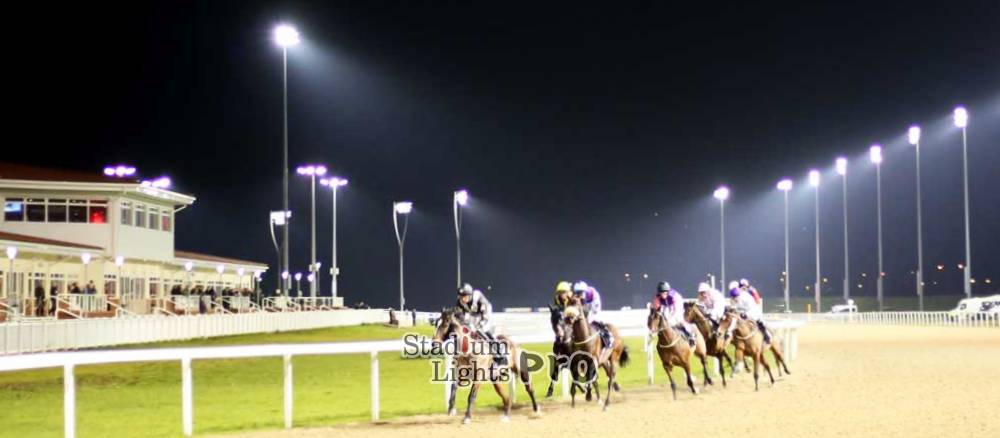
For high-level racing events, where timing accuracy, high speed, and public viewing are central components, lighting must meet rigorous standards. Lux levels between 500 and 1000 are typically used in these conditions. Anything less would impair the visual accuracy required for such demanding activities.
These lux values support not just the performance of the horse and rider but also enable cameras to capture fast motion clearly, providing a better experience for viewers both on-site and watching remotely. Without sufficient lux, rapid movements blur, visual definition breaks down, and the ability to track competitors is diminished.
Another challenge at this level is ensuring uniform brightness across all sections of the track. Uneven lighting can mislead the rider and startle the horse, especially during high-speed turns or acceleration zones. Using high mast lighting systems with adjustable beam angles helps distribute light evenly, preventing both dark patches and overexposed areas.
Glare control becomes critical in this environment. Overly intense light can reduce contrast and cause horses to flinch or hesitate. Shielded floodlights positioned to eliminate direct line-of-sight glare allow for a clear and balanced visual field from start to finish. This helps horses maintain focus and composure while supporting peak performance and safety.
Balancing Function and Comfort Across All Use Cases
Choosing the most suitable lux level isn’t just about meeting minimum standards—it’s about creating an environment that aligns with the specific demands of the activity. Lower lux values support energy efficiency and are appropriate for slower, less demanding routines. As the complexity and speed of the event increase, so does the need for enhanced visibility, clarity, and control over light distribution.
Whether it’s a quiet evening trot or a nationally televised race, matching lux levels to the intended use of the track enhances the overall experience and helps prevent accidents, missteps, or behavioral issues. The right lighting creates a sense of continuity between rider and horse, allowing each to perform at their best without unnecessary visual obstacles or distractions.
Impacts of Different Lux Levels
Visual Performance at Lower Lux Ranges
When lux levels fall below 100, the visibility on the track becomes patchy and unreliable. Low-light environments hinder depth perception, making it difficult for riders to judge distances accurately. This can cause hesitation during high-speed turns, missed cues from surrounding competitors, or delayed reactions to obstacles. A dim track also increases the risk of trip hazards, especially during wet or uneven conditions.
Horses are especially vulnerable in these settings, as their eyes take longer to adjust to fluctuating brightness. They may become startled by unexpected shadows or hesitate during runs, interpreting dark patches as holes or dips. For basic activities such as walking or warming up, 50 to 100 lux might be tolerable, but these values are well below what is required for high-performance or safe racing environments.
Enhanced Visual Acuity at Moderate Lux Levels
Once lux values approach or exceed 200, noticeable improvements in clarity begin to emerge. The edges of the track become more defined, shadows are softened, and moving objects such as horses or riders are easier to follow with the naked eye. This enhances not only visual comfort but also reaction speed and spatial coordination.
Intermediate lux levels reduce the strain on both human and equine eyes, enabling more consistent performance. Riders can better anticipate turns or obstacles, and horses are more confident in their movements when the track ahead appears steady and predictable.

Glare and Visual Overload at High Lux Levels
Pushing brightness levels too far beyond the 500 to 1000 lux range may lead to new problems. Excessive lux contributes to glare, especially when light fixtures are not properly shielded or aimed. Glare can obscure vision momentarily and cause disorientation. For humans, this may result in squinting, eye fatigue, or misjudging distances.
Horses, with their wider peripheral vision and heightened light sensitivity, can suffer even more under overly bright conditions. Glare may trigger startled responses, causing the horse to break rhythm, slow down abruptly, or shy away from the source of brightness. These behaviors disrupt race dynamics and elevate the potential for collisions or injuries.
Lux Sensitivity in Specific Racecourse Zones
Different sections of the racecourse have varying lux requirements. Straight paths benefit from high uniformity and directional light, whereas curved bends require focused, shadow-free illumination to avoid confusion and reduce the risk of slipping. Stables and preparation areas may not require more than 150 to 200 lux, but the main race path must deliver consistent brightness across its full width and length.
Spectator stands and camera zones also demand higher lux levels for clear broadcasting and viewer engagement. However, balancing this with the visual needs of the track is delicate—light spill onto the race path must be minimized to prevent glare from adjacent lighting setups.
The Psychological Impact of Inconsistent Lighting
Fluctuating lux levels, particularly when moving between brighter and darker zones, create stress for horses. Horses experience slower pupil adjustments, so even brief transitions between brightness levels can induce uncertainty. A horse that feels unsure about its footing is less likely to perform at full capacity, undermining the race outcome.
Even for spectators and broadcasters, inconsistent lighting affects the ability to follow the race in real time. Cameras may experience white-out effects or blurry motion trails under poorly balanced lux setups, diminishing the overall quality of the experience.
Problems of Too Bright or Too Dim Racecourse Lighting
Racecourse lighting must be designed with careful consideration for visual health, perception, and overall comfort. Extremes at either end of the lux spectrum—whether too dim or too bright—can interfere with performance and pose hazards that impact both horses and riders.
Horse Vision and Eye Sensitivity
Horses perceive light and motion very differently than humans. They have a wide monocular visual field, allowing them to see nearly 350 degrees around their bodies, but with a narrow zone of binocular vision directly ahead. Their eyes are adapted for detecting movement in low-light settings, yet their ability to adjust to sudden changes in brightness is much slower than that of humans.
In environments with insufficient lux levels, horses can struggle to identify dips, shadows, or minor changes in terrain. This often results in hesitation, missteps, or slowed pacing, especially during fast turns or in areas with poor uniformity. A poorly lit corner or shadowed patch may appear as a physical barrier to a horse, causing it to shift off-course or even stop altogether.
On the other hand, excessively bright lighting can overwhelm their vision. The retina may become overstimulated, leading to visual discomfort or a startled response. Horses exposed to harsh lighting are more likely to show nervous behaviors, such as shying away from brightly illuminated zones, breaking stride, or becoming difficult to control.
Another complication is the formation of hard shadows, which may confuse a horse’s depth perception. These shadows can mimic obstacles or holes, leading the animal to react defensively, even when there is no physical threat present. Inconsistent lighting often causes such shadows to appear abruptly, undermining the horse’s trust in the environment.
Health Effects of Inappropriate Lux Levels
Exposure to lighting extremes doesn’t just impact short-term performance—it also has physiological consequences. Artificial light affects melatonin production, a hormone critical to managing sleep-wake cycles. Horses exposed to high-intensity lighting for prolonged periods during night races may experience disruption of their natural circadian rhythm.
This disruption can lead to reduced rest quality, prolonged recovery periods, and elevated stress levels. A horse that does not rest adequately is more prone to injury, fatigue, and erratic behavior. Similarly, trainers and riders may experience sleep pattern disruption, affecting focus, coordination, and decision-making ability.
Low lighting brings its own set of health concerns. Riders navigating tracks in suboptimal brightness face increased risks of eye strain, impaired depth perception, and slower reaction times. These issues become more pronounced in high-speed situations where fractions of a second matter. A misjudged obstacle or curve caused by poor visibility can easily result in collisions or falls.
High lux levels introduce the hazard of glare, especially when lighting fixtures are not properly shielded or directed. This glare can lead to temporary blindness or visual confusion for both jockeys and horses. While the human eye may recover quickly from such visual disruption, horses react with instinctive behavior, often veering away or stopping abruptly in response to bright flashes or inconsistent lighting.
Behavioral and Safety Impacts
Behavioral changes are often the first signs that lighting conditions are not well-suited for equestrian use. Horses may begin to show signs of anxiety, skittishness, or reduced obedience when lighting conditions fall outside their comfort range. These behaviors not only impair performance but also create safety concerns for the rider, support staff, and other participants.
For jockeys, inadequate lighting can compromise their ability to anticipate the horse’s movement, align their balance, or respond to sudden changes in race dynamics. Visibility challenges make it harder to navigate tight packs, judge distance to competitors, or coordinate movements in tandem with the horse’s pace.
Lighting that causes glare or strong shadows can also impair the clarity of visual signals from other jockeys or referees. A missed flag or cue, whether due to shadowing or brightness imbalance, can result in race violations or disqualifications.
Balancing Light Intensity for Long-Term Comfort
Achieving the right lux balance means maintaining consistency, clarity, and moderation across all zones of the racecourse. Lighting must be neither too low to obscure vision nor too bright to cause glare or disorientation. Horses benefit most from lighting setups that offer smooth brightness transitions with minimal abrupt contrast changes.
Healthier light environments also contribute to better post-race recovery and behavior. When horses and riders are not overwhelmed or fatigued by visual strain, their ability to rest, refocus, and prepare for subsequent activities is enhanced. Well-designed lighting reduces the likelihood of stress-related symptoms, making the overall race environment more predictable and less volatile.
Racecourse designers, therefore, must take into account not just visibility but also the long-term physiological and behavioral well-being of both horse and rider when determining optimal lux levels.
Factors Affecting the Lux Level
Several physical and environmental variables influence the actual lux levels achieved on a racecourse. From the height of lighting poles to the efficiency of the fixtures themselves, these factors collectively shape how light is distributed, perceived, and maintained over time. Proper planning and customization are essential to create a stable and functional lighting environment.
Height of Lighting Poles
The elevation of mounting poles plays a foundational role in how effectively light reaches the racecourse surface. When poles are elevated beyond 20 meters, they allow for broad light distribution that can cover large areas more uniformly. This approach helps reduce the number of hot spots and shadowed zones, enhancing visibility for both horse and rider.
However, there’s a tradeoff. Higher poles can also lead to lux loss at ground level due to wider dispersal. Without correct beam angle adjustment or adequate luminaire output, the lighting may lose intensity before reaching the track. This creates an illusion of coverage while leaving critical areas underlit.
Lower poles may seem like a solution to preserve intensity, but they often create narrow, overlit zones. The result is uneven lighting that demands more fixtures to fill in dark spots. Therefore, the relationship between height, beam angle, and luminaire placement must be carefully calibrated to deliver reliable lux levels across the full track.
Beam Angle and Fixture Positioning
The beam angle defines how wide or narrow a lighting fixture casts its light. A narrow beam is useful when lighting specific segments such as the starting gate or finish line. A wider beam can cover long straightaways and general zones more economically, though at the cost of reduced intensity unless supported by high-output fixtures.
Orientation is equally influential. A poorly positioned fixture can direct light upward or sideways, wasting energy and creating glare hazards. When light shines directly into a horse’s or rider’s line of sight, it can cause hesitation, misjudgment, or confusion.
The use of rotating heads and adjustable brackets offers a solution for fine-tuning after installation. These features allow technicians to optimize light direction during trial runs, helping ensure that target lux levels are actually achieved on the track, not just in design specifications.
Surface Reflectivity and Track Color
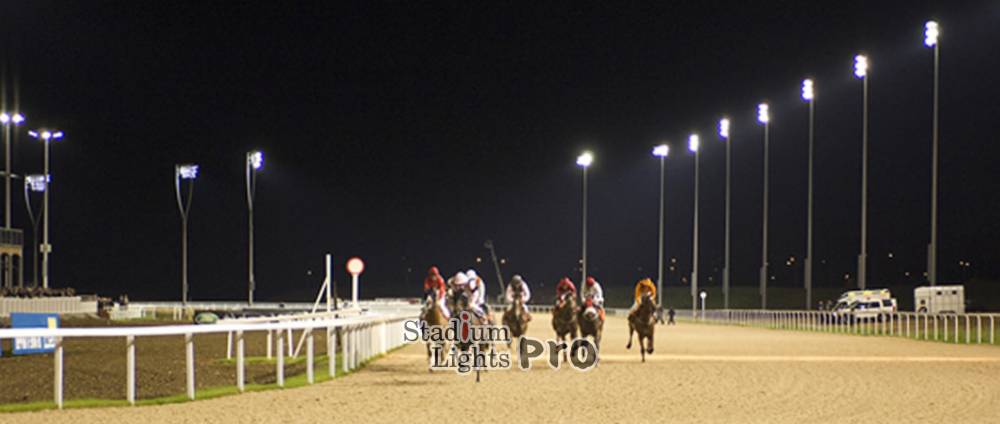
The color and texture of the racecourse surface affect how light is reflected and absorbed. A dark-colored track absorbs more light, reducing the perceived brightness even under adequate lux. This means that designers must increase light output or add fixtures to meet the visual needs of the course.
On the other hand, pale or sandy tracks reflect more light, making them appear brighter under the same lux value. This property can be both helpful and challenging. While it can reduce the need for high-output fixtures, it also increases the chance of excessive glare or visual noise, particularly when combined with glossy or uneven textures.
The interaction between surface color and lighting fixture type must be modeled accurately. A highly reflective surface paired with overly intense lighting can result in confusing reflections or sharp shadows, both of which impair depth perception and tracking ability.
Weather and Environmental Conditions
Racecourses are subject to variable weather, which has a measurable effect on lux performance. Fog, rain, humidity, and airborne dust can scatter or absorb light, leading to a drop in actual brightness on the track surface. Even lighting setups that perform well under test conditions may fall short during adverse weather.
To compensate, lighting designers often build in a performance buffer, planning for slightly higher lux levels than theoretically needed. This helps preserve visibility in real-world settings, especially when clarity is paramount during nighttime or televised races.
Environmental regulations and sustainability goals may also limit the wattage or run-time of fixtures. In response, many racecourses now employ smart lighting systems that adjust brightness dynamically based on weather sensors, crowd size, or race schedules. These adaptive systems keep lux levels optimized while reducing energy waste.
Type and Efficiency of Light Fixtures
The technology behind the lighting fixture makes a substantial difference in how lux levels are achieved and sustained. Traditional lighting systems such as halogen and metal halide lamps were once standard but have now largely been replaced by LED lighting due to its efficiency, control, and longevity.
LEDs offer greater precision in lux control, allowing operators to balance intensity and coverage more easily. Unlike older technologies, LEDs can be zoned, dimmed, and programmed for different track sections, meaning light can be directed exactly where it’s needed without spillover.
Their low energy consumption and minimal heat output make LEDs more sustainable and less likely to overheat or require frequent maintenance. Advanced fixtures can even include features like color temperature control or anti-glare diffusers to further refine the visual quality of the racecourse lighting.
Through proper selection of LED models and configurations, racecourse operators can ensure that lux levels remain stable, adaptable, and comfortable throughout the life of the system, regardless of changes in event type, time of day, or weather.
Fixture Spacing and Layout Design
Even with efficient fixtures, the physical layout of the lighting system remains a major determinant of lux performance. The spacing between poles and fixtures must be balanced to avoid gaps in illumination or excessive overlap. Overlapping beams may lead to zones with double intensity, while gaps can leave sections of the track dim or uneven.
Designers use simulation software to model fixture layout before installation, analyzing where lux levels peak and drop. This process helps identify areas that need more coverage or where fixture realignment could prevent visual strain. A well-optimized layout distributes light evenly, allowing horses and riders to move fluidly without adjusting to brightness shifts.
Proper layout planning also simplifies future maintenance. Fixtures placed too close together may block each other, while those spaced too far apart may require higher wattage to fill in the gaps. A precise, functional layout ensures that every part of the track supports performance without distraction or delay.
Integration with Racecourse Architecture
Finally, lux levels are influenced by the physical design of the racecourse itself. Grandstands, stables, fences, and overpasses can block or reflect light in ways that alter its spread. Tall architectural features can create shadow zones, while highly reflective surfaces like glass panels may redirect beams unpredictably.
Lighting design must therefore be synchronized with architectural planning. Ensuring that fixtures are placed where they won’t be blocked and using shielded lights to prevent unwanted reflection are both strategies that help maintain a steady lux level across the track.
Architectural integration also supports visual harmony, making the track not only functional but also aesthetically cohesive. When lighting works in tandem with structures rather than against them, lux performance becomes more consistent and reliable.
Ending Thoughts
Determining how many lux are needed for racecourse lighting requires balancing performance goals, biological factors, and environmental constraints. Lux values around 100 to 200 are usually adequate for recreational activities, while professional races may need upwards of 500 to 1000 lux for optimal clarity and visibility. Each use case demands a tailored lighting approach based on the unique visual needs of horses and riders.
Horses are particularly sensitive to visual inconsistencies caused by inadequate or excessive lighting. Maintaining a stable visual environment enhances safety and performance for both the animal and the human. Lux levels should always be considered in tandem with pole height, beam angle, track color, and fixture efficiency to ensure lighting not only meets expectations but supports long-term operational health. Designing lighting with these details in mind allows for consistent, glare-free, and visually comfortable racing environments that meet professional standards and support the well-being of all participants.