
Lighting on ski slopes goes far beyond basic visibility; it plays a role in shaping the overall experience for skiers and snowboarders. The recommended lux level—measuring how much light falls on a surface—varies depending on slope use, location, and skiing discipline. Unlike general area lighting, ski slope illumination must ensure safety, performance support, and visual comfort across variable terrain and weather conditions. The correct lux level contributes to an environment that supports smooth navigation and minimizes risks associated with poor lighting such as misjudging snow texture or slope angles.
Recommended Lux Level Based on Skiing Type and Use
| Skiing Type / Area | Typical Lux Range |
|---|---|
| Alpine Skiing (Downhill, Super-G) | 100–150+ lux |
| Slalom and Giant Slalom | 150+ lux |
| Freestyle / Terrain Parks | 150–200 lux |
| Ski Jumping Hills | 200+ lux |
| Recreational Slopes | 30–50 lux |
| Cross-Country Trails | 10–30 lux |
| Training Slopes | 60–100 lux |
| Night Skiing (General) | Varies (Boosted) |
Ski slope lighting must be carefully adjusted to the nature of the activity taking place. From casual night skiing to elite-level alpine racing, the required lux level varies widely. The goal is to provide enough visibility for users to perceive snow conditions, identify elevation changes, and make quick decisions, all while avoiding over-illumination that might cause glare or eye strain. The following outlines how lux requirements are shaped by different types of skiing environments and purposes.
Alpine Skiing – High-Speed Precision Requires Elevated Lighting Levels
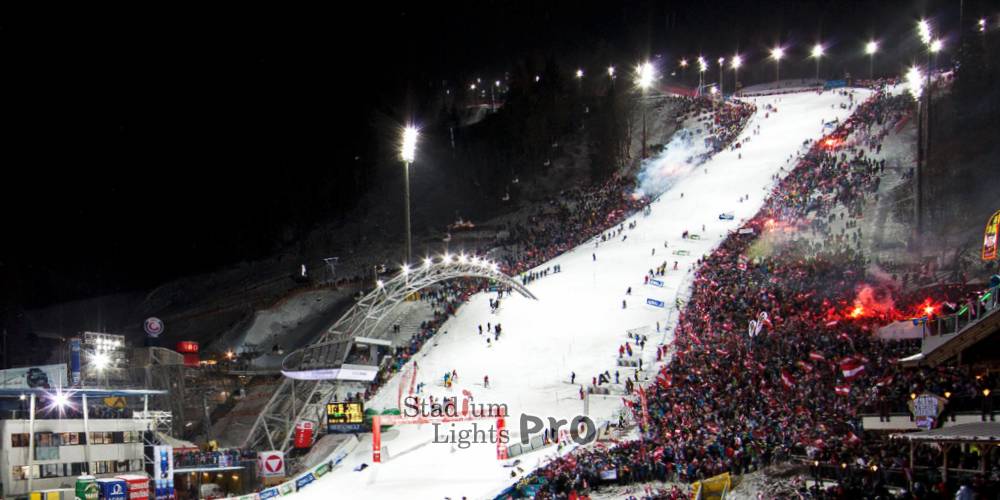
Alpine skiing, especially in professional downhill and super-G events, demands some of the highest lux levels in slope lighting. Skiers travel at high speeds, often exceeding 100 km/h, navigating steep inclines, uneven terrain, and sudden directional changes. To ensure visibility for such rapid movement, slopes are usually lit to at least 100 lux, with some competitive venues pushing toward 150 lux or more.
The lighting setup must account for both horizontal and vertical illumination so that skiers can interpret depth, slope angles, and snow texture. Minor lapses in lighting continuity could lead to missed turns or delayed responses, which at high speeds can be dangerous. A precisely distributed lighting system reduces shadows while enhancing visibility of key slope features, including gates and terrain transitions.
Slalom and Giant Slalom – Precision Lighting for Technical Courses
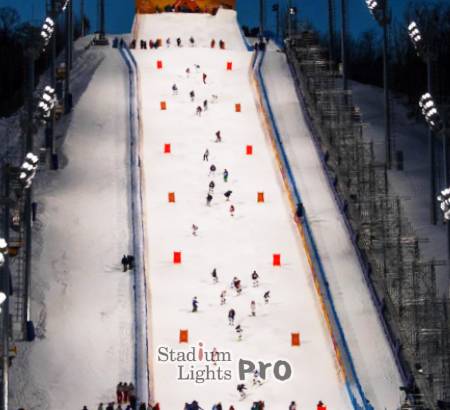 Slalom and giant slalom courses place a strong emphasis on technical performance. Skiers need to make rapid, consecutive turns around closely spaced gates. The visual demands here differ slightly from downhill events, requiring a more focused light to differentiate between gate poles and changing surface textures.
To meet these demands, lighting often exceeds 150 lux in high-profile competition settings. Uniformity is especially critical, as any inconsistencies in brightness can lead to mistimed turns or visual confusion. The placement and angling of fixtures are designed to minimize shadows cast by the gates, enhancing visibility and ensuring that athletes can perceive the course layout clearly from top to bottom.
Freestyle and Terrain Parks – Vertical and Aerial Illumination
Freestyle skiing zones, which include jumps, half-pipes, rails, and terrain parks, introduce vertical motion into the visibility equation. Athletes launch into the air, spin, and land on sloped surfaces, all of which require exceptional visibility both on the ground and above it.
Lighting for these areas typically reaches between 150 and 200 lux to provide clear views of takeoff points, aerial space, and landing zones. Directional fixtures are often mounted at elevated angles to deliver vertical illumination, ensuring that athletes can visually track their position mid-air. The landing zones must be lit in a way that highlights contours and transitions, aiding both safety and performance execution.
Ski Jumping Hills – Lighting for Aerial Control and Safe Landing
Ski jumping presents a distinct set of lighting challenges, as the athlete’s flight path and landing trajectory span a large vertical and horizontal area. The lighting must deliver clarity without interfering with the jumper’s line of sight, which means glare control and vertical lux distribution are prioritized.
High-intensity lighting, typically exceeding 200 lux at focal points such as the landing slope, is deployed to enhance the jumper’s visibility and depth perception. Multiple lighting arrays at different elevations help balance visibility through the takeoff, flight, and landing phases. Every part of the hill must be evenly lit to reduce visual ambiguity at high speed and during rapid descent.
Recreational Ski Slopes – Focus on Comfort and Safety
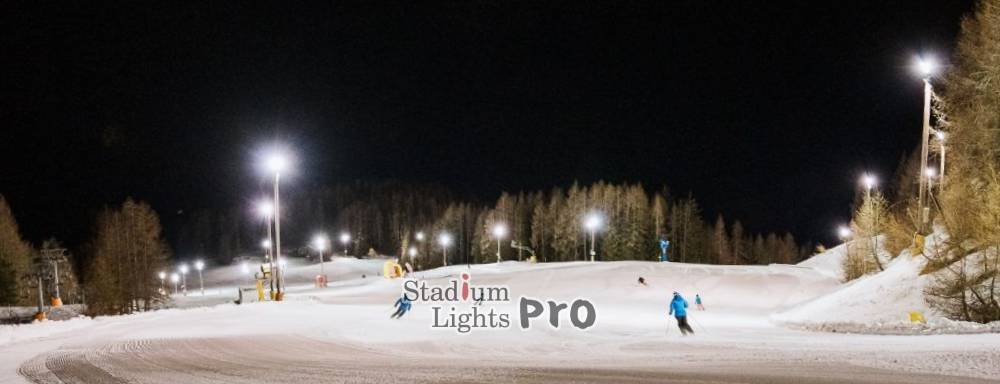
Recreational ski slopes are designed for enjoyment and comfort rather than competitive intensity. The lighting objective shifts toward creating a relaxing environment that enables casual skiers to enjoy night skiing without stress. These slopes often support a diverse user base, including beginners, families, and occasional skiers.
Lux levels for recreational slopes generally range between 30 and 50, which provides enough illumination to see ahead, follow the trail, and detect surface changes without overwhelming the senses. The lighting is usually softer and more diffused compared to competitive courses. Pole spacing tends to be wider, and the fixture brightness is moderated to reduce glare and visual fatigue. Consistency across the slope remains important, but the tolerance for lower intensity is much higher in these settings.
Cross-Country Trails – Low-Intensity Illumination Over Long Distances
Cross-country skiing trails differ in nature from downhill slopes, with long, winding paths traversing flatter terrain. The pace is generally slower, and the visual environment is more stable. As a result, these trails require significantly lower lux levels compared to alpine runs.
Lux levels typically range from 10 to 30 along cross-country trails, just enough to mark the path clearly while preserving the natural surroundings. In many cases, lighting must accommodate ecological considerations, especially in wooded or wildlife-rich areas. Warm-toned and shielded lighting designs help avoid disturbing nocturnal animals. Fixtures are often spaced widely, with lower mounting heights, and sometimes feature motion-activated controls to reduce power consumption when the trail is empty.
Training Slopes – Balancing Realism and Energy Use
Training slopes are dedicated to athlete development and are designed to mirror competition conditions as closely as possible. These slopes must provide athletes with an environment that fosters technical improvement and familiarity with race scenarios.
Typical lux levels for training purposes fall between 60 and 100, although this may be increased depending on the intensity and specificity of the training. Coaches often want athletes to experience visual conditions similar to those in official races, so the lighting setup may include features such as directional fixtures and contrast-enhancing color temperatures. Some facilities implement adjustable lighting systems that allow coaches to dim or brighten areas as needed to suit different drills or simulate specific conditions.
Night Skiing Adaptations Across All Categories
Night skiing introduces unique demands on lighting systems, regardless of slope type. Snow reflectivity, fog, precipitation, and ambient light levels can all alter visibility dramatically. For this reason, even recreational slopes may require boosted lux levels or adaptive lighting systems to maintain clear conditions throughout the night.
Color rendering becomes an added concern, as white light may reflect too intensely off snow or ice, distorting color perception. Some operators adopt lighting solutions that offer cooler color temperatures for better visibility or use advanced optics to reduce glare. Many night skiing facilities install smart control systems that can increase or decrease output dynamically depending on the visibility, user density, and time of night.
Overall, the lux level on any given slope reflects its usage type, user profile, and the visual demands of the terrain. Whether ensuring safe landings in freestyle zones or maintaining comfort for recreational night skiing, the illumination intensity is chosen with precise intent. Each slope type is best served by a thoughtful and tailored approach to lighting, guided by how users engage with the space and how visual conditions can either support or hinder their experience.
Variables Influencing Lux Requirements on Ski Slopes
The lighting needs of ski slopes are shaped by a complex interaction of many variables. Each factor must be carefully considered to create an effective lighting system that meets the demands of safety, performance, and comfort for all users.
Light Pole Placement and Density
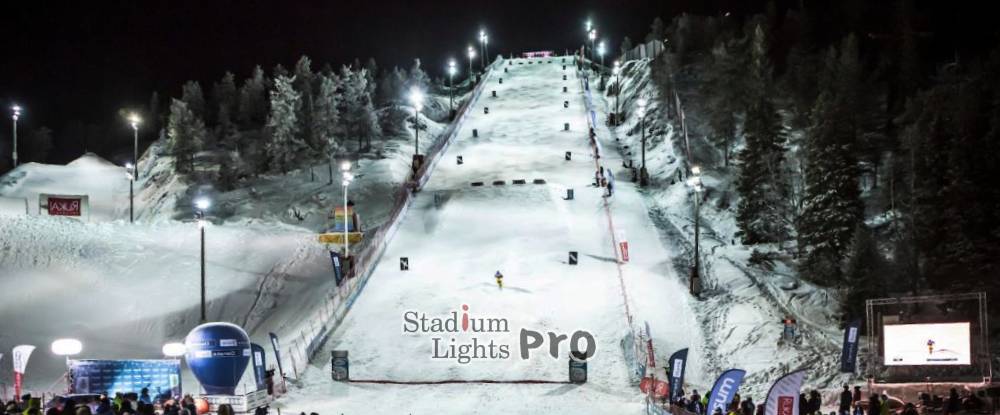
The number and spacing of light poles on a ski slope are among the most influential factors determining the overall lighting quality. Poles that are too widely spaced risk producing dark zones or uneven lighting patterns that can impair skier visibility and increase the likelihood of accidents. Conversely, placing poles too close together can cause overlapping light beams that increase glare and create visual discomfort. Achieving the right balance requires detailed analysis of the slope’s geometry, including its angle of incline, the typical direction of skier movement, and potential obstacles such as trees, lift towers, or variations in terrain elevation.
The strategic placement of poles also impacts the uniformity of illumination, a critical aspect for avoiding harsh shadows that can mask hazards or interfere with depth perception. Careful layout and adjustment of pole heights and fixture angles ensure that the entire slope receives consistent light coverage without excessive hot spots or dim patches.
Glare Control and Visual Comfort
Glare control is a fundamental part of designing lighting for snow-covered terrain, where the reflective surface can amplify brightness and reduce contrast if not properly managed. The reflection of light off the snow has the potential to cause eye strain or momentary blindness, which may impair skier performance and increase risk.
To mitigate glare, lighting systems often incorporate shielding devices such as louvers or visors that direct light beams precisely onto the slope while preventing spill light into the eyes of skiers or spectators. Additionally, the use of narrow beam optics helps concentrate illumination on downhill sections where visibility is most needed, reducing stray light behind skiers.
Another crucial element in glare management is the color temperature of the light source. Lights with cooler color temperatures (in the range of 4000K to 5000K) tend to improve contrast against the white snow, aiding depth perception, while warmer lights can increase glare due to their spectral characteristics. Selecting the appropriate color temperature enhances visual comfort and helps skiers better judge terrain features.
Impact of Slope Usage Type on Lux Requirements
The purpose of the slope heavily influences lighting design decisions. Recreational slopes, designed for leisure and comfort, usually require less intense lighting and more diffused beams. In contrast, training slopes demand illumination levels that simulate competition conditions, enabling athletes to prepare effectively.
Competitive ski slopes, especially those hosting national or international events, are subject to more stringent lighting standards. These include minimum lux levels to support high-speed performance, uniform illumination to avoid shadows or dark spots, and specific color rendering requirements to provide accurate color reproduction under broadcast cameras. Television and streaming broadcasts require lighting systems that minimize flicker and color distortion, which can be challenging in outdoor night conditions.
Environmental and Weather Considerations for Outdoor Slopes
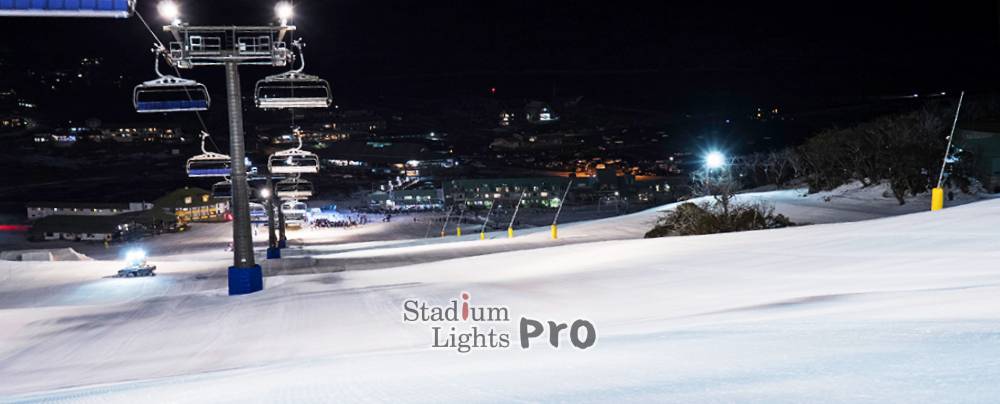
Outdoor ski slopes face the additional challenge of dealing with weather variability. Snowstorms, fog, and varying ambient light levels from moonlight or nearby urban areas can drastically change visibility conditions throughout the evening or night.
To address these factors, many outdoor lighting installations are designed with adaptive control systems. These systems adjust lighting intensity dynamically, increasing output during fog or heavy snowfall and reducing brightness when natural light is sufficient or to conserve energy during low-use periods.
Proper fixture sealing and weatherproofing are also essential, ensuring the lights maintain consistent performance despite exposure to moisture, freezing temperatures, and ice buildup.
Lighting Requirements for Indoor Ski Facilities
Indoor ski slopes operate under a completely different set of constraints due to the absence of natural daylight. Because all illumination must be provided artificially, these venues typically rely on high-density LED arrays mounted on ceilings or walls to deliver consistent, even lighting.
Indoor lighting systems can maintain stable lux levels throughout operating hours, unaffected by weather or time of day. The focus is often on minimizing shadows and providing sufficient brightness to highlight slope contours, ramps, and obstacles clearly for skiers and snowboarders.
Moreover, indoor facilities can implement highly controllable lighting schemes, including zoning and dimming capabilities, to tailor illumination for different activities or skill levels, maximizing energy efficiency without compromising safety or experience quality.
Influence of Broadcast and Spectator Needs
In addition to the athletes’ requirements, lighting designs must also consider the experience of spectators and broadcast audiences. Television production demands high lux levels with precise color rendering to capture clear, vibrant footage without flicker or distortion.
Lighting systems are often engineered to balance the needs of live events and television broadcasts by using flicker-free ballasts, high color rendering index (CRI) fixtures, and adjustable beam angles. The arrangement of lights also minimizes shadows cast on athletes and ensures the visibility of advertising and branding around the slopes, supporting commercial aspects of ski events.
Purpose of Lux Levels on Ski Slopes
Lux levels on ski slopes play a role that extends beyond simple visibility, shaping the entire experience for users. The quality of lighting directly influences how skiers perceive the terrain, navigate the slope, and interact with their environment.
Enhancing Depth Perception and Terrain Recognition
One of the most significant impacts of appropriate lighting is on depth perception and the ability to recognize changes in terrain. Poorly lit slopes can create a flat and featureless appearance, where subtle bumps, dips, or icy patches blend into the background, making them difficult to detect. This lack of visual cues increases the risk of falls and injuries, especially at higher speeds or on challenging terrain.
Conversely, well-calibrated lighting—typically in the range of 50 to 100 lux for general recreational use—emphasizes surface texture and contour. Skiers can quickly react to variations in slope angle, identify obstacles, and follow trail markers more confidently. The enhanced visual clarity supports better decision-making and smoother movement, improving both safety and enjoyment.
Building Confidence and Comfort for Recreational Skiers
Lighting also contributes to the psychological comfort of skiers, particularly those who are less experienced. Recreational skiers often feel more at ease on slopes that are brightly and evenly illuminated, where the snow surface and trail boundaries are clearly visible. This visibility fosters a sense of security and encourages extended use, which benefits ski resorts through increased visitor satisfaction and repeat patronage.
A well-lit environment, typically maintained at 30 to 50 lux for beginner and intermediate slopes, reduces anxiety by helping users anticipate turns and avoid collisions with other skiers or obstacles. This sense of safety can be especially reassuring during night skiing sessions when natural light is absent.
Supporting Ski Patrols and Operational Staff
Beyond the skiers themselves, appropriate lux levels facilitate the work of ski patrols, rescue teams, and resort personnel. In emergency situations, clear illumination—ideally in the range of 50 to 100 lux—enables faster identification and evacuation of injured individuals, potentially saving lives and reducing the severity of injuries.
Lift operators and slope maintenance crews depend on consistent lighting to monitor slope activity safely, perform grooming operations, and enforce slope closures when necessary. Adequate lighting helps maintain operational efficiency while reducing risks for staff working during early morning or night hours.
Meeting Broadcast and Spectator Requirements
Competitive ski events impose additional demands on lighting. Television broadcasts, particularly those employing high-definition and slow-motion cameras, require balanced and consistent illumination to capture every detail of skier performance.
For international competitions, lighting levels are significantly higher, typically around 150 to 300 lux, with strict requirements for uniformity (minimum 0.7 uniformity ratio) and color rendering (CRI ≥ 80). Uneven or insufficient lighting can create distracting shadows and distort the perception of motion and terrain on screen, reducing viewer engagement and making it difficult to follow the action. To address this, competitive venues adhere to strict international lighting standards designed to provide high lux levels with uniform coverage and color accuracy, ensuring that spectators both on-site and watching remotely receive an optimal visual experience.
Performance Effects from Different Lux Conditions
Lighting conditions, expressed in lux levels, influence athlete performance on ski slopes in multiple ways. For skiers who depend on split-second decisions and precise control, the quality of illumination can directly affect outcomes.
Impact of Low Lux on Athlete Performance
When lighting is insufficient—typically falling below 30 lux—the ability of athletes to perceive the slope accurately diminishes. In low-light environments, depth perception weakens, and subtle surface details become harder to discern. This visual impairment can delay reaction times, reduce the precision of turns, and disrupt the fluidity of movement. For elite athletes, where every millisecond counts, even slight visibility deficits can translate into less optimal line choices and slower run times.
Athletes may respond to poor lighting by skiing more cautiously or compensating for unseen terrain variations, which lowers efficiency and performance potential. In competitive contexts, this could be the difference between victory and defeat. Furthermore, incomplete or patchy illumination increases the risk of accidents, as skiers struggle to anticipate sudden changes in slope angle or texture.
Importance of Shadow and Surface Definition
High-performance skiing relies heavily on the ability to detect subtle cues in the snow, such as icy patches, soft areas, or irregularities caused by grooming or natural terrain features. Proper lighting in the range of 100 to 200 lux for training and 150 to 300 lux for competition creates shadows and contrast that help reveal these details, enabling athletes to adjust their technique and speed accordingly.
When lighting fails to highlight these surface nuances, athletes lose valuable information that informs their movement decisions. This effect is especially pronounced in technical disciplines like slalom, where rapid, precise turns demand continuous spatial awareness.
Effects of Excessively High Lux Levels
While adequate brightness is crucial, overly intense lighting—above 400 lux on snow surfaces—can be problematic. Excessively high lux levels, particularly from fixtures that are not properly shielded or aimed, can generate glare. This glare is intensified when light reflects off icy or packed snow surfaces, potentially causing visual discomfort or temporary blindness.
Such conditions reduce contrast and obscure critical details, undermining the benefits of strong illumination. The best lighting setups carefully balance intensity, incorporating directional beams and glare control technologies to maintain clear, comfortable vision for athletes. Both horizontal and vertical lighting must be optimized to support dynamic movement without overwhelming the skier’s eyes.
Consequences for Recreational Skiers
Although recreational skiers are less likely to suffer competitive disadvantages, lighting conditions still influence their overall safety and experience. For this group, 30 to 50 lux is generally sufficient to ensure visibility without discomfort. Dim or uneven lighting below this range may cause users to avoid night skiing altogether or tire more quickly due to eye strain. Vulnerable groups such as children, older adults, and beginners are particularly sensitive to poor lighting, as their reaction times and confidence levels are more easily affected.
By ensuring consistent and adequate lux levels, resorts promote safer, more enjoyable experiences for all users, encouraging nighttime slope use and extending operational hours.
Maintaining Fairness in Competition
Consistency of lighting is an often-overlooked factor in ensuring fairness during ski competitions. When races are conducted in multiple heats or different time slots, uneven lighting can unintentionally advantage some athletes while disadvantaging others.
For this reason, organizers frequently employ lighting sensors and control systems that monitor lux levels in real time. Competitive venues often target lux levels of 150 to 300 lux, with uniformity ratios above 0.7, to minimize any performance variation due to lighting. These technologies enable adjustments to maintain uniform illumination across the entire course and throughout all race heats. The goal is to create equal conditions for all competitors, preserving the integrity of the event and the validity of results.
Planning and Sustaining a Ski Slope Lighting System
Creating an effective lighting system for ski slopes requires thorough preparation and ongoing attention. The process begins well before any hardware is installed, with a comprehensive analysis of the site and its specific needs.
Site Analysis and Lighting Design
An in-depth understanding of the terrain and environmental conditions informs every aspect of the lighting plan. Engineers assess the slope’s profile, including its gradient, curvature, and any natural or artificial features that might affect light distribution. They consider typical usage patterns—whether the slope hosts recreational skiing (30–50 lux), training sessions (100–200 lux), or competitive events (150–300 lux)—and factor in local climate elements such as average snowfall and elevation. These variables influence decisions about the intensity, placement, and type of fixtures best suited for the location.
Simulation tools play a critical role in the design phase. Lighting professionals use advanced software to model how different layouts and lighting technologies will perform across the slope, taking into account factors such as shadowing from trees or terrain changes, as well as potential glare spots. These simulations help refine pole placement and beam direction to achieve uniform lighting with a minimum uniformity ratio of 0.5 for recreational and 0.7 for competitive slopes, ensuring consistent illumination that meets the visual demands of users.
Adoption of LED Technology
LED lighting has become the standard choice for ski slope illumination. This technology brings several benefits that align with the unique requirements of winter sports environments. LEDs consume less energy than traditional metal halide lamps, leading to reduced operational costs and environmental impact. Their directional nature allows precise targeting of light, minimizing spill into adjacent forests, residential areas, or the night sky.
LEDs also offer superior durability and low maintenance. They withstand cold temperatures and vibration better than older technologies and have a longer service life. Quick restart capability is another advantage, especially in mountainous locations where power interruptions might occur. The color temperature, typically in the range of 4000K to 5700K, is selected to optimize snow visibility, enhancing contrast and reducing eye strain for skiers and staff.
Structural Considerations and Environmental Impact
Mounting poles and fixtures must be engineered to endure the demanding alpine environment. Poles are anchored firmly to resist strong winds, snow loads, and seismic activity where relevant. The height of light poles is calculated carefully to ensure the optimal beam angle—enough to provide even horizontal and vertical illuminance, ideally meeting 50 lux minimum for general slopes and 150+ lux for competitive runs, without flooding surrounding areas with unwanted light.
Ski resorts are often located near sensitive ecosystems or inhabited zones, so reducing light pollution is a priority. Fixtures equipped with shields and downward-focused optics prevent light from spilling upwards or horizontally beyond the target area. This approach protects nocturnal wildlife and preserves the natural darkness of the mountain environment.
Smart Lighting Controls and Energy Efficiency
Modern lighting systems integrate intelligent controls to adapt to real-world conditions and reduce energy use. Automated dimming adjusts brightness levels during low-traffic times or favorable ambient conditions, often dimming to 20–30 lux during maintenance or idle hours. Motion sensors can increase illumination only when skiers or grooming equipment are present. Time-based scheduling ensures that lights operate only during necessary hours.
Some advanced installations connect to weather stations or cloud-based platforms, allowing lighting to respond dynamically to visibility changes caused by fog, snowfall, or daylight. This responsiveness enhances safety while optimizing power consumption.
Maintenance and Performance Monitoring
Regular maintenance supports consistent lighting performance across seasons. Technicians schedule inspections during the off-season to clean fixture lenses, replace any damaged components, and recalibrate light angles if needed. The harsh mountain environment can cause snow and ice buildup on fixtures, vibrations from grooming machinery may loosen components, and animals might interfere with wiring or hardware.
Although LEDs degrade more slowly than traditional lamps, their output diminishes over time. Integrated monitoring systems track real-time lux levels, issuing alerts if illumination drops below target thresholds (e.g., below 30 lux for recreation, 100 lux for training, or 150 lux for competition). Proactive replacement or upgrading of fixtures prevents unexpected outages and maintains even lighting quality throughout the slope.
Environmental and Sustainability Considerations
Energy consumption and ecological impact are increasingly factored into lighting decisions. Resorts aim to reduce their carbon footprint by selecting energy-efficient equipment and minimizing light trespass. Fixtures that limit glare and precisely target the ski surface help protect wildlife habitats, particularly for species sensitive to artificial lighting.
Material recyclability and end-of-life disposal also shape product choices, with many operators preferring systems designed for sustainability. By balancing performance needs with environmental responsibility, ski resorts contribute to preserving mountain ecosystems.
Conclusion
By tailoring lux levels to the type of skiing and environmental conditions, employing energy-efficient technologies like LEDs, and integrating smart control systems, resorts can achieve optimal visibility while minimizing ecological impact and operational costs. Thoughtful lighting design not only supports athletes and recreational users but also helps preserve the natural mountain environment for future enjoyment.