
Creating a golf course that shines at night is more than just slapping a few lights on poles. Lighting design for golf courses blends aesthetics, functionality, and safety, making sure players can see clearly without feeling like they’re in a spotlight. Whether it’s a driving range, putting green, or the entire course, a thoughtful lighting plan can transform evening play into an enjoyable experience.
How Does Lighting Design Work for Golf Courses?
Lighting a golf course isn’t just about brightness. It’s about understanding how light interacts with the terrain, the greens, and even the players’ eyes. Designers often start by mapping the course and figuring out which areas need more illumination. For example, tee boxes, fairways, and putting greens all require slightly different lighting levels because the tasks players perform there vary. A putting green needs more uniform light so players can judge distances accurately, while fairways can have slightly broader, less intense illumination.
The process usually begins with creating a lighting plan using software simulations. These programs let designers visualize how the light spreads across the grass, trees, and bunkers. It also helps predict potential shadows and glare spots. The goal is to have players feel like they’re playing in natural light, even when the sun has gone down.
Points to Look at When Designing Lighting for a Golf Course
Lighting a golf course is more than just deciding how bright it should be. There are a bunch of factors that affect both playability and comfort, and getting them right can make a huge difference for night golfers.
Lux Levels and Illuminance
One of the first things to figure out is the lux level, or the amount of light hitting the playing surface. Driving ranges usually aim for around 300 lux (28 foot-candles), which is enough for players to see balls clearly at long distances without making the lighting feel harsh. On putting greens, you need something closer to 500 lux (46 foot-candles) because players need to read subtle slopes and breaks on the green. For chipping areas, somewhere in the 400–450 lux range works well.
It’s not just about hitting a number on the lux meter, though. Illuminance uniformity plays a huge role. You could have a bright putting green, but if the light is uneven, shadows can mess with depth perception and ball tracking. A uniformity ratio of 0.5 to 0.7 is generally recommended. This means the dimmest spot on your green should be at least half as bright as the average light across the area. Some high-end courses even aim for 0.8 uniformity to make night play feel as natural as daytime.
Controlling Glare
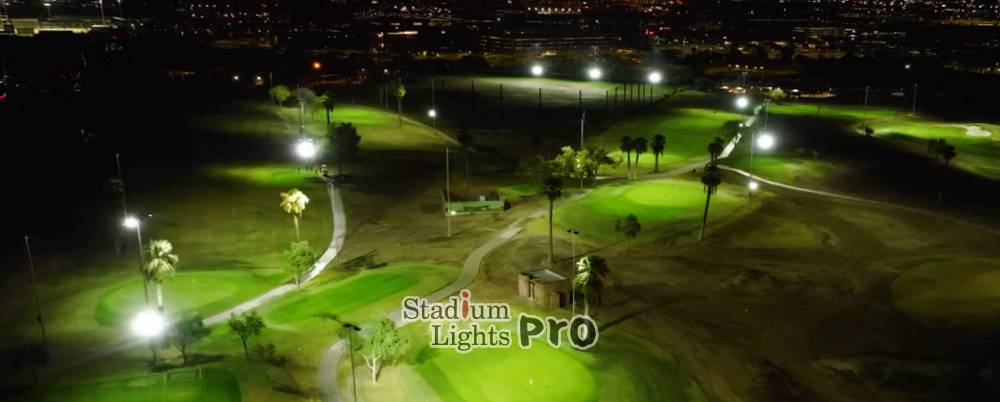
Glare is something that often gets overlooked but can really ruin a night round. Too much glare makes it hard for golfers to track the ball mid-flight, and it can even create temporary “blind spots.” Designers often talk about the glare index, which measures how much light is shining directly into a player’s eyes. A glare index below 20–25 is usually comfortable for most players.
Positioning is key. Lights should be angled away from players’ line of sight, and shields or louvers can help direct light only where it’s needed. For example, on a 150-meter fairway, floodlights might be tilted 10–15 degrees downwards to reduce upward spill and skyglow, while still illuminating the playing surface effectively. Overlapping beams from adjacent poles can also minimize harsh shadows without increasing glare.
Uniformity and Beam Spread
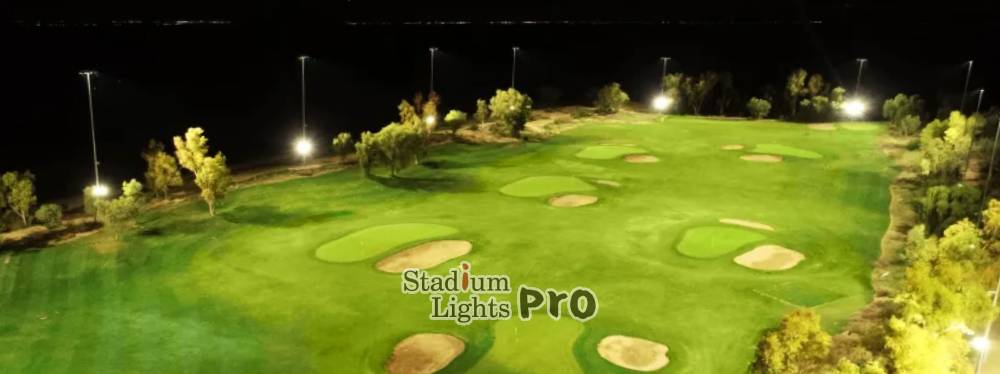
Another factor to consider is beam distribution. Wide beam angles are great for fairways because they cover more area with fewer poles, while narrower beams work better on greens for precise, uniform lighting. Designers sometimes use asymmetric optics so the light spreads more along the fairway than across it, reducing dark patches at the edges.
Spacing between poles also interacts with uniformity. For example, a 15-meter-high pole might be spaced about 25–30 meters apart to achieve smooth coverage, depending on the beam angle of the fixtures. Getting these numbers right ensures golfers don’t suddenly lose sight of the ball in a shadowy patch.
Color Temperature and Color Rendering
Lastly, the color temperature and color rendering index (CRI) of your lights can make a big difference. Neutral white lights around 4000K give a natural feel that helps players distinguish the green from surrounding turf and sand traps. A CRI of 80 or higher ensures that colors appear natural, which is crucial when reading greens or spotting balls against the grass. Some designers even experiment with 4200K–4500K lights for a slightly cooler look that still feels comfortable.
Matching the light color across the course is also worth thinking about. Imagine hitting from a fairway lit with slightly yellow light onto a green lit with cool white LEDs—it can be visually jarring and make judging distances harder.
| Aspect | Recommended Values |
|---|---|
| Driving Range Lux | 300 lux (28 fc) |
| Putting Green Lux | 500 lux (46 fc) |
| Chipping Area Lux | 400–450 lux |
| Uniformity Ratio | 0.5–0.7 (high-end 0.8) |
| Glare Index | < 20–25 |
Layout Guide
Designing the lighting layout for a golf course is a mix of math, physics, and a bit of art. You want enough light to make the course playable at night, but without flooding it so much that it feels like a stadium.
Pole Height and Placement
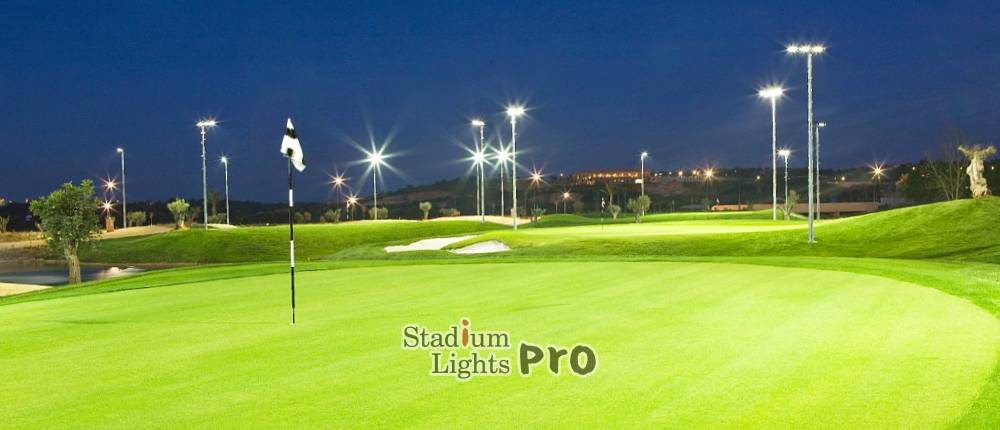
Pole height usually falls between 12 and 18 meters, depending on whether you’re lighting a driving range, a fairway, or a putting green. Taller poles spread the light over a larger area, which means you can use fewer of them, but higher poles can drive up costs, both for installation and the stronger fixtures required. For smaller greens, a 12–14 meter pole is often sufficient, while long fairways might need poles closer to 16–18 meters to maintain even coverage.
The spacing between poles is just as important. A typical rule of thumb is to space them about 1.5 to 2 times their mounting height. So, if you’ve got a 15-meter pole, spacing it roughly 22 to 30 meters from the next pole tends to give good light overlap without leaving dark patches. Designers often tweak this based on beam angles and the lux target for each area. For example, a wide 120-degree beam angle lets poles be spaced farther apart, while a narrow 60-degree beam means they need to be closer together.
Number of Fixtures and Wattage
How many lights go on each pole depends on both the area you’re lighting and the type of fixture. For most golf courses, high-performance LED floodlights in the 400W to 1500W range are common. A single 800W LED floodlight can light a 20–25 meter stretch of fairway quite effectively, assuming a good pole height and beam angle. On putting greens, designers might use 3–4 smaller fixtures per pole, around 400–600W each, to keep light uniform and shadows minimal.
The wattage you choose also affects energy use, so it’s a balance. Too low, and the area looks dim; too high, and you get glare and waste electricity. Modern LED technology helps because it delivers more lumens per watt compared to older metal halide lights. A 1000W LED floodlight can give roughly 120,000–130,000 lumens, enough to cover a long section of fairway without multiple poles in close proximity.
Angles and Beam Overlap
Angles are another factor that can’t be ignored. Floodlights should be aimed to minimize long shadows and avoid glaring into players’ eyes. Designers often tilt lights 10–15 degrees downward, depending on pole height, to create even light spread.
Overlapping beams from adjacent poles are key for uniformity. Without overlap, you can end up with dark spots between poles, which is frustrating when players are trying to follow the ball at night. For fairways, a 20–30% overlap is common practice, while putting greens often need 50% or more overlap to ensure consistent lighting across the small, detailed surface.
| Aspect | Recommended Values |
|---|---|
| Floodlight Tilt Angle | 10–15° downward |
| Pole Height | 15 meters (example) |
| Pole Spacing | 25–30 meters (for 15 m pole) |
| Color Temperature | 4000K (neutral white), 4200–4500K |
| CRI (Color Rendering Index) | ≥ 80 |
Types of Lights Used in Golf Courses
Choosing the right type of lighting is just as important as planning the layout. Different areas of a golf course have different needs, and using the right fixtures can make night play comfortable, safe, and visually appealing.
Floodlights
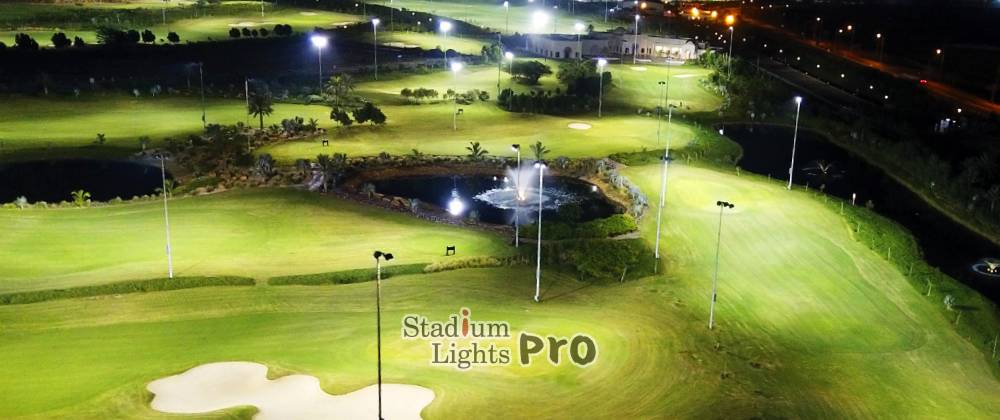
Floodlights are the workhorses of golf course lighting. They offer wide coverage and high brightness, making them ideal for fairways, driving ranges, and large greens. Most courses use LED floodlights ranging from 400W to 1500W, with lumen outputs between 50,000 and 130,000 lumens depending on the size of the area being lit.
These lights are usually mounted on poles and can be adjusted to target specific areas. For example, on a 150-meter fairway, floodlights might be tilted 10–15 degrees downward to reduce glare and ensure even coverage. Some high-end courses even use asymmetric optics so the light spreads along the fairway rather than across it, minimizing dark patches at the edges.
Wall Packs
Wall packs are smaller fixtures typically mounted on buildings, like the clubhouse or maintenance sheds. They’re not strong enough to light an entire fairway, but they’re perfect for parking lots, pathways, and practice areas, where consistent visibility is needed without overpowering the space.
A standard wall pack might provide 2,500–5,000 lumens, enough to safely illuminate a walkway or entry area. Some courses combine them with motion sensors, which not only saves energy but also adds a layer of security.
Solar Lights
Solar lights are becoming more popular, especially for pathways, small practice areas, and cart paths. They’re eco-friendly and reduce the need for complicated wiring, which can be expensive on sprawling courses.
The main limitation is intensity. Most solar fixtures provide 100–500 lumens per light, so they’re great for marking paths but aren’t bright enough for greens or long fairways. That said, they can be combined with traditional fixtures to create a layered lighting system that’s both energy-efficient and practical.
LED Strips and Specialty Lights
Some courses get creative with LED strips or specialty lights, especially around hazards, signature holes, or decorative elements. These can provide subtle illumination that guides players visually without adding harsh light. For instance, a small pond or bunker edge might be outlined with low-intensity LEDs at 1,000–2,000 lumens, helping golfers navigate the hole while adding visual appeal.
Common Mistakes When Designing Golf Course Lighting
Even with experience, lighting a golf course at night is tricky, and small mistakes can really affect playability, safety, and even costs. Knowing what to watch out for can save headaches down the road.
Over-lighting
One of the most frequent errors is over-lighting. People sometimes assume that brighter is always better, but cranking up the wattage or adding extra fixtures can backfire. Too much light creates harsh glare, which makes it hard to track the ball mid-flight, and it can also make the grass look unnatural under your lights.
For example, a putting green that’s illuminated with 700–800 lux instead of the recommended 500 lux can feel like a soccer field rather than a golf green. Over-lighting also drives up energy costs, sometimes by 30–40%, and can create complaints from neighbors if the light spills beyond the course boundary.
Poor Uniformity
Another common problem is uneven light distribution. Even if the average lux level is high, dark patches between poles or under trees can make it hard for players to judge distances or find their balls. Uneven lighting often happens when designers underestimate the effects of trees, bunkers, and slopes, which cast shadows that reduce visibility.
A practical tip is to aim for a uniformity ratio of at least 0.5–0.7. Anything lower, and players might notice “dim spots” where tracking the ball becomes tricky. On high-end courses, uniformity can go as high as 0.8, which feels almost like playing in daylight.
Incorrect Pole Placement
Pole placement seems simple, but it’s surprisingly easy to get wrong. Poles that are too low, spaced too far apart, or positioned at awkward angles can leave parts of a fairway in shadow. On the flip side, putting poles too close together or using too many fixtures can create unnecessary hotspots, making the light feel harsh and uneven.
For example, a 15-meter pole spaced 40 meters apart instead of the recommended 22–30 meters may leave gaps of shadow on a fairway. Conversely, spacing them only 15 meters apart might create overlapping glare, wasting fixtures and electricity.
Ignoring Maintenance
Finally, maintenance is often overlooked during the design phase. Even the best lighting setup can degrade if the fixtures aren’t accessible for cleaning or bulb replacement. Dirt, dust, or worn-out LEDs can reduce output by 20–30% over a few years, which may turn a well-lit green into a patchy, dim area.
Designers can avoid this by choosing durable, weather-resistant fixtures and planning for easy access. For instance, adjustable LED floodlights mounted on poles with service ladders or brackets allow quick maintenance without needing specialized equipment.
Other Common Slip-ups
Other mistakes include using inconsistent color temperatures across the course, which can make greens look different from fairways, and ignoring glare control, which can frustrate players. Even small oversights, like failing to account for reflective surfaces near water hazards or cart paths, can affect the overall night golfing experience.
Conclusion
Lighting a golf course at night requires more than technical know-how—it demands a sense of how players interact with the space and how light affects both performance and enjoyment. A well-lit course doesn’t just extend playtime; it makes evening rounds more inviting and safer. By carefully considering lux levels, glare, uniformity, fixture types, and layout, designers can create a golf experience that’s just as good at night as it is in daylight.
Even small details, like the angle of a single floodlight or the color temperature of LEDs, can make a noticeable difference. When done right, night golfing feels effortless, with the course looking just as beautiful and playable as during the day.