
People don’t always think about how much lighting affects the vibe of a volleyball game, but anyone who has played under dim lamps or overly harsh floodlights knows the difference immediately. A court that’s too dark feels slow and uncomfortable, while one that’s too bright can be almost blinding. Getting the right balance isn’t only about making things look good; it shapes how players react, how spectators follow the action, and even how safe the court feels.
So the real question is: how many lux and foot-candles does a volleyball court actually need to feel natural, energizing, and easy to play on? Let’s break it down in a way that feels more approachable and real, instead of speaking like a lighting manual.
Why Brightness Level Is Important for a Volleyball Court
Lighting for volleyball isn’t only about visibility—it influences the flow and speed of the entire match. A volleyball travels fast; spikes can easily pass 60 mph, and even recreational games involve split-second reactions. If the lighting isn’t evenly spread or bright enough, the ball’s movement becomes harder to track, and players may hesitate or misjudge distances.
A good brightness level also affects how people feel on the court. Players tend to move more confidently when the court is evenly lit, because shadows don’t get in the way and the ball stays visible from every angle. Poor lighting can lead to eye strain, especially during long games or tournaments.
Spectators also benefit from better lighting. When matches are recorded or broadcasted, the camera needs a reliable lighting environment—uneven points of brightness can make the footage look washed out or grainy.
So, while lighting might seem like a “background” element, it influences almost every moment of the game. And that’s why knowing the right lux or foot-candle range really helps when planning or upgrading a court.
Average Lux and Fc Levels for a Volleyball Court
 Before diving into the numbers, it helps to get a feel for what lux and foot-candles really mean. Lux measures how much light actually lands on the playing surface, while foot-candles (fc) do the same thing but with a different unit. One foot-candle equals about 10.76 lux, which is why you’ll often see both used in sports-lighting guides or gym facility manuals.
A lot of newer lighting specs stick with lux, mainly because LED manufacturers tend to use it, but plenty of older gym charts, maintenance sheets, and municipal park standards still talk in foot-candles. So knowing both gives you more flexibility when comparing fixtures, especially LED floodlights or high-mast systems designed specifically for volleyball courts.
Once you understand that lux and fc measure the brightness hitting the court, it becomes easier to judge which setups work best for different levels of play—from a laid-back evening match at the beach to a televised indoor tournament that needs clear, high-definition visibility.
| Court Type / Level | Lux Range | Foot-Candles (fc) |
|---|---|---|
| Outdoor Sand – Recreational | 100–200 | 10–20 |
| Outdoor Sand – Local League / High School | 200–300 | 20–30 |
| Outdoor Sand – Competitive / Tournaments | 300–500 | 30–50 |
| Indoor – Recreational | 300–500 | 30–50 |
| Indoor – High School | 500–750 | 50–70 |
| Indoor – College / Semi-Pro | 750–1000 | 70–100 |
| Indoor – Professional / Televised | 1000–1500 (sometimes 1500–2000) | 100–150 (up to ~150–200) |
Sand Volleyball Courts (Outdoor)
Recreational and Training Sand Courts
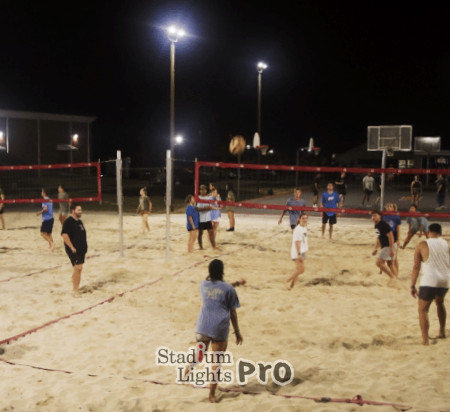 For casual outdoor sand court lights, the typical range sits around 100 to 200 lux, which translates to roughly 10 to 20 fc. This level offers enough brightness for players to track the volleyball during serves, digs, and rallies without feeling like stadium floodlights are blasting down on them.
Sand surfaces naturally scatter light because each grain reflects in different directions. That scattering effect is why a court that technically has “enough lux” on paper might still feel dim if the lighting isn’t evenly distributed. At around 150 lux, most people find the lighting comfortable enough for social matches, training sessions, and evening recreational games. It’s bright enough to avoid heavy shadows but still keeps that relaxed beach vibe.
Adding LED floodlights with a beam angle designed for wide coverage—typically around 60° to 120°—helps the brightness spread out, making the court feel more balanced. If the poles are set at around 6 to 8 meters high, hitting that 100 to 200 lux zone becomes much easier and more consistent.
Local League or High School Sand Volleyball
When sand courts host more organized games, especially for youth leagues or high school teams, the lighting often increases to 200 to 300 lux, or roughly 20 to 30 fc. This bump in brightness helps a lot when players start performing sharper movements like quick transition digs, roll shots, and high-arc serves that travel right through the upper lighting zone.
Once you get past about 250 lux, shadows on the sand become noticeably lighter and less distracting. This helps players judge ball height more accurately, especially during jump serves or when the ball gets pushed high by the wind. Coaches and referees also appreciate the clearer visibility, since calls involving boundary lines or touches become easier to make.
Facilities that rent courts for night leagues often aim closer to the 280 to 300 lux mark because it improves consistency from edge to edge. A lighting uniformity ratio around 0.5 or better usually pairs well with this lux level, making the whole court feel smoother to play on.
Competitive or Nighttime Sand Volleyball Tournaments
For competitive levels—especially events with spectators, cameras, or nighttime brackets—the lighting usually jumps to around 300 to 500 lux, or roughly 30 to 50 fc. At this point, the lighting needs to feel crisp, not just visible. Nighttime sand matches are faster and more intense than people realize, and players rely heavily on their ability to track the ball against darker backgrounds.
At 400 to 500 lux, the court becomes much more “readable.” You can see the ball’s spin more clearly, and sets or digs that normally blur in dim light become much easier to follow. This range also helps cameras capture cleaner footage because the light bounce from the sand gives off a more even appearance on video.
Tournament organizers often raise pole heights to around 8 to 10 meters and use LED fixtures with asymmetric beam distributions that push light across the court rather than straight down. This helps reduce glare for players while still hitting the required luminance.
A lot of official beach tournaments use lighting specs inspired by international standards, which commonly land around 350 to 500 lux for competitive night matches. That extra brightness helps minimize dark patches and keeps long rallies visible from every angle.
Why Higher Lux Matters More on Sand
Sand courts absorb and scatter light differently than indoor floors, which means the ball can “disappear” for a split second if the lux level is too low. With sand reflecting light at unpredictable angles, even a difference of 50 lux can noticeably change how the court feels during gameplay.
That’s why tournament setups usually push toward the higher end—closer to 400 or even 500 lux—because it gives the ball a clearer outline in mid-air, especially during high sets or cross-court hits. The sand itself becomes more uniform-looking, which helps players judge distance when sprinting or diving.
Boosting brightness also improves overall player safety. While volleyball isn’t a contact-heavy sport, sand dives, digs, and collisions can happen quickly, and better lighting helps players anticipate movement before they commit to a jump or slide.
Conventional Indoor Volleyball Courts
Recreational Indoor Courts
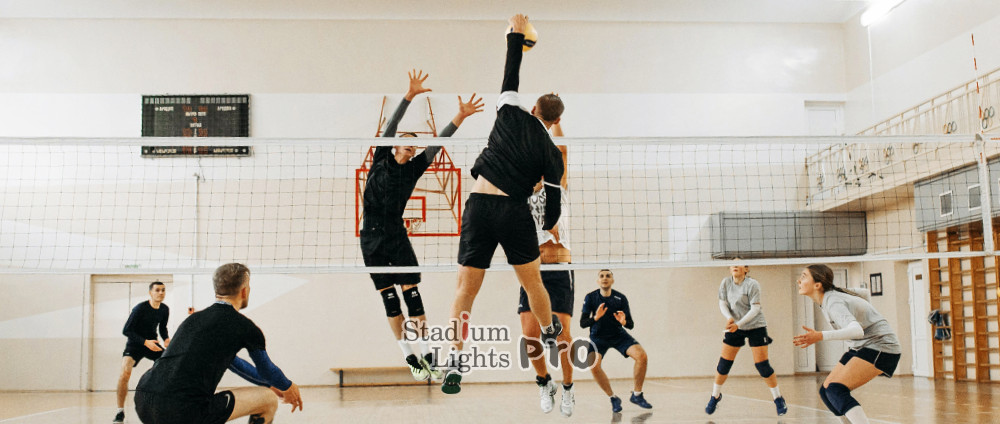
Casual indoor volleyball usually works well with lighting levels in the range of 300 to 500 lux, or about 30 to 50 fc. This range feels comfortable for families, pickup groups, and school clubs who just want a smooth, enjoyable game without squinting or losing the ball in dark patches. What matters most at this level is how evenly the light spreads across the hardwood floor.
Indoor gyms can build up shadows much more easily than outdoor courts because walls, bleachers, and ceilings reflect and block light in odd ways. If one side of the gym hits 450 lux but the corners dip to 250, players definitely notice. An even lighting layout—usually achieved by spacing LED high-bay fixtures around 6 to 9 meters above the court—makes rallies feel smoother and reduces the awkward moments when the ball suddenly slips into a dim area.
A well-designed recreational setup often uses LEDs with high color rendering (CRI 80+ or better), which makes the ball and boundary lines look clearer. Even though 300 to 500 lux isn’t super bright by arena standards, it still gives enough clarity for players to react naturally without feeling overwhelmed by glare.
High School Indoor Volleyball
High school gyms often push the lighting a bit higher, into the 500 to 750 lux zone or roughly 50 to 70 fc. At this stage, games get faster, hits get stronger, and players rely heavily on being able to see the ball’s spin, angle, and height instantly.
Because high school facilities typically host multiple sports—basketball, badminton, school assemblies, and volleyball—the lighting has to stay consistent from wall to wall. A uniformity ratio of around 0.6 or better is common for this level. It reduces dark patches near the baselines and makes it easier for players to judge depth when running for a tip or reacting to a block.
Spectators also benefit from this brightness range. With bleachers that sometimes sit farther from the court, especially in larger gyms, those extra 200 lux help people follow the action without feeling like the ball vanishes every time it gets close to the ceiling.
College and Semi-Professional Volleyball
College-level and semi-pro volleyball jump to the 750 to 1000 lux range, which equals around 70 to 100 fc. At this level, the game pace changes dramatically—sets are quicker, spikes are sharper, and rallies often last longer. Stronger lighting helps athletes read the ball’s path more accurately and react a fraction of a second faster.
A lot of colleges also record practices for coaching analysis or broadcast games for streaming. Higher lux levels make those videos look cleaner, especially when capturing fast movements or slow-motion replays. LED fixtures with a higher CRI (often 90+) and flicker-free technology become pretty common here because they ensure that cameras pick up crisp, smooth footage without weird banding or flashing.
Some NCAA facilities also fine-tune beam angles so light reaches the upper airspace of the court—basically the zone above the net up to around 7 or 8 meters high—because that’s where the ball spends so much time during long rallies or jump serves.
Professional or Televised Indoor Volleyball
Once you reach professional leagues or televised tournaments, the lighting ramps up noticeably. Most setups aim for 1000 to 1500 lux, or 100 to 150 fc, though certain international events push the brightness to 1500 to 2000 lux when ultra-clear slow-motion captures are involved.
At this level, the lighting isn’t just for players—it’s for multiple camera angles, HD and 4K broadcasting, instant replays, and thousands of spectators. Higher lux keeps the court looking sharp from every angle, whether you’re courtside or watching from the upper tiers of the arena.
Teams, broadcasters, and venue managers want consistent colors, too. Stronger lighting makes uniforms pop, court lines stand out, and the ball stay visible even during rapid swings and tight rallies. Many pro installations use advanced LED floodlights with glare-control lenses, precise optical shaping, and color temperatures around 5000K to mimic daylight clarity without feeling harsh.
Televised matches typically get checked with light meters before game time to confirm uniformity across all zones of the court, including the attack lines, backcourt, and serving areas. Even a drop of 100 lux in one corner can show up on camera more than you’d expect, so keeping everything balanced is key for a professional-level experience.
Why Different Levels Matter for Different Situations
Not every volleyball court needs stadium-level lighting, and honestly, most people would feel uncomfortable under pro-level brightness if they’re just playing a friendly match. Different environments and different skill levels naturally call for different lux and fc ranges, and once you look at how volleyball actually works in real time, the differences start to make a lot more sense.
Recreational games can stay in the lower lighting ranges because players aren’t reacting to 60–70 mph spikes or timing blocks down to milliseconds. But once you step into competitive or televised settings, the speed, the angles, and even the height of play start changing dramatically. Professional athletes jump higher, hit harder, and cover more court area—so the lighting has to keep up.
Another big factor is the environment itself. Sand courts absorb and scatter light because of the texture of the grains. Even if you hit 200 lux on paper, it doesn’t always feel like 200 lux on the actual sand since the light bounces off unevenly. Indoor courts, meanwhile, reflect light more efficiently, but that also means they can create harsher shadows or bright spots if fixtures aren’t carefully placed. A glossy hardwood floor can easily push light toward one side while leaving the opposite corner feeling slightly duller.
Higher levels of competition also rely on precision. A college match with long rallies demands a lighting setup that stays stable across the entire court, including the upper airspace where jump serves and high sets travel. That’s why a pickup match that’s fine at 350 lux might feel underwhelming for trained athletes who are used to reading the ball the moment it leaves the setter’s hands.
By the time you get to the pro level, everything needs to be readable—spin, speed, trajectory, even the moment the ball brushes a fingertip during a block. That level of clarity only happens with elevated lux and fc ratings that stay consistent no matter where the ball moves.
A Few Real-World Examples
To make things feel more grounded, imagine a typical high school team practicing under about 250 lux. The moment a serve goes high or a spike sends the ball flying toward a dim corner, the ball almost disappears for a heartbeat. Players hesitate, timing gets thrown off, and misreads happen more often. Once that same gym upgrades to around 600 lux, the difference is almost instant. The ball stays visible from every angle, and players react faster—sometimes close to a full second faster during quick plays.
Now picture a nighttime sand court running at around 80 lux. You can still play, but everything feels slightly delayed. The ball looks heavier in the air, blocks are harder to time, and players can misjudge height by a surprising margin. Pushing the lighting up to around 250 lux transforms the space. Suddenly the ball pops into view clearly, jump serves feel smoother to track, and the whole court feels more energetic.
These adjustments may seem small on paper, but even a 50–100 lux difference can change the rhythm of a game.
Some Thoughts on Choosing the Right Lighting
When it comes to selecting the right brightness level, the goal isn’t to blast the court with light. The real trick is finding a level that matches the purpose of the court and makes the space feel natural to play in. A lot of facilities overshoot the brightness at first, thinking more is automatically better. But in volleyball, too much brightness can wash out the ball, create glare, or make the court feel strangely harsh.
What actually matters more is how evenly the light is distributed. A dim court isn’t ideal, but a patchy court with bright spots and dark edges can be even more frustrating. Players end up constantly adjusting their eyes, which gets tiring fast. That’s why uniformity—the idea that the whole court stays close to the same brightness level—often matters more than raw lux numbers.
For indoor courts that plan to host mixed sports or occasional tournaments, aiming a little higher—around 800 to 1000 lux—can offer more flexibility without overwhelming casual players. Sand courts, on the other hand, need to think about factors like wind, uneven ground, and glare from surrounding areas. Mounting height matters too; a light mounted at 6 meters spreads differently than one mounted at 10 meters, and that alone can shift how shadows behave during gameplay.
Choosing the right lighting is really about understanding how people actually play and move on the court. With the right setup, the game feels smoother, quicker, and a whole lot more enjoyable for everyone involved.
Closing Reflections
Figuring out the right lux and foot-candle levels for a volleyball court isn’t complicated once you understand how lighting shapes the feel of the game. Whether you’re setting up a laid-back sand court or preparing a professional arena, the right brightness creates a smoother, more enjoyable experience for everyone involved.
A well-lit court brings out faster reactions, clearer movement, better recordings, and just a more comfortable game overall. With the numbers above, you can match the lighting to the level of play and create a court that feels inviting, energetic, and easy to enjoy—whether it’s a weekend pickup match or a full-scale championship.