Lighting inside a sports dome is one of those things people rarely think about until they have to pay for it. Then suddenly, questions start piling up. How much does sports dome lighting cost? Why does pricing vary so much? And what are you really paying for beyond just lights hanging from the ceiling?
Whether you’re planning a new air-supported dome or upgrading an aging facility, lighting plays a huge role in how the space feels, performs, and operates day to day. A well-lit dome supports player safety, improves visibility for spectators, and even affects how long the facility can stay open each day. The cost, however, depends on more than just the number of fixtures.
Below, we walk through what shapes the pricing, what you can realistically expect to spend, and how to make smarter decisions that pay off over time.
What Drives the Cost of Sports Dome Lighting?
Sports dome lighting costs can feel a bit all over the place, and there’s a good reason for that. No two domes are truly the same. A modest community training dome used a few evenings a week has very different lighting needs compared to a multi-sport complex running from early morning to late night, hosting leagues, tournaments, and even livestreamed events. Usage patterns, performance expectations, and operating hours all quietly shape the final number on the quote.
Dome Size and Ceiling Height
The overall size of the dome is usually the first thing that pushes costs up or down. A 50,000 square foot sports dome might only need 60 to 80 fixtures to achieve comfortable recreational lighting. Scale that up to a 120,000 square foot dome, and the fixture count can easily double. More square footage means more coverage, more wiring, and more installation time.
Ceiling height adds another layer. Many sports domes have mounting heights ranging from 40 to 90 feet. The higher the lights are mounted, the more powerful they need to be to reach the playing surface evenly. Higher lumen output requires stronger optics and tighter beam control, which increases fixture cost and demands more precise aiming during installation. Even a 10-foot difference in mounting height can change the lighting design and budget noticeably.
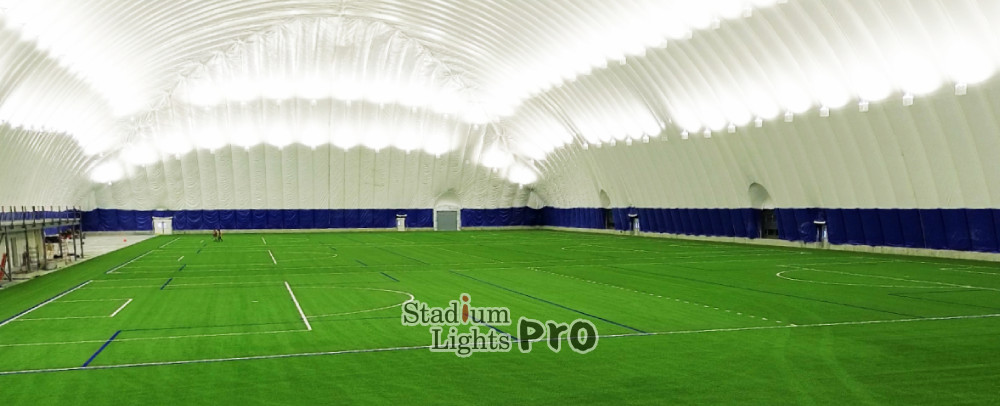
Sports Type and Performance Requirements
What happens inside the dome matters just as much as its size. Recreational soccer practices or casual tennis sessions usually perform well at 30 to 50 foot-candles, which keeps costs manageable. Competitive play, youth tournaments, and high-level training often push that requirement to 70, 80, or even 100 foot-candles for better visibility and player comfort.
Some facilities also host multiple sports under one roof, like soccer, baseball, lacrosse, and pickleball. Each sport has slightly different lighting expectations for uniformity and glare control. Designing a system that handles all of them often means more fixtures or higher-quality optics, which naturally affects the overall investment.
Lighting Technology and Fixture Quality
Lighting technology is one of the biggest cost influencers today. Traditional metal halide systems once dominated sports domes, but they’ve largely been replaced by LED sports lighting systems. While LEDs typically cost more upfront, the performance gap is hard to ignore.
A metal halide fixture might consume 1,500 watts, while a comparable LED fixture can deliver the same or better brightness at 600 to 800 watts. That’s a 50 to 60 percent reduction in energy use right away. Over a year of operation, especially in domes running 12 to 16 hours a day, that difference can translate into tens of thousands of dollars in energy savings.
Fixture quality also plays a role. Higher-end LED sports lights offer better glare control, tighter beam angles, and longer lifespans, often rated at 50,000 to 100,000 hours. Cheaper fixtures may reduce upfront costs but can increase maintenance, replacement, and downtime later on.
Controls, Uniformity, and Design Expectations
Beyond the fixtures themselves, lighting controls and design standards quietly shape the final cost. Dimming systems, zoning, and scheduling controls add to initial expenses, but they allow operators to run lights at lower levels during practice or partial field use. Facilities using smart controls often see 20 to 30 percent additional energy savings over time.
Uniformity requirements also matter. A dome designed for training might tolerate slight variations in brightness, while competition-ready spaces often aim for uniformity ratios of 1.5:1 or better. Achieving that level of consistency usually requires more fixtures, better optics, and careful photometric planning.
Installation Conditions and Dome Structure
Finally, the structure of the dome itself affects cost. Air-supported domes, fabric structures, and permanent domes all require different mounting approaches. Some installations need specialized rigging systems or lifts, especially when working around fabric membranes. These conditions increase labor time and call for experienced installers who understand sports dome environments.
When you add everything together, it becomes clear why sports dome lighting costs vary so widely. It’s not just about turning on the lights. It’s about matching space, sport, performance, and long-term operation in a way that actually works for the facility.
Average Cost Range for Sports Dome Lighting
When people ask how much sports dome lighting costs, they usually want a straight answer. The honest version is that there is a range, but it’s a pretty realistic one once you understand what’s behind it. For most sports domes today, total lighting project costs typically land between $150,000 and $500,000, with some larger or higher-performance facilities going beyond that.
| Dome Size / Type | Total Project Cost | Cost per Sq. Ft. |
|---|---|---|
| Small community / recreational dome | $150,000 – $220,000 | $2.50 – $3.50 |
| Mid-sized dome (leagues & rentals) | $250,000 – $350,000 | $3.50 – $4.50 |
| Large tournament / multi-sport dome | $400,000 – $500,000+ | $4.50 – $6.00 |
| Example: 75,000 sq. ft., mid-level LED | $225,000 – $300,000 | — |
| Example: 120,000 sq. ft., tournament LED | $400,000+ | — |
Typical Total Project Cost
At the lower end of the range, smaller community domes used mainly for training or recreational play tend to sit closer to $150,000 to $220,000. These spaces usually operate fewer hours per day and don’t need competition-level brightness across the entire field.
Mid-sized domes that host leagues, clubs, and regular rentals often fall into the $250,000 to $350,000 range. These facilities usually aim for higher light levels, better uniformity, and longer daily operating hours, which pushes up fixture count and system quality.
Large sports domes designed for tournaments, showcases, or multi-sport scheduling can reach $400,000 to $500,000 or more. These projects often prioritize visibility, glare control, and flexibility, especially if spectators or cameras are involved.
Cost Per Square Foot as a Reference Point
Looking at pricing on a per-square-foot basis helps put things into perspective. Most sports dome lighting systems fall between $2.50 and $6.00 per square foot. This number includes the lighting fixtures themselves, standard wiring, mounting hardware, and installation labor.
Smaller domes with lower light levels might stay closer to $2.50 to $3.50 per square foot. Larger domes or facilities aiming for brighter, more uniform lighting often land between $4.50 and $6.00 per square foot. Once you cross into higher-performance lighting with tighter uniformity targets, costs tend to rise more quickly.
Real-World Cost Examples
To make the numbers feel more concrete, consider a 75,000 square foot sports dome with mid-level LED lighting designed for club training and weekend matches. A typical setup might cost around $225,000 to $300,000, depending on fixture quality and control options.
Step up to a 120,000 square foot dome built for tournaments and extended daily use, and the total cost can easily exceed $400,000. These larger spaces often need more fixtures, higher lumen output, and more detailed aiming to keep light levels consistent across multiple fields.
What’s Usually Included in These Numbers
Most cost estimates at this level cover LED lighting fixtures, basic lighting controls, electrical wiring, and installation labor. That said, they don’t always include advanced control systems, custom photometric engineering, or specialty mounting solutions. Those elements can add another 10 to 20 percent to the project cost, depending on complexity.
A Closer Look at Sports Dome Lighting Cost Breakdown
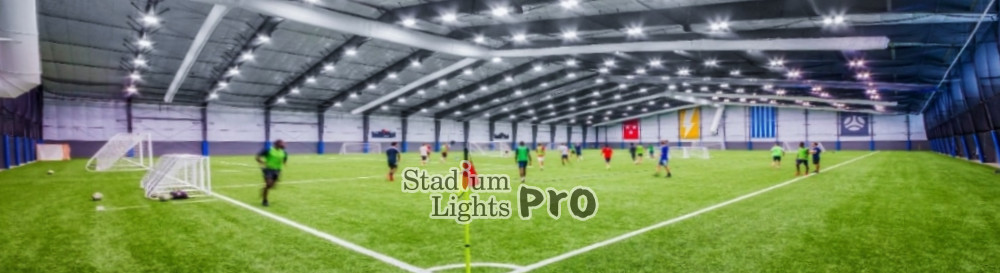
When you start peeling back the layers of a sports dome lighting budget, it becomes much easier to see why costs don’t always line up neatly from one project to another. The total number isn’t just about buying lights. It’s the result of several moving parts working together, each with its own impact on performance and long-term operation.
Lighting Fixtures and System Hardware
Lighting fixtures usually take the biggest slice of the budget, often accounting for 40 to 55 percent of the total project cost. High-quality LED sports dome lights typically range from $800 to over $2,500 per fixture, depending on lumen output, beam distribution, glare control, and build quality.
Higher-output fixtures designed for mounting heights of 60 feet or more cost more, but they often reduce the total number of fixtures needed. Durability also matters in domes that operate year-round. Fixtures rated for long lifespans and stable light output tend to hold performance better over time, which helps avoid early replacements.
Electrical Infrastructure and Power Distribution
Electrical work is another major part of the cost, usually representing 15 to 25 percent of the overall budget. This includes wiring, electrical panels, breakers, and power distribution systems sized to handle the lighting load.
Sports domes often require longer cable runs due to their size, and air-supported or fabric structures add extra complexity. Mounting systems must be carefully designed so they don’t interfere with the dome membrane, which increases planning and installation time. These behind-the-scenes elements don’t get much attention, but they’re what keep the system running safely and reliably.
Installation, Labor, and On-Site Work
Installation and labor costs typically make up 20 to 30 percent of the total project cost. Installing lights in a sports dome is very different from a standard indoor space. Crews often work at heights of 40 to 90 feet, sometimes using specialized lifts or rigging systems.
Aiming and commissioning also take time. Sports lighting needs precise alignment to achieve good uniformity and minimize glare. Even small adjustments can affect how the field looks during play, so experienced installers are a big part of the equation.
Lighting Design and Performance Planning
Design services usually represent a smaller portion of the budget, but their impact is felt every time the lights are turned on. Photometric layouts, lighting calculations, and compliance checks help ensure the dome meets target light levels and uniformity standards.
A well-designed plan can reduce wasted light, avoid over-lighting, and sometimes even lower fixture counts. In the long run, good design often saves money by improving efficiency and preventing costly adjustments after installation.
Installation and Maintenance Costs Over Time
When people think about lighting costs, they often focus on the upfront install and stop there. In reality, installation and maintenance expenses stretch across the entire lifespan of the system, and for sports domes, those long-term costs can quietly add up if they’re not planned for early.
Installation Challenges Unique to Sports Domes
Installing lights in a sports dome isn’t like swapping fixtures in a gym. Many domes require specialized lifts, scaffolding, or rigging systems, especially when mounting heights reach 60, 70, or even 90 feet. Just getting crews and equipment into position takes time, which naturally increases labor costs.
Air-supported and fabric domes add another layer of complexity. Installers need to work carefully around the membrane and anchoring systems, and mounting hardware often has to be customized. These details don’t always show up clearly on a quote, but they can influence both installation schedules and costs more than people expect.
Ongoing Maintenance and Service Requirements
Maintenance costs depend heavily on the type of lighting system installed. Older metal halide systems typically require lamp replacements every 6,000 to 10,000 hours. In a busy dome operating 12 to 16 hours a day, that can mean changing lamps every year or two. Each replacement involves lifts, labor, and downtime, which adds up fast.
It’s not unusual for facilities using metal halide lighting to spend $8,000 to $15,000 per year just on maintenance and service visits. Beyond the direct cost, there’s also the inconvenience of scheduling work around booked field time.
LED Lifespan and Long-Term Savings
LED sports dome lighting systems shift that equation in a big way. Most high-quality LED fixtures are rated for 50,000 to 100,000 hours, which often translates to 10 to 15 years of operation before light output drops to a point where replacement makes sense.
That doesn’t mean zero maintenance, but it does mean far fewer service calls. Over a decade, many facilities save tens of thousands of dollars simply by avoiding frequent lamp changes and lift rentals. For domes running long hours every day, reduced maintenance quickly becomes one of the most noticeable benefits of upgrading.
Energy Use and Ongoing Operating Expenses
Beyond installation and maintenance, energy use plays a major role in the total cost of owning a sports dome lighting system. For year-round facilities, electricity bills can rival staffing or HVAC costs if the lighting isn’t efficient.
| Factor | Metal Halide | LED Systems |
|---|---|---|
| Energy Consumption | 1.5–2 W per sq. ft. | 0.6–1 W per sq. ft. |
| Annual Electricity (100,000 sq. ft. dome) | ~$55,000 | ~$28,000 |
| 10-Year Energy Savings | — | $200,000–$400,000 |
| Lighting Controls Impact | Minimal | 20–30% additional energy savings with dimming/zoning/scheduling |
Comparing Energy Consumption
Traditional metal halide systems typically consume between 1.5 and 2 watts per square foot. LED sports lighting systems often bring that down to 0.6 to 1 watt per square foot while still delivering equal or better brightness.
For a 100,000 square foot dome, that difference can translate into $20,000 to $40,000 in annual electricity savings, depending on local utility rates and how many hours the lights run each day. Over 10 years, that alone can offset a large portion of the initial upgrade cost.
The Role of Lighting Controls
Lighting controls add another layer of efficiency. Being able to dim lights during practice sessions, shut off unused zones, or schedule automatic on and off times helps avoid wasting energy when full brightness isn’t needed.
Facilities that actively use controls often see 20 to 30 percent additional energy savings on top of the efficiency gains from LEDs. Over time, those savings usually exceed the cost of the control system itself, especially in domes that operate from early morning until late at night.
Practical Ways to Manage Sports Dome Lighting Costs
Managing sports dome lighting costs doesn’t mean settling for dim fields or cutting quality. It’s really about making smart choices that match how the dome is actually used day to day. When lighting decisions are tied to real operating needs, budgets tend to stretch further without sacrificing performance.
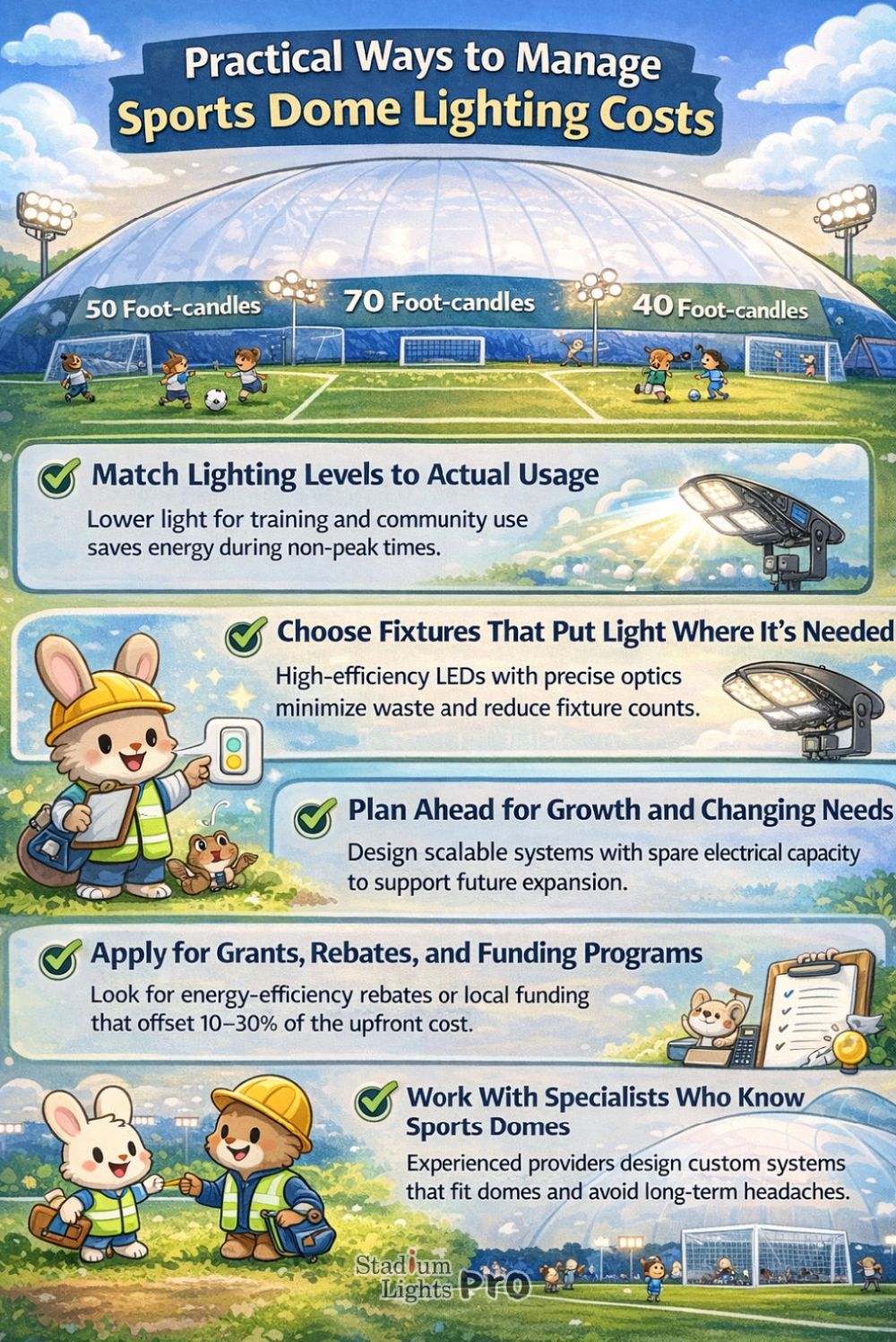
Match Lighting Levels to Actual Usage
One of the easiest ways to control costs is by designing light levels around how the space is used most of the time. Not every hour inside a sports dome needs tournament-level brightness. Training sessions, youth practices, and casual rentals often perform perfectly well at lower light levels.
By separating lighting zones and using adjustable output, facilities can avoid running 70 or 80 foot-candles when 40 to 50 foot-candles would do the job. Over a year, that difference can translate into noticeable energy savings, especially for domes operating 12 or more hours per day.
Choose Fixtures That Put Light Where It’s Needed
Fixture selection has a bigger impact on cost than many people realize. High-quality LED sports lights with precise optics and controlled beam angles reduce wasted light and improve uniformity across the field. When light is directed exactly where it’s needed, fewer fixtures are often required to reach target levels.
Better uniformity also means fewer dark spots and less glare, which improves player comfort without driving up energy use. While these fixtures may cost more upfront, they often reduce the total system size and operating costs over time.
Plan Ahead for Growth and Changing Needs
Future-proofing the lighting system can save money later. Sports domes often expand their programming, add new courts, or extend operating hours as demand grows. A system designed with scalable controls and spare electrical capacity makes these changes easier and less expensive.
Instead of replacing fixtures or rewiring the entire dome, operators can add zones, adjust schedules, or upgrade controls without major disruptions. That flexibility helps avoid large, unexpected expenses down the road.
Apply for Grants, Rebates, and Funding Programs
One cost-saving option that often gets overlooked is grants and funding support. Many sports facilities qualify for energy-efficiency grants, utility rebates, or local government funding when upgrading to LED lighting. Depending on the region, these programs can cover 10 to 30 percent of project costs, sometimes even more.
Community sports domes, school-affiliated facilities, and non-profit organizations are often strong candidates for this kind of support. Some programs also offer low-interest financing tied to energy savings, which helps spread out the upfront cost. Working with a lighting provider familiar with these programs can make the application process much smoother.
Work With Specialists Who Know Sports Domes
Lighting specialists who understand sports domes specifically can help avoid costly mistakes. Domes have unique structural, optical, and operational challenges, and experience matters when designing systems that perform well long term.
A knowledgeable partner can optimize fixture placement, recommend the right control strategies, and anticipate issues before installation begins. That kind of planning often prevents redesigns, delays, and performance complaints after the lights are turned on.
When all these strategies come together, managing sports dome lighting costs becomes less about trimming budgets and more about making thoughtful decisions. The result is a lighting system that fits the facility, performs consistently, and keeps operating costs under control year after year.
A Sample Sports Dome Lighting Cost Scenario
To make the numbers feel more real, let’s walk through a typical sports dome lighting scenario and see how the costs and savings play out over time.
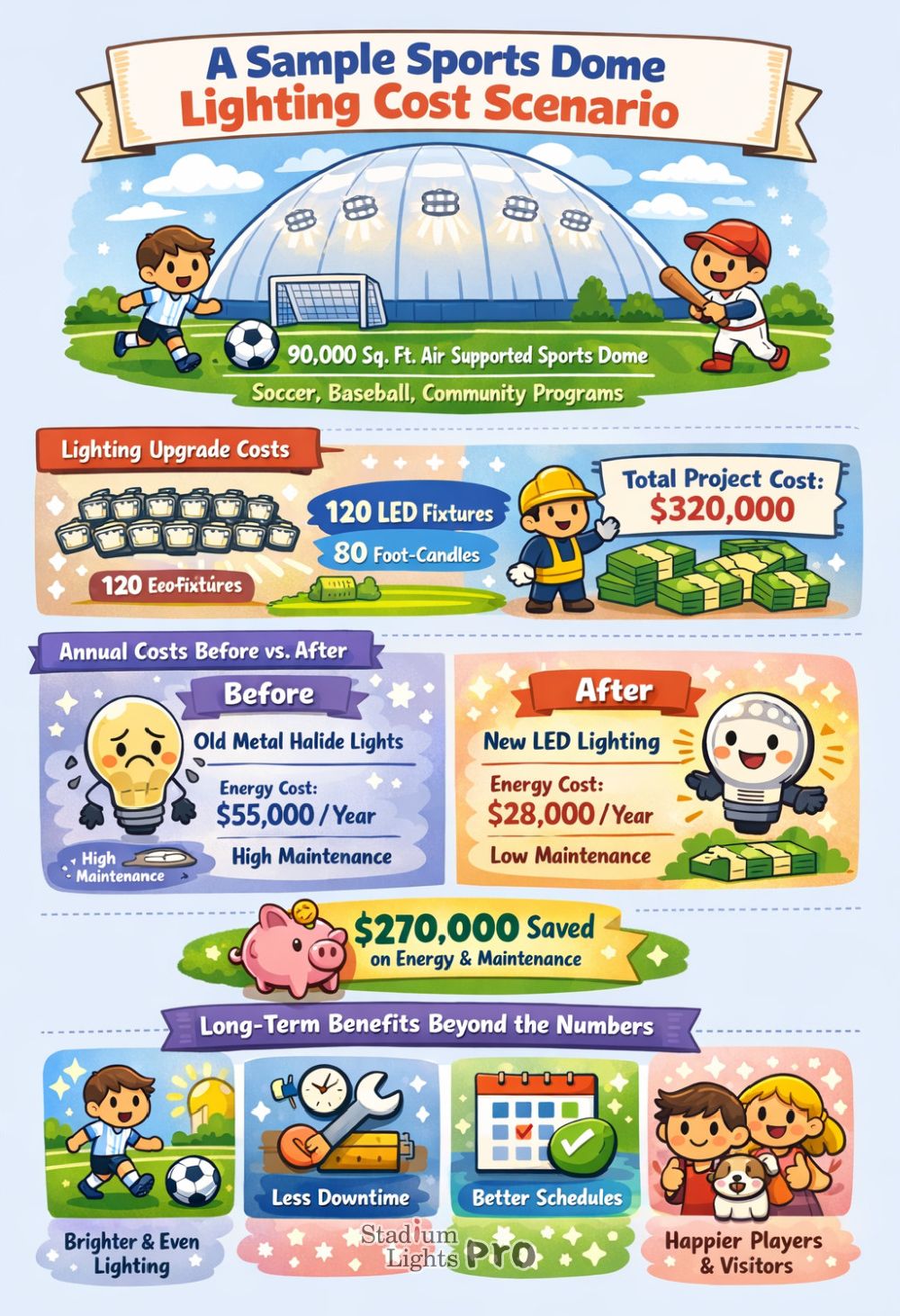
Imagine a 90,000 square foot air-supported sports dome used mainly for soccer, baseball training, and a mix of community programs. The dome runs almost every day of the week, opening early for morning training sessions and staying active until late evening. On average, the lights are on about 14 hours per day, six days a week, which adds up quickly over a full year.
Lighting Design and System Scope
The facility wants lighting that works for both training and competitive play, so the design targets around 80 foot-candles across the main playing areas, with good uniformity and low glare. Based on the dome’s size and mounting height, the lighting plan calls for roughly 120 LED sports lighting fixtures.
Each fixture is chosen for high output, precise beam control, and long lifespan. The average installed cost comes in at about $2,200 per fixture, which includes the light itself, mounting hardware, wiring, and labor. That puts the lighting portion of the project at approximately $264,000.
Additional Project Costs
Beyond the fixtures, the project includes electrical upgrades, power distribution, and a basic lighting control system that allows zoning and scheduling. Installation crews work at heights of over 60 feet, using specialized lifts designed for dome environments. When everything is added together, the total project cost reaches around $320,000.
This number reflects a system designed to perform well under heavy daily use while leaving room for future adjustments, such as dimming during practice sessions or extending operating hours for special events.
Energy and Maintenance Impact Over Time
Before the upgrade, the dome relied on older metal halide lighting. Annual energy costs averaged around $55,000, driven by high wattage fixtures and long operating hours. Maintenance was also a regular expense, with lamp replacements and service visits scheduled every year.
After switching to LED lighting, annual energy costs drop to about $28,000, cutting the electricity bill nearly in half. Maintenance needs fall sharply as well, with no frequent lamp replacements and fewer service calls. Over the course of 10 years, the combined savings from reduced energy use and lower maintenance exceed $270,000.
Long-Term Value Beyond the Numbers
Beyond the direct savings, the facility benefits from more consistent light levels, faster start-up times, and better visibility across all fields. Staff spend less time dealing with outages, and scheduling becomes easier because lighting can be adjusted to match different activities throughout the day.
In a scenario like this, the lighting system doesn’t just pay for itself over time. It also supports higher-quality programs, longer operating hours, and a better experience for players and visitors alike, which adds value well beyond the balance sheet.
Frequently Asked Questions About Sports Dome Lighting Costs
Does brighter lighting always mean higher costs?
Not always, and this is one of the biggest misconceptions around sports dome lighting. Brighter lighting does require higher lumen output, but higher brightness no longer equals higher energy bills the way it once did. Modern LED sports lighting systems are dramatically more efficient than older technologies, which changes the cost equation in a big way.
To put it into perspective, an older metal halide system delivering around 50 foot-candles might consume 1,500 watts per fixture. A modern LED system can comfortably deliver 80 foot-candles while using 600 to 800 watts, sometimes even less depending on the optics and layout. That means you can increase visibility on the field while still lowering overall energy consumption.
Design plays a huge role here. When fixtures are properly spaced, aimed, and matched to the dome’s mounting height, light goes where it’s needed instead of spilling into unused areas. Better optics also reduce glare, which improves player comfort without needing to crank up brightness. In many cases, facilities discover they can run higher-quality lighting at a similar or even lower operating cost than their previous setup.
Can lighting costs be phased over time?
Yes, and for many facilities, phasing is a practical and realistic way to move forward. Sports domes working with tight budgets often choose to spread lighting investments over multiple stages rather than doing everything at once.
One common approach is installing the full fixture layout upfront but activating only certain zones initially. Another option is starting with moderate light levels for training and recreational use, then increasing output later as the dome begins hosting more competitive events. Because LED systems are highly flexible, output adjustments can often be made through controls rather than physical fixture changes. Phased lighting plans work best when the electrical infrastructure and control systems are designed with growth in mind from the start. Planning for future expansion avoids costly rewiring or equipment replacement later on. This approach gives operators breathing room financially while still keeping the long-term vision intact.
Do utility rebates really make a difference?
In many cases, yes, and the impact can be larger than expected. Utility rebates and energy-efficiency incentives are designed to encourage upgrades to LED lighting, especially in large facilities like sports domes. Depending on the region and program, rebates can cover 10 to 30 percent of the total project cost, and sometimes even more for high-efficiency systems.
For a lighting project costing $300,000, that could mean $30,000 to $90,000 back in rebates, which makes a noticeable dent in the upfront investment. These programs usually base incentives on verified energy savings, so systems that significantly reduce wattage per square foot tend to qualify for higher amounts. While the application process can feel time-consuming, experienced lighting providers often help gather the necessary documentation and coordinate with utility companies. When handled properly, rebates shorten payback periods and make higher-quality lighting systems much easier to justify financially.
Is custom lighting design worth paying for?
For sports domes, custom lighting design is usually a smart investment once you look beyond the upfront cost and focus on how the system performs every single day. Generic, off-the-shelf layouts often create uneven lighting, where some areas feel overly bright while others still look dim. To fix those gaps, extra fixtures are often added later, which quietly drives up both installation and long-term energy costs.
A custom lighting design considers dome size, mounting height, field configuration, and real usage patterns from the start. The focus isn’t just on brightness, but on uniformity, glare control, and comfort. When light is evenly distributed across the playing surface, players track the ball more easily, depth perception improves, and overall fatigue is reduced. In many projects, a well-optimized design actually lowers the total number of fixtures needed, helping balance out the design effort itself.
Over time, the advantages become clear through lower energy bills, fewer complaints from players and coaches, and far less need for adjustments after installation. Facilities that invest in proper planning upfront tend to avoid the frustration of lighting that almost works but never quite feels right.
To make this process easier, we offer free sports dome lighting design as part of our consultation. Our team creates detailed lighting layouts and performance simulations so you can see exactly how the system will perform before making any commitment, helping you move forward with clarity and confidence.
How long does installation usually take?
Most sports dome lighting installations take between 2 and 6 weeks, but the timeline can shift depending on several factors. Dome size and mounting height are obvious ones, but weather conditions, access to equipment, and scheduling around existing bookings also matter.
Retrofit projects often move faster because the structure, power supply, and mounting points are already in place. New builds typically take longer, especially if lighting installation needs to coordinate with other trades. Air-supported and fabric domes require extra care during installation, which can slow things down slightly to ensure the membrane and anchoring systems aren’t disturbed.
Facilities that plan installation during off-peak seasons or scheduled downtime usually experience smoother timelines and fewer disruptions to daily operations.
Will LED lighting affect the dome’s fabric or structure?
When designed and installed properly, LED lighting is actually easier on sports dome structures than older lighting technologies. LEDs generate significantly less radiant heat than metal halide fixtures, which reduces stress on fabric membranes and surrounding materials.
Proper mounting methods, adequate spacing, and thoughtful airflow design help ensure the lights don’t interfere with the dome’s structure or air pressure system. Experienced installers understand how to work within these constraints and select fixtures that are suitable for air-supported and fabric environments.
This is one area where experience really shows its value. Dome-specific knowledge helps prevent long-term issues and ensures the lighting system supports the structure rather than working against it.
Where Cost Meets Long-Term Value
Sports dome lighting isn’t just a line item on a budget. It shapes how players experience the space, how often the dome can be used, and how much it costs to operate year after year. While upfront costs can feel high, long-term energy savings, reduced maintenance, and improved performance often change the financial picture over time.
If you’re exploring options or trying to make sense of pricing for your specific dome, our team is happy to help. We work with facility owners, designers, and operators to create lighting solutions that fit real-world needs and real budgets. Reach out anytime for a tailored consultation and a clearer path forward.