When the sun goes down, soccer does not have to stop. Across schools, community parks, and semi-professional venues, solar-powered soccer field lights are quietly changing how fields stay usable after dark. Instead of relying on the grid, trenching cables, or dealing with rising electricity bills, many operators are turning to solar lighting as a more flexible and future-friendly option. It is not just about sustainability buzzwords. It is about predictable costs, simpler installation, and lighting that actually works for real training sessions and competitive matches.
Solar field lighting has matured a lot over the past decade. LED efficiency has jumped, battery technology has stabilized, and lighting design has become far more precise. What used to feel experimental is now a practical choice for many types of soccer fields.
How Solar Soccer Field Lighting Works
Solar soccer field lighting runs on a pretty natural rhythm. It works with the sun instead of fighting against it. During the day, the system quietly collects solar energy, then later releases it as bright, usable lighting once the field comes alive at night. There is no grid dependency, no digging up trenches, and no guessing when the lights should turn on.
From Sunlight to Stored Solar Energy
During daylight hours, solar photovoltaic panels absorb sunlight and convert it into direct current electricity. Most modern systems use monocrystalline or high-efficiency polycrystalline panels, typically rated between 400W and 600W per panel. On a clear day, a field lighting system might collect 4 to 6 peak sun hours, which translates into enough energy to support evening training or matches.
The electricity generated by the solar panels flows through a solar charge controller. This component manages voltage and current, making sure the batteries charge efficiently without being stressed. Advanced controllers also adjust charging behavior based on temperature and sunlight intensity, which helps extend battery lifespan. It is one of those behind-the-scenes parts that makes solar lighting feel reliable rather than experimental.
Battery Storage and Nighttime Power Release
Once the sun starts to dip, the system shifts gears. The stored solar energy sits in deep-cycle batteries, waiting for dusk. Most modern solar soccer field lights rely on lithium iron phosphate batteries, often ranging from 5kWh to 20kWh per pole depending on lighting demands. These batteries are designed to handle daily charging and discharging without losing capacity too quickly.
When ambient light levels fall below a preset threshold, a built-in light sensor or astronomical timer sends a signal to the controller. The LED fixtures then switch on automatically. No manual switches, no staff staying late to manage lighting schedules. Some systems also allow remote control through wireless monitoring platforms, so operators can dim lights after 9 or 10 pm, or shut them off completely once the last session ends.
In practical terms, a properly sized solar lighting system can deliver 6 to 10 hours of consistent illumination per night, even after one or two cloudy days. That buffer is especially helpful during tournament weeks or winter seasons when sunlight hours are shorter.
LED Technology Made for Solar Applications
LED fixtures are where everything comes together. Compared to old-school metal halide or high-pressure sodium lamps, LEDs use up to 60 to 70 percent less energy for the same brightness. A typical solar LED floodlight used for soccer fields might consume 200 to 400 watts while producing 30,000 to 60,000 lumens.
That efficiency matters because solar systems are designed around energy balance. Less power draw means smaller battery banks, fewer solar panels, and lower long-term stress on the system. LEDs also deliver instant brightness with no warm-up time, which is ideal for training sessions that start right after sunset.
Another bonus is durability. Most solar LED fixtures are rated IP65 or higher, meaning they can handle rain, dust, and temperature swings without drama. With lifespans often exceeding 50,000 hours, many fixtures can run for more than a decade before needing replacement.
Automation and Smart Solar Controls
One reason solar soccer field lighting feels so user-friendly is automation. Solar lighting systems are designed to run themselves, adjusting to daily light cycles without constant oversight. Photocells, timers, and programmable controllers work together to ensure lights turn on only when needed.
Some setups include smart features like motion sensors or preset lighting modes. For example, the system might run at full brightness during matches, then drop to 50 percent output during casual training to save energy. These small adjustments can extend battery life and improve overall system performance without affecting player experience.
Behind all of this is a simple goal: dependable lighting powered entirely by the sun. When the system is designed correctly, solar energy collection, battery storage, and LED lighting work together smoothly, night after night, season after season.
System Components and Configuration
A solar soccer field lighting system works best when every part is designed to work together, not just on paper but out on the field where weather, usage, and time all come into play. From solar panels down to the fixtures themselves, each component affects how reliable the lighting feels on a random Tuesday night practice or during a packed weekend match.
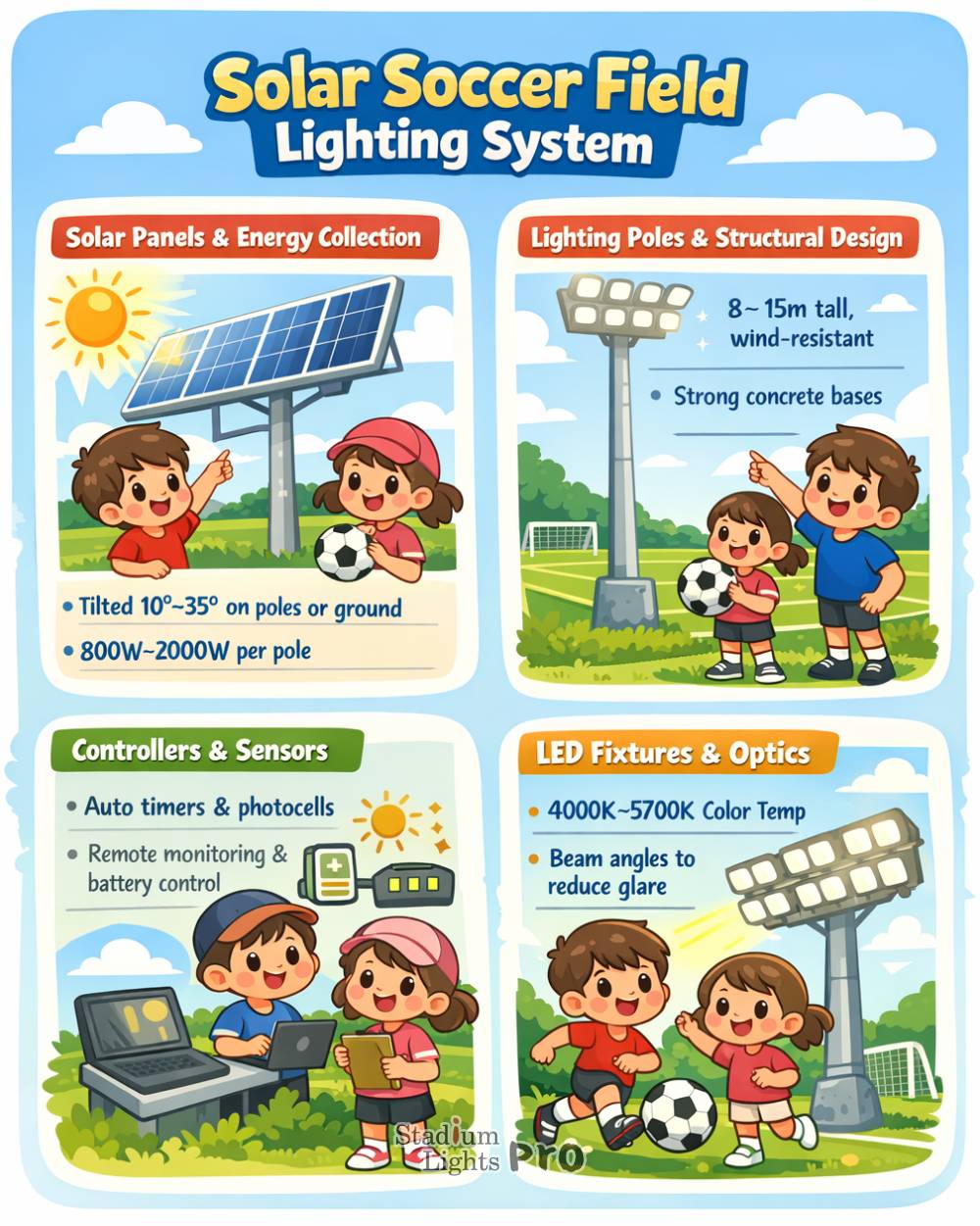
| Component | Function / Role | Key Specs / Details |
|---|---|---|
| Solar Panels | Convert sunlight to electricity | Pole or ground-mounted; tilt 10–35°; 800–2,000W; durable 20–25 year lifespan |
| Lighting Poles | Support panels & fixtures | 8–15m height; wind-rated; concrete foundations |
| Controllers & Sensors | Manage energy and automation | Timers, photocells, battery protection; optional remote monitoring |
| LED Fixtures | Provide field lighting | 4000K–5700K; beam angles matched to field; reduce glare and spill |
Solar Panels and Energy Collection Setup
It all starts with the solar panels. In most projects, solar photovoltaic panels are mounted either on top of the lighting poles or on nearby ground-mounted structures. The mounting angle is not random. It is calculated based on the site’s latitude and local sun path, usually tilted somewhere between 10 and 35 degrees. This helps capture usable solar energy throughout the year instead of only performing well in peak summer months.
Panel capacity varies depending on field usage. A single pole might carry 800W to 2,000W of solar panels, depending on how many hours the lights are expected to run each night. In regions averaging around 4.5 peak sun hours per day, this setup can comfortably support evening training schedules while still recharging the batteries before the next night. Panels are also chosen for durability, with tempered glass and corrosion-resistant frames designed to sit outdoors for 20 to 25 years.
Lighting Poles and Structural Design
The poles are more than just tall metal posts. They are structural elements designed to handle wind, weight, and long-term exposure. Soccer field lighting poles typically range from 8 meters for smaller training fields to 12 or even 15 meters for competition-level pitches. Taller poles allow light to spread more evenly across the field, which helps reduce harsh shadows and glare in players’ line of sight.
Wind load calculations are part of the design from day one. In open fields, gusts can easily exceed 100 kilometers per hour during storms. That is why poles are engineered with specific wall thicknesses and anchored into deep concrete foundations. A properly designed pole system can remain stable for decades with minimal maintenance, even in challenging weather conditions.
Controllers, Sensors, and Smart Solar Management
If solar panels and batteries are the muscles of the system, controllers and sensors are the brain. These components manage how energy flows through the system and decide when lights should turn on, dim, or shut off. Most systems use a combination of photocells and programmable timers to support dusk-to-dawn operation.
Advanced solar controllers also protect batteries by regulating charge and discharge cycles. This helps prevent overcharging during long sunny periods and deep discharging during heavy use. Many newer systems now include remote monitoring features. With a simple dashboard, operators can check battery voltage, solar energy production, and lighting status from a phone or laptop. That kind of visibility makes troubleshooting faster and reduces the need for on-site inspections.
LED Fixtures and Optical Configuration
LED fixtures are where lighting quality really shows. Solar-powered LED floodlights are selected based on beam angles, lumen output, and color temperature, not just raw brightness. For soccer fields, fixtures usually fall within the 4000K to 5700K range. This neutral-to-cool white light feels close to natural daylight, making it easier for players to judge distance and track the ball in motion.
Beam angles are carefully chosen to match pole height and field dimensions. Narrow beams work well for long throws from taller poles, while wider beams help fill in darker zones near the sidelines. A poorly matched fixture can create bright hotspots or spill light outside the field, which is not only distracting but can also trigger complaints from nearby residents.
When all these components are configured properly, the system feels seamless. The lights come on when they should, stay bright and even throughout play, and shut down automatically when the night winds down. That smooth experience is the result of thoughtful solar system design, not just powerful hardware.
Battery Technology and Energy Storage
Batteries tend to stay out of sight, but in a solar soccer field lighting system they do most of the heavy lifting once the sun goes down. Even with high-efficiency solar panels, reliable energy storage is what keeps the field bright at 8 or 9 pm, not the sunshine from earlier in the day. The way batteries have evolved over the years is one of the main reasons solar lighting feels much more dependable now than it did a decade ago.
From Traditional Batteries to Modern Solar Storage
Early solar field lighting systems leaned heavily on sealed lead-acid batteries. They were relatively affordable and easy to source, which made them popular at the time. The downside was size and sensitivity. Lead-acid batteries are bulky, have a limited depth of discharge, and do not love extreme temperatures. In very hot or cold environments, their capacity can drop quickly, sometimes by 20 percent or more.
That shift toward better performance led to lithium iron phosphate batteries, often referred to as LiFePO4. These batteries have become the go-to choice for modern solar soccer field lighting projects. They are lighter, more compact, and far more stable across temperature ranges. In practical terms, a LiFePO4 battery can deliver 2,000 to 4,000 full charge cycles, which usually translates to around 6 to 10 years of daily use before noticeable capacity loss. Some systems even push beyond that with smart charging and conservative depth-of-discharge settings.
Sizing Batteries for Real-World Field Use
Battery sizing is not guesswork. It is based on how the field is actually used. Engineers start by estimating nightly energy consumption. For example, a training field running LED lights at a total load of 3 to 4 kilowatt-hours per night might host sessions four or five evenings a week. If the system is designed with two nights of autonomy, the battery bank needs to store at least 8 kilowatt-hours of usable energy, not just nominal capacity.
Depth of discharge is part of that calculation. Lithium batteries often operate best when they are not drained completely. Designing for an 80 percent usable capacity helps extend battery life and keeps performance consistent. Seasonal sunlight variation also matters. In winter, when daylight hours are shorter, batteries may need to carry a heavier load for a few months each year. Good system design accounts for that without overworking the storage system.
Battery Protection and Temperature Management
Temperature has a quiet but real impact on battery performance. Excessive heat can shorten battery lifespan, while extreme cold can temporarily reduce available capacity. That is why battery placement and enclosure design matter more than many people realize. Most solar soccer field lighting systems house batteries inside sealed cabinets or pole-mounted enclosures that shield them from direct sun, rain, and freezing winds.
Some advanced systems include built-in battery management systems that monitor temperature, voltage, and current in real time. These systems adjust charging behavior automatically, reducing stress during heat waves or cold snaps. The result is more predictable performance year-round, whether the field is in a coastal climate or an inland region with wide seasonal swings.
When battery technology, sizing, and protection are done right, the lighting system simply works. Players see bright, steady light. Operators see fewer maintenance calls. And the field stays usable long after sunset, powered quietly by energy stored during the day.
Lighting Design for Training and Competition Fields
Lighting a soccer field is not about just blasting the area with light. Good lighting design is about balance, control, and consistency, especially when the system runs on solar energy. Players need to track the ball, referees need clear sightlines, and spectators shouldn’t be distracted by glare or harsh shadows. Getting all of that right starts with understanding light levels and how they translate to real-world play.
Understanding Lux, Foot-Candles, and Visual Comfort
Designers often measure brightness using lux or foot-candles. Lux measures lumens per square meter, while foot-candles measure lumens per square foot. The conversion is simple: 1 foot-candle equals about 10.76 lux. Both units describe the same thing; it’s just a matter of preference.
For training fields, light levels usually sit between 150 and 300 lux (about 15 to 30 foot-candles). This supports passing drills, conditioning, and small-sided games without wasting energy. Competition fields require more illumination—typically 300 to 500 lux (30 to 50 foot-candles) to meet official match requirements. Broadcast-level venues can demand even higher brightness, but for solar systems, designers focus on efficiency while still keeping visibility sharp.
Matching Light Levels to Field Use
Not every field needs the same output. A small community training field used a few nights a week has very different energy needs than a league stadium hosting nightly matches. Solar lighting systems often include dimming options, allowing full brightness during matches but lowering output by 20 to 30 percent for casual training. That flexibility saves battery energy while still keeping the field comfortably lit.
Beam Angle and Fixture Optics
Beam angle and fixture optics are key to uniform coverage. Narrow beams can project light farther but may create hot spots, while wider beams help fill areas near the poles and reduce shadows. Designers carefully select and aim fixtures to cover the field evenly. Pole height interacts with beam angle—taller poles allow wider spread with fewer fixtures, while shorter poles require careful aiming to avoid dark corners.
Uniformity, Glare Control, and Pole Layout
Uniformity is often more noticeable than raw brightness. A field with dark patches or bright spots can affect player performance and comfort. Most designs aim for a uniformity ratio where the minimum light level is 50 to 70 percent of the average, ensuring even illumination across the pitch.
Glare control also matters, especially in residential areas. Solar LED fixtures are designed with shielding and precision optics that direct light downward, keeping it out of players’ eyes and off neighboring properties. Pole spacing, height, and aiming all work together to maintain uniform coverage while minimizing unwanted spill light.
Wattage, Lumens, and Efficient Solar Lighting
Thanks to modern LED technology, solar-powered field lights deliver high brightness with relatively low energy draw. A single LED fixture might consume 150 to 400 watts but produce 30,000 to 60,000 lumens of usable light. On a standard field, four to eight fixtures per pole—correctly aimed—are often enough.
The focus isn’t on cranking up wattage but on directing light precisely where it’s needed. This approach ensures clear visibility, reduces wasted energy, and helps the solar system perform consistently night after night.
System Sizing and Engineering Considerations
Getting the size right is where solar soccer field lighting either shines or struggles. System sizing always starts with how the field is actually used, not how it looks on a plan. A training pitch that runs a few evenings a week places far less demand on a solar system than a competition field hosting matches almost every night. Engineers begin by mapping out usage patterns, lighting hours, and required brightness, then work backward to calculate energy needs.
Matching Energy Demand with Solar Supply
Daily energy demand is usually measured in kilowatt-hours. For example, a medium-sized training field might consume around 3 to 5 kWh per night, while a competition-level field can easily reach 8 to 12 kWh depending on lighting levels and duration. Once that number is clear, the solar array is sized to produce more energy than the field consumes on an average day.
Sunlight availability plays a big role here. A site receiving 5 peak sun hours per day can rely on a smaller solar array compared to a location averaging only 3.5 hours. Engineers also account for seasonal variation. In many regions, winter sun hours drop by 20 to 40 percent, so systems are designed to perform even during the shortest days of the year. The goal is to keep the batteries healthy without constantly draining them to their limits.
Structural Engineering and Wind Load Planning
Solar lighting poles may look simple, but structurally they carry a lot of responsibility. Wind load calculations directly affect pole diameter, wall thickness, and foundation depth. In wide-open fields, wind speeds during storms can exceed 120 kilometers per hour, sometimes higher in coastal or elevated areas.
To handle this, poles are engineered with safety margins that allow them to flex slightly without failing. Foundations are just as important. Depending on soil conditions and pole height, concrete foundations typically range from 1 to 2 meters deep. Sandy soil, clay, and rocky ground all behave differently under stress, so site-specific soil analysis helps prevent long-term stability issues.
Planning for Growth and Future Use
Many field owners think only about current needs, but future flexibility often saves money later. Oversizing the solar array or battery storage slightly at the beginning can allow for longer operating hours, additional training sessions, or higher lighting levels down the line. The cost difference upfront is usually far lower than retrofitting a system years later.
Well-engineered systems strike a balance. They meet today’s requirements without being wasteful, while still leaving room for growth. That balance between performance, cost, and adaptability is what separates a decent system from a truly reliable one.
Installation and Site Preparation
One of the reasons solar soccer field lighting is so attractive is how straightforward installation can be. Without the need to trench electrical cables or connect to the utility grid, disruption to the field is kept to a minimum. Most of the work happens around foundations, pole installation, and fixture setup.
Foundations, Poles, and On-Site Work
Before anything goes up, the site is evaluated. Soil testing helps determine how large and deep the foundations need to be. A typical installation involves pouring concrete foundations, allowing them to cure properly, and then erecting the poles using cranes or lift equipment. Once the poles are in place, solar panels, batteries, controllers, and LED fixtures are mounted and wired.
Because everything is self-contained, there is no need to coordinate with utility companies or wait for power connections. This can shorten project timelines significantly, especially for remote or rural fields.
Permits, Regulations, and Local Requirements
Permitting varies from place to place. Some municipalities treat solar lighting as standard field equipment, while others require structural or electrical permits, particularly for taller poles. Working with installers who understand local codes helps avoid delays and unexpected redesigns.
In some regions, solar installations are viewed favorably and move through approval faster than grid-tied projects. That is especially true when the system supports community sports, schools, or public facilities.
Aiming, Testing, and Commissioning
Once everything is installed, the final step is aiming and testing. Photometric plans guide fixture alignment, but small adjustments on-site can make a noticeable difference. Proper aiming improves uniformity and reduces light spill beyond the field boundaries.
After commissioning, systems are usually monitored over several nights. Battery performance, lighting schedules, and automation settings are checked to ensure everything behaves as expected. When done properly, the system fades into the background, quietly powering evening play with energy collected during the day.
Cost, Long-Term Value, and Return
At first glance, solar soccer field lighting can look more expensive than traditional grid-tied systems. The upfront number often raises eyebrows. But when you step back and look at the full lifecycle, the long-term value tells a very different story. Solar lighting removes several cost layers that usually stay hidden in conventional projects.
Upfront Investment Versus Ongoing Savings
A mid-sized solar lighting system for a standard soccer field typically falls between USD 80,000 and 150,000, depending on lighting levels, battery capacity, and pole height. That price includes solar panels, batteries, LED fixtures, poles, foundations, and controls. Grid-powered systems sometimes appear cheaper at the start, but that comparison often ignores utility infrastructure.
In many locations, trenching cables, installing transformers, and connecting to the grid can easily add USD 20,000 to 30,000 or more, especially for fields located away from existing power lines. On top of that come monthly electricity bills that never really go away. With solar lighting, once the system is installed, the energy cost drops to zero.
Maintenance, Lifetime Performance, and Reliability
Solar soccer field lighting is designed for low maintenance. There are no bulbs to replace every season and no ballasts to fail unexpectedly. LED fixtures commonly last between 50,000 and 100,000 hours, which can translate to 10 years or more of normal evening use. Most routine maintenance involves occasional cleaning of fixtures and solar panels to keep performance steady.
Batteries are usually the first major component that may need replacement. Depending on usage and battery type, that might happen after 6 to 10 years. Even with battery replacement factored in, solar systems often come out ahead over a 10 to 15 year ownership period compared to grid-powered lighting. The savings become even more noticeable as electricity rates rise over time.
Predictable Costs for Schools and Municipalities
For schools, parks departments, and municipalities, predictability matters. Solar lighting offers stable operating costs year after year, with no exposure to utility rate increases or demand charges. Budget planning becomes simpler because energy expenses are no longer a moving target.
This stability also makes it easier to justify extended field hours. Evening training sessions, youth leagues, and community programs can run without worrying about higher power bills. The field becomes a more flexible asset rather than a cost center that needs to be carefully rationed.
Return on Investment and Lifecycle Benefits
When you consider installation, maintenance, and energy savings over 10 to 15 years, solar lighting often delivers a strong ROI. Initial costs are offset by lower operational expenses, longer-lasting LEDs, and minimal maintenance. Add potential grants or incentives, and the financial case becomes even stronger, making solar lighting both a smart and sustainable choice for long-term field management.
Grants, Incentives, and Funding Opportunities
Solar soccer field lighting has grown in popularity not just because it’s efficient and low-maintenance, but also because funding support makes it more accessible. Many schools, municipalities, and community organizations can reduce upfront costs through grants, rebates, and incentive programs tied to renewable energy, sustainability, and community development. Knowing what programs are available and how to leverage them can make a big difference in project feasibility.
Public and Government Incentives
At the federal and state level in the United States, renewable energy incentives often apply, especially for public or educational facilities. These programs may cover 20 to 40 percent of total project costs, depending on eligibility and program rules. Some states offer additional grants aimed at improving public infrastructure or meeting energy efficiency targets.
Local governments also sometimes provide small-scale clean energy grants or matching funds for community sports projects. These can reduce the upfront financial burden while helping cities and towns meet their sustainability goals. Even when solar systems are off-grid, some municipalities consider them energy-efficient upgrades, which can make them eligible for support that would otherwise only go to traditional grid-connected systems.
Utility Rebates and Energy Efficiency Programs
Utility companies occasionally offer rebates for energy-efficient lighting, and in some cases, even off-grid solar projects qualify. Programs may vary over time, but rebates can cover a few thousand dollars per project, helping to offset initial costs and improve the project’s payback period. For example, an LED-focused solar system might qualify for a rebate based on total wattage installed, energy saved, or environmental impact.
Staying in touch with local utility programs and timing applications carefully can make a meaningful difference. For fields in remote or rural locations, this can sometimes mean the difference between a solar project being feasible or stretching the budget too thin.
Support for Non-Profits and Community Sports
Non-profit sports organizations, youth clubs, and community foundations can also access grants that prioritize field accessibility, safety, and extended usage. Programs often favor projects that provide evening training, after-school activities, or community events—exactly the type of impact solar soccer lighting supports.
A strong grant application highlights measurable benefits: reduced operating costs, longer system lifespan, lower maintenance, and clear community impact. Including realistic timelines, performance data, and energy savings estimates improves the likelihood of approval. Solar lighting is particularly attractive because it simultaneously addresses multiple goals: extended access, sustainability, and financial efficiency.
Environmental Programs and Carbon Reduction Benefits
Solar lighting contributes directly to carbon reduction efforts. By replacing traditional grid-powered lights, each field can offset several tons of CO2 emissions over its lifetime, depending on the local energy mix. This can support sustainability reporting, qualify for environmental certifications, or even earn recognition in green programs for municipalities, schools, or sports leagues.
Some organizations combine solar projects with broader sustainability initiatives, such as energy-efficient building upgrades or community green programs. In these cases, solar field lighting strengthens the overall environmental narrative, making applications for grants and incentives more compelling.
Combining Funding Opportunities for Maximum Impact
The best approach is often layered funding: combining federal and state incentives, utility rebates, non-profit grants, and environmental program support. Doing so can significantly lower upfront investment and reduce the payback period. For example, a project that initially costs USD 120,000 might see USD 40,000 to 50,000 offset through grants and incentives, making solar lighting much more financially accessible for schools and community organizations.
By leveraging available funding, organizations not only reduce costs but also create a project that is sustainable, energy-efficient, and community-focused. Solar soccer field lighting stops being just an expense—it becomes an investment in long-term value, environmental impact, and expanded access for players.
Looking Ahead
Solar soccer field lights are no longer a novelty. They are a practical option shaped by better batteries, smarter controls, and lighting designs that meet real-world standards. Fields that once sat dark after sunset can now host training sessions, leagues, and tournaments without adding strain to the grid or the budget.
Every field has its own challenges, from climate to usage patterns, and that is where thoughtful design makes the difference. When solar lighting is planned properly, it delivers reliability, performance, and long-term value.
If you are exploring solar lighting for a training ground or competition field, our team is happy to help. We offer site assessments, lighting simulations, and guidance on system sizing, funding options, and installation planning. Reach out to us anytime for a conversation about how solar field lighting can work for your project.