
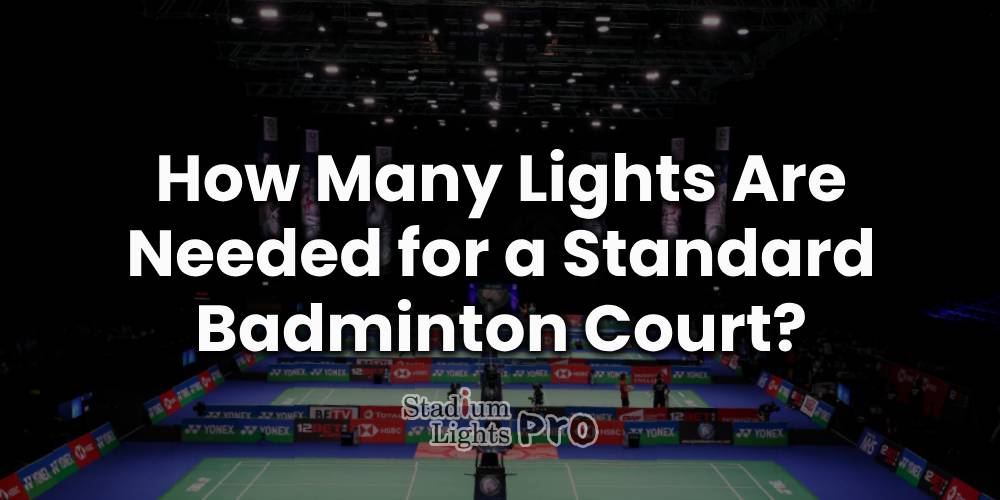
Determining the right number of lights involves understanding various factors such as the type of court, competition level, and technical requirements. The aim is to create an evenly lit environment that supports fast-paced gameplay and reduces visual fatigue for players.
Number of Lights for Different Types of Badminton Courts
The lighting requirements for badminton courts vary significantly depending on several key factors, primarily whether the court is situated indoors or outdoors, as well as the level of play that the facility is intended to support. Understanding these distinctions is crucial for designing an effective and efficient lighting system that not only ensures optimal visibility but also enhances player comfort, safety, and overall playing experience.
| Court Type / Condition | Recommended Number of Lights |
|---|---|
| Indoor Standard Court | 8 to 12 luminaires |
| Indoor Professional/Competition | 12 to 18+ luminaires |
| Outdoor Recreational Court | 10 to 16 luminaires |
| Outdoor Competition Court | 12 to 20 luminaires |
| Recreational Level Courts | 8 to 12 luminaires |
| Training Level Courts | 12 to 16 luminaires |
| Competition Level Courts | 15 to 20+ luminaires |
| Elite Professional Events | 20 to 30+ luminaires |
| Multiple Courts (Indoor Hall Example) | 40 to 50+ luminaires |
Indoor Badminton Court Lighting Requirements
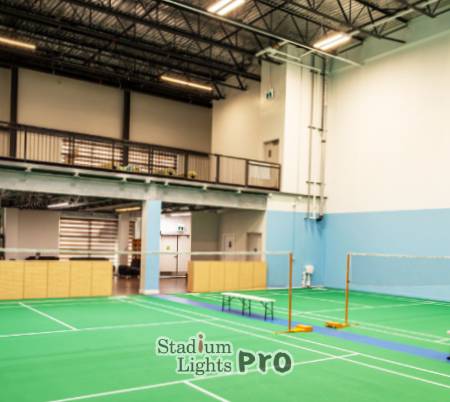 Indoor badminton courts present unique challenges and requirements when it comes to lighting, primarily because they rely exclusively on artificial light sources. Unlike outdoor courts, indoor courts have no access to natural sunlight, which means the entire playing area must be illuminated uniformly by carefully planned and installed lighting fixtures.
The importance of uniform light distribution in indoor courts cannot be overstated. The fast-paced nature of badminton means players must quickly track the shuttlecock’s speed and trajectory, and any dark spots, uneven lighting, or harsh glare can seriously impair their performance. Shadows and reflections can be particularly disruptive, causing momentary lapses in player focus or misjudgments.
A standard indoor badminton court, typically measuring approximately 13.4 meters in length and 6.1 meters in width, generally requires between eight to twelve luminaires to reach the recommended illumination levels for recreational and training purposes. The exact number of fixtures depends on multiple factors, including the wattage of each lamp, the beam angle of the fixtures, the height at which the lights are mounted, and the type of lighting technology used.
Advancements in LED technology have significantly impacted indoor sports lighting. Modern LED luminaires often have wider beam spreads—usually between 60 and 90 degrees—which allows each fixture to cover a larger area more effectively. This wider coverage often means fewer fixtures can be used without sacrificing the uniformity or quality of the lighting. Additionally, LEDs provide better control over light distribution and reduce glare compared to older lighting technologies such as metal halide lamps.
Most indoor badminton courts employ a setup with four to six poles or ceiling mounts, with each support carrying multiple luminaires. These fixtures are strategically positioned around the court perimeter or ceiling to minimize shadows and ensure consistent illumination across the entire playing surface. This layout is designed to optimize sightlines and player comfort by eliminating problematic dark zones.
For professional or competition-level indoor courts, the lighting requirements become more stringent. These venues often demand more sophisticated lighting systems with twelve to eighteen or more fixtures to meet the stringent illumination standards required for televised events and professional tournaments. Such systems often include precise aiming, dimming capabilities, and advanced glare control to accommodate camera setups and enhance spectator visibility.
Outdoor Badminton Court Lighting Needs
Outdoor badminton courts benefit from natural sunlight during daytime play, reducing the need for artificial lighting during those hours. However, evening and nighttime use necessitate a carefully designed artificial lighting system that compensates for the absence of daylight and provides adequate, uniform illumination.
Outdoor lighting presents additional challenges due to environmental exposure, including varying weather conditions, potential obstructions, and the need to illuminate a larger and more open area. Lighting fixtures must be mounted on taller poles, usually between 8 and 12 meters high, to provide broad and even coverage over the court. These elevated fixtures help reduce shadows caused by nearby objects such as fences, trees, or surrounding buildings, which are common outdoors.
The number of light fixtures required for outdoor badminton courts generally ranges from ten to sixteen or more, depending on the size and layout of the court as well as the level of play it is designed to support. Poles are commonly placed around the court’s perimeter at regular intervals, often spaced every 8 to 10 meters. This spacing helps achieve an even spread of light and minimizes glare that could interfere with player vision during fast rallies.
Outdoor lighting systems are typically designed to achieve illumination levels between 200 and 400 lux for casual recreational play. This provides sufficient brightness for safe and comfortable play while avoiding excessive power consumption. However, competitive or tournament-level outdoor courts demand higher illumination standards, often targeting 500 lux or more to satisfy player performance needs, broadcast requirements, and spectator expectations.
To meet these higher standards, outdoor lighting setups commonly employ twelve to twenty or more fixtures. Careful planning is necessary to avoid excessive light spillage into surrounding areas, which not only wastes energy but can also cause light pollution and discomfort to neighbors.
Lighting Requirements Based on Level of Play
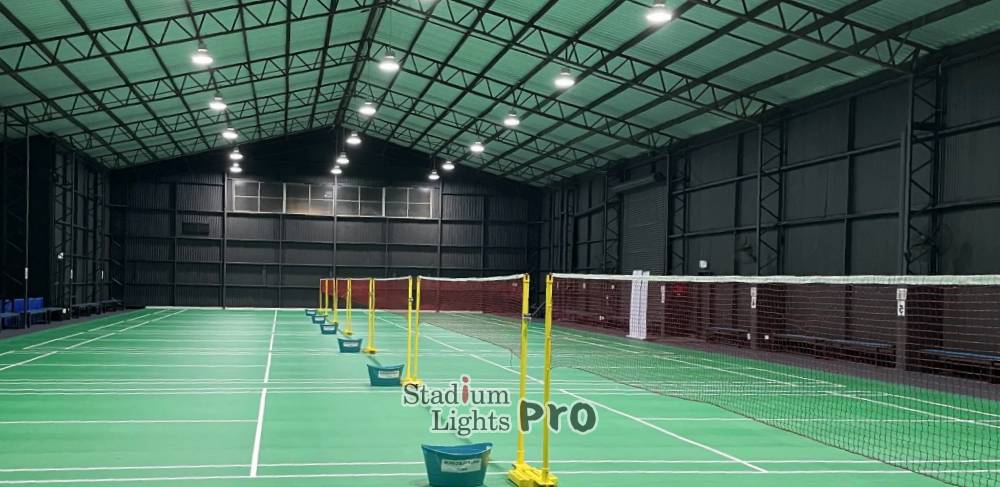
The level of play significantly influences the lighting intensity and quality required on a badminton court. Recreational courts designed for casual players typically require the lowest level of illumination, with recommended lux levels between 200 and 300 lux. For these facilities, a lighting arrangement consisting of approximately eight to twelve fixtures usually provides sufficient brightness to ensure player comfort and safety.
Training courts, where players spend extended periods refining skills and technique, demand higher lighting standards. These courts typically require lux levels ranging from 300 to 500, necessitating the use of twelve to sixteen luminaires. In these cases, lighting systems often incorporate more precise aiming and enhanced glare control to support intensive training sessions and reduce visual fatigue.
Competition-level courts have the most demanding lighting requirements. Uniform illumination of 500 lux or higher is essential to ensure fair play, provide excellent visibility for spectators, and meet broadcasting standards. These courts often require fifteen to twenty or more fixtures, with some elite professional events exceeding 750 lux and using as many as twenty to thirty or more luminaires. Such lighting systems are typically integrated with additional fixtures to accommodate cameras and spectator areas, providing comprehensive coverage and enhancing the overall event experience.
Factors Affecting the Number of Fixtures Needed
Several factors beyond court type and level of play influence the total number of fixtures necessary for effective badminton court lighting. The dimensions of the court are fundamental; larger courts or facilities housing multiple courts side by side naturally require more luminaires to maintain uniform lighting levels across all playing areas. For instance, an indoor hall containing four courts may require forty to fifty fixtures or more to meet recommended illumination standards adequately.
The height at which the lights are mounted also plays a crucial role. Courts with lower mounting heights generally need more fixtures to avoid creating shadows or uneven lighting, while taller poles can support fewer but more powerful luminaires that provide broader coverage.
The beam angle of the light fixtures is another key consideration. Narrow beam angles focus light on smaller, more concentrated areas, necessitating a higher number of fixtures to cover the entire playing surface. Conversely, fixtures with wider beam angles can cover larger zones with fewer units but may offer less control over glare and unwanted light spillage.
Glare control and adherence to light pollution regulations can significantly impact fixture count and placement. To minimize glare that impairs player vision and to reduce light trespass affecting neighboring areas, designers may opt for a greater number of fixtures equipped with precise optics and shielding rather than fewer high-powered lamps. This approach enhances visual comfort and helps comply with environmental and community standards.
Finally, energy efficiency and maintenance considerations affect lighting design choices. Installing a larger quantity of lower-wattage LED fixtures can sometimes be more cost-effective and energy-efficient over the long term compared to fewer high-powered lamps. Additionally, a layout designed for easy access during maintenance reduces downtime, lowers repair costs, and extends the lifespan of the lighting system, ensuring consistent performance and reliability.
Impact of Lighting on Player Performance in Badminton
Badminton is a fast-paced sport that demands exceptional speed, agility, and precision from players. In such a dynamic environment, the quality of lighting plays a critical role in supporting player performance and ensuring fair play. The right lighting conditions not only enhance visibility but also help maintain player comfort and safety during intense rallies.
How Lighting Affects Shuttlecock Visibility and Reaction Time
One of the most significant impacts of lighting on badminton players is its influence on shuttlecock visibility. Because the shuttlecock travels at very high speeds and follows unpredictable trajectories, players must rely heavily on their visual acuity to track it accurately. Poorly lit courts with uneven illumination or areas of shadow can cause players to misjudge the shuttlecock’s speed and flight path, resulting in delayed reactions and decreased shot accuracy.
For standard indoor courts, achieving 750 to 1000 lux is common in recreational and club-level play, while international competition lighting requires 1000 to 1500 lux, with vertical illuminance of at least 500 lux for television broadcasts. To meet these levels, 8 to 12 LED fixtures are typically installed per single court, mounted at a height of 7 to 9 meters, depending on ceiling design and beam angle.
When lighting is inconsistent, shadows can create visual confusion, making it difficult for players to anticipate shots, especially during fast rallies where milliseconds matter. On the other hand, a court that is evenly and adequately illuminated helps players track the shuttlecock smoothly, allowing for quicker responses and more precise shots.
Reducing Eye Strain and Enhancing Comfort
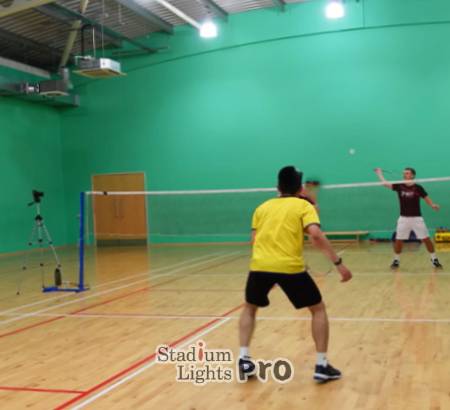 Another critical aspect of good lighting is its effect on player comfort and endurance. Insufficient or harsh lighting can lead to eye strain and visual fatigue, which may shorten the length of play sessions and reduce overall performance quality. A well-lit court with consistent brightness helps to minimize eye strain, enabling players to maintain focus for extended periods without discomfort.
To achieve visual comfort, the fixtures must be arranged to maintain uniformity ratios above 0.7 across the court, while also minimizing glare. This is often accomplished through a combination of symmetric and asymmetric beam LED floodlights, spaced evenly along the court perimeter or mounted centrally along the trusses in ceiling grids.
Consistent lighting also plays a vital role in maintaining players’ spatial awareness. By reducing glare and avoiding abrupt changes in brightness across the court, players can better perceive distances, court lines, and their opponents’ movements. This improved spatial perception directly contributes to better coordination and movement on the court.
Importance of Color Rendering and Light Quality
The color rendering index (CRI) of the lighting system is another important factor affecting player performance. CRI measures how accurately a light source reveals the true colors of objects compared to natural daylight. Lights with a CRI above 80 are standard for most professional badminton facilities, while CRI 90+ is preferred for international events or facilities that accommodate live broadcasting.
High CRI ensures that shuttlecocks, court lines, and player uniforms appear clear and natural. This enhanced color clarity helps players distinguish fine details quickly and reduces the chance of visual errors during play.
In contrast, lighting with a low CRI can cause colors to appear washed out or distorted, making it harder for players to accurately judge their surroundings, which can negatively impact gameplay and decision-making.
Effects of Improper Lighting on Concentration and Game Quality
Inadequate lighting does not only affect physical visibility but can also lead to reduced concentration and mental fatigue. Players struggling to see clearly may find it harder to focus, leading to a higher likelihood of unforced errors and decreased overall performance. Both amateur and professional players benefit from lighting systems designed to minimize distractions and support sustained mental alertness.
Therefore, the number, placement, and quality of light fixtures must be carefully designed to create optimal visual conditions. A thoughtfully planned lighting setup—typically comprising 8 to 12 high-efficiency LED fixtures per court, depending on wattage and beam angle—reduces glare, prevents shadow formation, and maintains uniform illumination levels. These systems are engineered not only to meet technical lux requirements but also to deliver a consistent and comfortable playing experience for all skill levels.
Factors Influencing the Number and Placement of Light Fixtures on Badminton Courts
Designing an effective lighting system for a badminton court involves careful consideration of multiple factors that directly impact how many light fixtures are needed and where they should be positioned. These decisions ensure that the court is illuminated uniformly, minimizing shadows and glare while meeting the specific visual requirements of players.
Target Illumination Level (Lux) and Its Role in Fixture Quantity
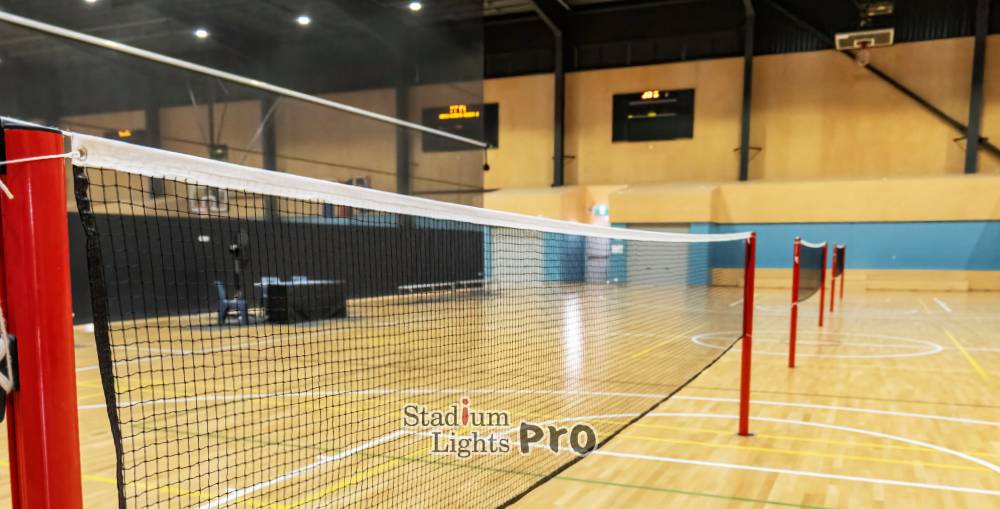
One of the most important factors influencing the number of light fixtures is the target illumination level, measured in lux. Lux defines the amount of visible light falling on a square meter of surface. The required lux levels vary significantly based on the intended use and standard of the badminton court.
Recreational courts typically require around 200 to 300 lux, which provides sufficient visibility for casual play and practice. This level can be achieved using 4 to 6 LED fixtures rated at around 100–150 watts each. Training facilities demand higher levels, usually between 300 and 500 lux, and often rely on 6 to 8 fixtures per court to provide sharper illumination for technical drills and movement tracking. Competition or professional-level courts require 500 to 750 lux or more, and may use 8 to 12 fixtures per court, with fixtures often positioned overhead or elevated on beams, providing both horizontal and vertical illuminance for player visibility and potential broadcast coverage.
As the required lux level increases, the lighting design generally calls for either more powerful fixtures or a greater number of light sources distributed evenly across the court. This ensures that the entire playing area achieves the uniform brightness needed for optimal performance.
Lighting Layout and Fixture Placement Patterns
The layout pattern of the lighting system is another critical factor that affects both the number of fixtures and their placement. Different court types and environments require customized arrangements to optimize light distribution while reducing shadowing and glare.
For indoor badminton courts, a common setup includes 8 ceiling-mounted LED fixtures per court, arranged in two parallel rows along the length of the court. Each fixture is mounted at a height of 7 to 9 meters and aimed downward at an angle that minimizes glare and enhances even coverage.
Alternatively, where pole mounting is used (e.g., in multi-use halls or older facilities), 4 poles can be placed symmetrically around the court—two along each sideline—each supporting 2 to 3 luminaires, totaling 8 to 12 fixtures per court.
In outdoor settings, the poles are generally taller—often 8 to 12 meters—and spaced farther apart due to the larger scale and need to overcome environmental obstacles. Outdoor courts typically require 6 to 8 floodlights per court, mounted on 4 poles, with each luminaire delivering wider beam angles to cover the playing area while complying with dark-sky and light spill restrictions.
Glare Control and Fixture Type Selection
Managing glare is crucial for maintaining good visual comfort and player safety. Overly bright or improperly aimed lights can cause direct glare, which severely impairs player visibility and reaction times during fast-paced rallies.
To mitigate glare, lighting designers incorporate several strategies. Fixtures may be equipped with specialized anti-glare louvers, diffusers, or asymmetrical optics that direct light downward and prevent it from shining into players’ eyes. The mounting height and tilt angle of each luminaire are meticulously calculated to balance light intensity with comfort.
In high-end designs, increasing the total number of fixtures while lowering the wattage per fixture—for example, using 10 to 12 fixtures at 80–100 watts each—achieves a more even and soft lighting distribution. This method avoids harsh contrasts and bright spots, providing a visually comfortable environment that supports long sessions of play without eye strain.
Additional Influencing Factors – Court Size, Surroundings, and Energy Efficiency
Other considerations influencing fixture quantity and placement include the dimensions of the court, the presence of nearby structures or vegetation that may cast shadows, and local regulations on light pollution.
Standard single courts (13.4m × 6.1m) need 6 to 12 fixtures, depending on height and usage level. Double or triple court halls require a centralized grid system or distributed layout using 20 to 40 fixtures, depending on total area, ceiling height, and beam spread. Nearby walls, curtains, or obstructions may require added fixtures or adjusted angles to eliminate dark zones and maintain lux uniformity.
Energy efficiency also plays a role in fixture selection and layout. Modern LED lighting systems often favor a higher number of low-wattage fixtures, which collectively deliver uniform brightness with lower total energy consumption and easier maintenance compared to fewer high-powered lamps. Motion sensors, dimming controls, and zoning are increasingly integrated into multi-court facilities to adjust lighting intensity dynamically based on court use.
Practical Considerations for Installing Badminton Court Lighting
Designing and installing lighting for badminton courts involves more than just meeting illumination requirements. Several practical considerations play a crucial role in ensuring the lighting system is efficient, safe, durable, and easy to maintain.
Emphasizing Energy Efficiency and Sustainability
One of the most important factors in modern lighting design is energy efficiency. With rising energy costs and increasing environmental awareness, sports facilities are prioritizing lighting systems that minimize power consumption while delivering excellent illumination.
LED technology has become the preferred choice for badminton court lighting due to its superior energy efficiency, longer lifespan, and improved controllability compared to traditional metal halide or fluorescent lamps. LEDs consume significantly less electricity, reducing operational costs over time. They also provide instant start-up and can be easily dimmed or integrated with smart controls for further energy savings.
Selecting the right number of energy-efficient fixtures ensures the court is brightly lit without unnecessary power waste. This balance helps facilities manage their budgets more effectively while maintaining high lighting standards.
Ensuring Safety in Installation and Operation
Safety is paramount during both the installation process and the ongoing use of badminton court lighting. Light poles and fixtures must be securely mounted and structurally sound to withstand various stresses such as wind, vibrations, and potential impacts, particularly in outdoor environments. Poles should be firmly anchored with durable foundations to prevent tipping or swaying that could cause accidents.
Electrical components, including wiring and control systems, must adhere to national and local electrical safety codes and standards. Proper insulation, grounding, and circuit protection devices reduce the risk of electrical hazards such as shocks or short circuits. Furthermore, lighting installations should be designed so that poles, cables, and fixtures do not obstruct player movements or interfere with the court equipment.
Thoughtful pole placement and cable routing are essential to maintain a safe playing environment and avoid tripping hazards or damage during games.
Facilitating Maintenance and Minimizing Downtime
Maintenance is a key practical consideration that affects both the longevity and reliability of the lighting system. Fixtures should be installed in locations that are easily accessible for routine cleaning, inspection, and repairs without requiring complex disassembly or disrupting court usage.
Choosing lighting components with long service lives and low failure rates reduces the frequency of maintenance interventions. For instance, LEDs typically last tens of thousands of hours, far exceeding traditional lighting technologies. When replacement or repair is necessary, the layout should allow maintenance staff to work safely and efficiently, ideally from ground level or with minimal use of specialized equipment.
An accessible and well-planned lighting system minimizes court downtime, ensuring that the facility remains operational and available for players and events.
Additional Practical Considerations
Other factors that may influence installation decisions include climate and environmental conditions, which affect the choice of fixture enclosures and materials, especially for outdoor courts. Fixtures must be weather-resistant and rated for protection against dust, moisture, and temperature extremes.
Integration with lighting control systems — such as timers, motion sensors, or remote monitoring — can further enhance energy savings and operational convenience. These systems allow precise control over lighting schedules and intensity, adapting to actual court usage patterns.
Conclusion
By choosing the right combination of fixtures, ensuring secure and compliant installation, and planning for long-term upkeep, facilities can provide optimal lighting conditions that enhance player performance while minimizing operational costs and downtime. Thoughtful design and implementation ultimately create a safe, sustainable, and enjoyable environment for badminton players at all levels.