
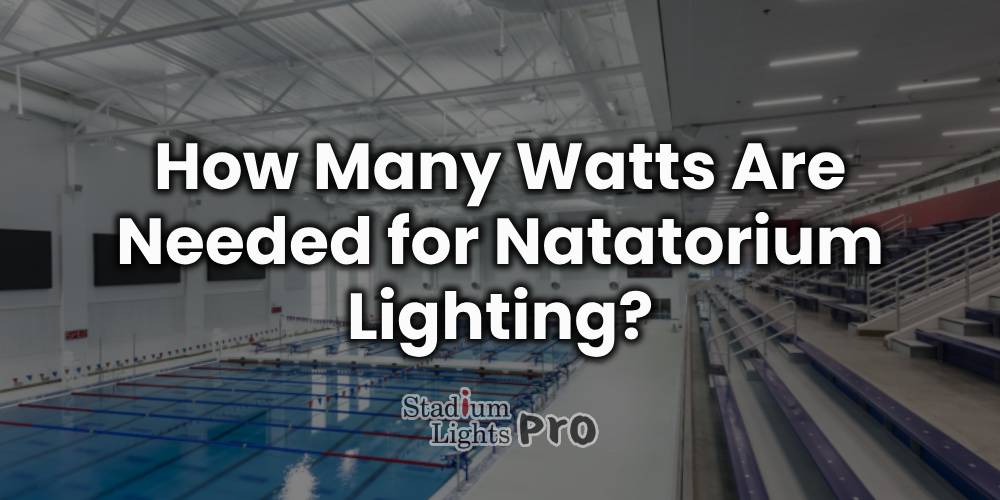
Lighting a natatorium involves more than simply installing fixtures around an indoor pool. The wattage needed is influenced by multiple elements, including the size of the space, the ceiling height, the type of use (recreational or competitive), the reflectivity of surfaces, and the choice of lighting technology. Balancing energy use with effective illumination leads to a comfortable environment for swimmers and spectators while managing electricity costs over time. This guide explores what impacts the wattage requirements of natatoriums, how to determine the right amount for various setups, and what wattage range can help reduce long-term expenses.
Wattage Estimates for Various Natatorium Sizes and Uses
| Natatorium Type | Area (sq ft) | Lighting Level (lux) | Lumens Needed | Fixture Wattage (W) | Number of Fixtures | Total Wattage Range (W) |
|---|---|---|---|---|---|---|
| Small Recreational Pools | 5,000 – 10,000 | 200 – 300 | 15,000 – 30,000 | 100 – 150 | 8 – 16 | 1,200 – 2,400 |
| Medium-Sized Community Pools | 10,000 – 20,000 | 300 – 500 | 45,000 – 100,000 | 150 – 200 | 20 – 40 | 3,000 – 8,000 |
| Large Competitive Venues | 20,000+ | 750+ | (High lumen output) | 200 – 600 | 40 – 80+ | 8,000 – 30,000 |
The amount of wattage a natatorium requires depends heavily on both the size of the facility and its intended functions. Different types of natatoriums—from small recreational pools to large competition venues—demand varying lighting levels, which directly influence total wattage consumption. The following sections provide a more detailed overview of typical wattage ranges, fixture counts, and lighting levels suited to each size category.
Small Recreational Pools – Lighting for Leisure and Therapy
Small natatoriums generally serve leisure swimmers, therapy patients, or casual training activities. These pools are often located within schools, hotels, fitness clubs, or residential complexes and usually cover an area between 5,000 and 10,000 square feet.
For these facilities, the goal is to provide a comfortable and safe environment with moderate lighting, typically achieving around 200 to 300 lux on the pool surface and deck areas. To meet these requirements, the total lumen output should range from 15,000 to 30,000 lumens.
Fixtures used in this context are often LED units rated between 100W and 150W, balancing energy efficiency with adequate brightness. A typical setup might involve 8 to 16 fixtures, which results in an overall wattage range of approximately 1,200 to 2,400 watts. The number of fixtures depends on pool shape, ceiling height, and fixture spacing, but careful design can keep wattage lower without compromising lighting uniformity.
Because these pools usually have lower ceilings—often around 12 to 20 feet—light loss due to height is minimal, allowing the use of lower-wattage fixtures effectively. The presence of light-colored surfaces in these spaces further helps reduce the total wattage needed by reflecting light efficiently.
Medium-Sized Community Natatoriums – Multi-Purpose Facilities
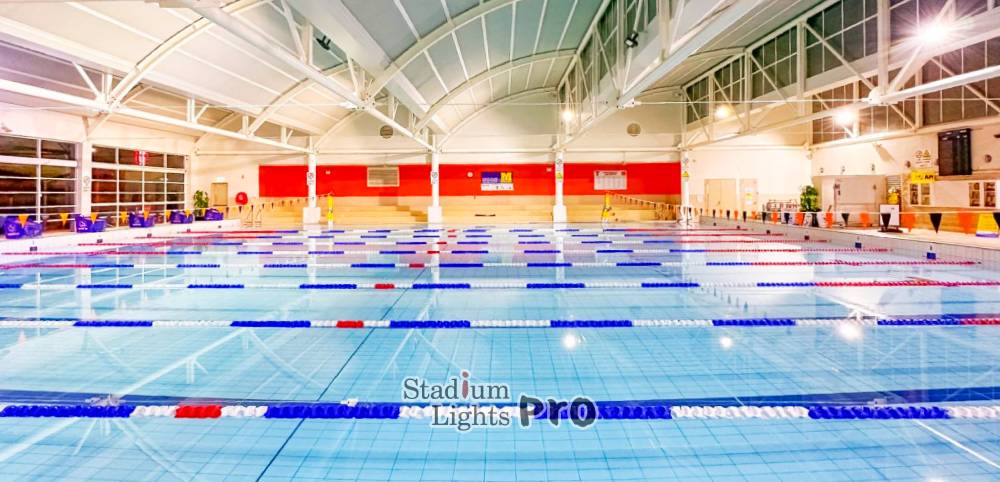
Community pools, YMCA centers, or school athletic facilities typically fall within the 10,000 to 20,000 square feet range. These natatoriums often have diverse uses, including recreational swimming, swim lessons, training sessions, and occasional amateur competitions.
The lighting design for these spaces aims for a higher average illumination level, generally between 300 and 500 lux, to support more active and varied uses. The total lumen requirement for such pools ranges from 45,000 to 100,000 lumens.
Fixtures chosen are commonly LED models rated between 150W and 200W. These wattages provide a good balance between brightness and energy consumption, especially in pools with ceiling heights between 20 and 30 feet. The higher mounting positions necessitate higher-powered fixtures to maintain adequate light levels on the pool surface.
The typical fixture count for mid-sized natatoriums can vary widely from 20 to 40 units, depending on pool configuration and ceiling height. Consequently, the total wattage load for these facilities often ranges between 3,000 and 8,000 watts.
At these wattage levels, many facility managers benefit from incorporating lighting controls such as dimmers or occupancy sensors, which can further optimize energy use during off-peak hours or less active periods. Additionally, the use of reflective interior finishes—such as white or pastel wall paint and glossy tiles—can reduce the overall wattage requirements.
Large Competitive Natatoriums – High-Performance Lighting for Sports Venues
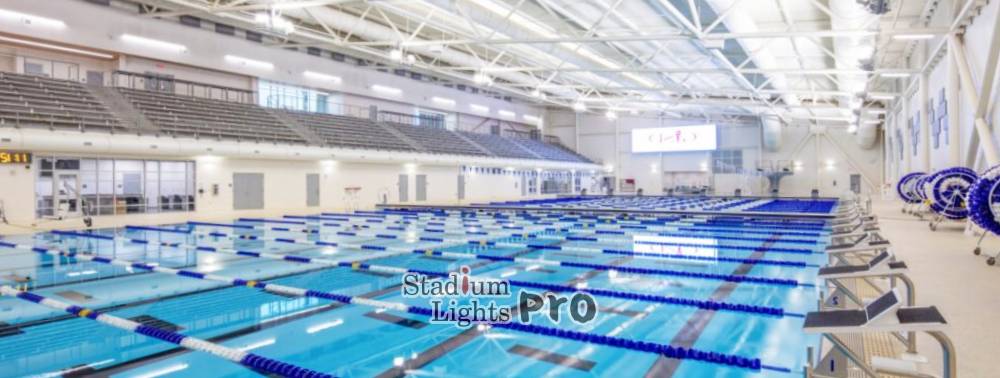
Large-scale natatoriums, such as those found in universities, regional aquatic centers, or Olympic training facilities, often exceed 20,000 square feet in area. These venues require lighting levels that meet or exceed 750 lux, often driven by broadcast quality standards and official competition regulations.
Because of the high ceilings—sometimes 30 to 40 feet or more—and the need for consistent, glare-free illumination across the entire pool and surrounding areas, fixtures with wattages ranging from 200W to 600W are typically employed. These high-output LED fixtures can deliver the intense brightness necessary for events that are televised or judged closely.
The number of fixtures in such venues can range from 40 to 80 or more, depending on the layout, beam angles, and fixture spacing. This results in a total wattage range between 8,000 and 30,000 watts, reflecting the demands of both fixture power and quantity.
In addition to wattage, these facilities often incorporate advanced lighting features, such as programmable lighting zones and color rendering optimization, to enhance visibility and broadcast quality. High-wattage fixtures are commonly paired with specialized mounting hardware to allow for precise aiming and beam control, ensuring uniformity and minimizing shadows.
Factors That Influence Wattage Requirements
Understanding what shapes the wattage needs of a natatorium is helpful when planning an effective and energy-conscious lighting system. Several variables interact to determine how much power must be delivered through lighting fixtures in order to achieve consistent brightness, safe visibility, and even distribution across the space. These elements involve the dimensions and geometry of the facility, its intended use, the materials used in construction, and the demands of the indoor aquatic environment.
Pool Size and Spatial Layout

The overall size of the natatorium is one of the first considerations that influence total wattage. A larger space means more square footage to illuminate, resulting in a greater number of lighting fixtures. However, it’s not just about horizontal dimensions. The height of the ceiling plays an equally important role.
In most natatoriums, ceiling heights range from 25 to 40 feet or more, particularly in facilities with diving wells. Higher ceilings create a greater distance between the light source and the water surface, which diminishes the intensity of light reaching the area that matters most. To counter this, facilities often install higher-powered fixtures, such as 200W to 400W LED lights, which can deliver adequate brightness over longer distances. Fixture beam angles must also be carefully selected to ensure that light is directed downward efficiently without excess dispersion.
In addition to the pool area, deck space, bleacher sections, and walkways also require proper illumination. The broader and more compartmentalized the layout, the more complex the lighting plan becomes, and the higher the total wattage needed to maintain consistent lighting coverage.
Height and Mounting Position
The mounting height of fixtures affects how light spreads and the strength of the beam required. Fixtures mounted closer to the pool may use lower wattages, as they don’t have to work as hard to deliver sufficient brightness. However, most natatoriums opt for ceiling or rafter-mounted systems for maintenance access and moisture protection. These elevated positions demand more powerful lighting, which translates to higher individual fixture wattages and greater total system wattage.
Purpose and Frequency of Use
The type of activities hosted in a natatorium strongly influences lighting requirements. A facility that serves multiple functions—such as lap swimming, diving, water polo, synchronized swimming, and competitions—must maintain adequate lighting for each of these settings.
For Recreational Pools, pools designed for casual swimmers, school physical education programs, or fitness sessions typically require moderate lighting levels, around 200 to 300 lux. Since high visual detail isn’t necessary in these contexts, lower-wattage LED fixtures, such as 100W to 150W models, are often sufficient. These pools emphasize comfort and safety over visual precision.
For Competitive Pools, pools designed for high-level training or events are held to higher standards. Sports organizations such as FINA, USA Swimming, or the NCAA set lux standards ranging from 500 to 750 lux or more, depending on the competition level and whether the facility is used for broadcast events. Achieving this level of brightness and uniformity calls for high-output fixtures and well-planned placement, often pushing the wattage requirements upward.
In competition settings, it’s also important that the lighting be glare-free and consistent across lanes, making wattage uniformity across fixtures even more vital. Facilities aiming for international broadcast standards might use 250W to 600W LED fixtures spaced uniformly, depending on ceiling height and beam angle.
Interior Surface Reflectivity
How light interacts with a natatorium’s surfaces—walls, ceilings, pool tiles, and deck materials—can either enhance or reduce brightness.
For Reflective Materials, when the interior is finished with light-colored, glossy, or semi-glossy materials, a portion of the light is bounced back into the room. This effect amplifies the perceived brightness, which can allow lighting designers to use lower-wattage fixtures to achieve the same lux levels. Materials like white tile, aluminum ceiling panels, or light-toned wall paint help extend the coverage of each fixture, making them more energy-efficient.
For Non-Reflective Surfaces, Conversely, dark-colored or matte surfaces absorb light, which results in more wattage being required to maintain visibility. Facilities with darker architectural finishes, natural wood, or exposed concrete may need to install more fixtures or choose higher wattages to overcome the lack of reflectivity. This is especially relevant in older buildings, where upgrades to lighting must take these surfaces into account.
Moisture, Heat, and Fixture Construction
A natatorium is a highly humid and chemically active environment. Chlorine in the air, combined with constant moisture, creates conditions that degrade standard lighting equipment. As a result, natatoriums require fixtures that are IP65 or higher-rated, meaning they are tightly sealed against water and dust. These rugged fixtures are often bulkier and designed for durability, which can impact both the thermal management and power requirements of the system.
Fixtures used in aquatic centers must be constructed with specialized coatings and gaskets that protect against corrosion. These units often include built-in heat sinks and require higher-wattage components to maintain performance in a sealed housing. The design of these fixtures may limit the availability of ultra-low-wattage options, pushing facility managers toward mid- to high-wattage ranges, even in smaller facilities.
Lighting fixtures not only emit light but also generate heat. In an indoor pool environment, managing heat is especially delicate, as it can disrupt air circulation and increase HVAC load. While LEDs produce less heat than older technologies like metal halide, high-wattage units still contribute to the ambient thermal conditions. This factor may prompt the use of more efficient, lower-wattage fixtures, distributed more evenly to avoid excessive heat concentration in one area.
Fixture Spacing and Beam Angle
The way fixtures are spaced across the ceiling and the angle of their beams can impact how much wattage is required per unit. Narrow-beam fixtures concentrate light in one direction and may need higher wattage to cover wider areas. On the other hand, wide-beam fixtures spread light more broadly, which can be effective at lower wattages—provided the ceiling is low enough for the light to reach its target without dispersing too much.
A thoughtful photometric layout considers how to place lights so they minimize overlap and shadows, which can reduce the need for high wattage per fixture. Symmetrical distribution patterns, carefully adjusted beam spreads, and appropriate mounting angles can help optimize total system wattage.
Wattage Levels That Help Lower Long-Term Costs

Selecting appropriate wattage for a natatorium isn’t just about ensuring brightness. It directly impacts long-term costs through its effect on energy consumption, fixture longevity, and maintenance frequency. Managing these variables with precision can help reduce overhead without sacrificing visual quality or safety for swimmers and staff.
Optimizing Fixture Efficiency
One of the most effective ways to reduce energy-related costs is by focusing on fixture efficiency. Fixtures that offer a higher lumen-per-watt ratio generate more light while consuming less power. For instance, a 150W LED that produces 22,000 lumens is more efficient than a 200W unit generating only 20,000 lumens. Despite consuming less energy, the former delivers better brightness.
When a facility chooses high-efficiency LED fixtures with better optical control and more precise distribution, fewer fixtures may be required to cover the same area. This strategy lowers the total installed wattage and can also reduce heat output, lessening the strain on HVAC systems. Over time, the use of premium LED models with optimized performance leads to measurable reductions in energy bills, and the investment often pays off within a few years due to decreased operational and replacement costs.
Using Zoning and Smart Controls
Beyond fixture selection, the method of control has a considerable impact on long-term cost reduction. Lighting controls do not alter fixture wattage, but they do manage how often and how intensely those fixtures operate. For example, integrating motion sensors into the lighting system allows specific zones within the natatorium to remain dimmed or off when not in use.
Timed lighting schedules can adjust illumination levels during non-peak hours or overnight, while automated daylight sensors adjust lighting in real time depending on the presence of natural light through windows or skylights. By using intelligent control systems, facility managers can extend fixture life by reducing their active hours and operating wattage, thereby minimizing wear and avoiding unnecessary energy costs.
Selecting the Right Mounting Configuration
The arrangement and positioning of light fixtures play a vital role in energy performance. Mounting configurations that maximize the reach and distribution of light can help ensure even coverage without the need for excessive wattage. For example, placing fixtures around the perimeter of the pool rather than overhead can increase the effectiveness of horizontal beam spread, especially in pools with reflective surfaces.
Positioning fixtures above white-painted ceilings or light-colored tiled walls enhances illumination by reflecting light throughout the space. Cross-aimed fixtures, directed at angles to prevent shadowing, can eliminate the need for added wattage in dim corners. These techniques, when guided by detailed photometric planning, can reduce the total number of fixtures required and allow lower-wattage lights to be used effectively, delivering energy savings while maintaining visual performance.
Preventing Over-Lighting
It is not uncommon for facility designers to exceed recommended lighting levels under the assumption that more brightness equals better visibility. However, excessive illumination creates problems of its own. Over-lighting can cause glare that distracts swimmers, reflect awkwardly off the water surface, and even contribute to visual fatigue among lifeguards and coaches. More importantly, operating at levels above the necessary lux requirements leads to unwarranted increases in power use and cost.
Instead of aiming for the highest possible lux, facilities benefit from designing lighting layouts that provide precisely the right amount of brightness for each task area—whether for recreational swimming, competition, or diving zones. Avoiding the installation of more wattage than needed preserves lighting quality, improves user comfort, and lowers both capital and operating expenses.
Replacing Legacy Systems with Modern LEDs
Older lighting technologies like metal halide, high-pressure sodium, and fluorescent lamps consume far more power and deliver less efficient light compared to modern LEDs. Traditional fixtures in natatoriums often consume between 400W to 1,000W per unit, yet their light output degrades quickly and requires frequent replacement or maintenance. They also take time to warm up and cannot integrate with dimming systems, which limits control and flexibility.
Modern LED systems, by contrast, operate efficiently in the 150W to 400W range while maintaining superior lumen output and color rendering. When retrofitted into existing facilities or installed in new builds, these fixtures can cut energy use by 50% to 60%. In facilities that also adopt smart control systems, the cumulative energy savings increase even further.
The initial cost of transitioning to LED lighting may appear higher, but this is offset by the rapid reduction in utility expenses, minimal maintenance, and longer lifespan of fixtures. In many cases, the return on investment is achieved in fewer than five years, especially for large facilities running lighting systems for extended daily hours.
Conclusion
Every natatorium has unique needs, but the goal remains consistent: to deliver adequate light levels for safety, performance, and aesthetics while managing energy use effectively. Wattage plays a foundational role in achieving this balance. By selecting the correct fixture type, optimizing installation layout, and using advanced control strategies, facilities can meet illumination requirements with minimal energy input. A tailored lighting design, based on actual use and architecture, ensures the chosen wattage delivers value in both the short and long term.