

Whether it’s a car race, horse track, go-kart arena, or even a cycling circuit, the right lighting setup makes all the difference. But one common question that always comes up is: how many watts of race track lighting is actually required? The answer depends on several factors, from the size and layout of the track to the type of lighting technology you use.
Let’s break it down step by step so you can get a clearer picture of how wattage plays into proper race track illumination.
Watts vs Lumens of Race Track Light
Before diving into how many watts you need, it helps to understand the difference between watts and lumens. A lot of people mix them up, but they mean completely different things.
Watts measure how much power a light fixture uses, while lumens measure how much light it actually gives off. In older lighting systems like metal halide or mercury vapor lamps, you needed a ton of watts just to get decent brightness. But with modern LED race track lights, the game has totally changed—you can get the same or even better brightness with far less wattage.
For example, a 400W metal halide floodlight might produce around 36,000 lumens, while a 150W LED floodlight can easily push out 22,000–25,000 lumens. That’s a massive difference in energy efficiency.
So when someone asks how many watts are required, what they really mean is how bright does the track need to be, and then how much power is needed to achieve that brightness using the chosen type of light.
The Common Wattage of Race Track Lights
The wattage requirement for race track lighting really depends on what kind of race you’re dealing with, how big the track is, and the lighting technology being used. A high-speed F1 circuit obviously demands more intense illumination than a small go-kart arena. Different racing environments call for different setups—not just in power, but also in how the light spreads and how evenly it covers the surface. Let’s break down the typical wattage needs for various types of race tracks and lighting systems.
Car Race Tracks
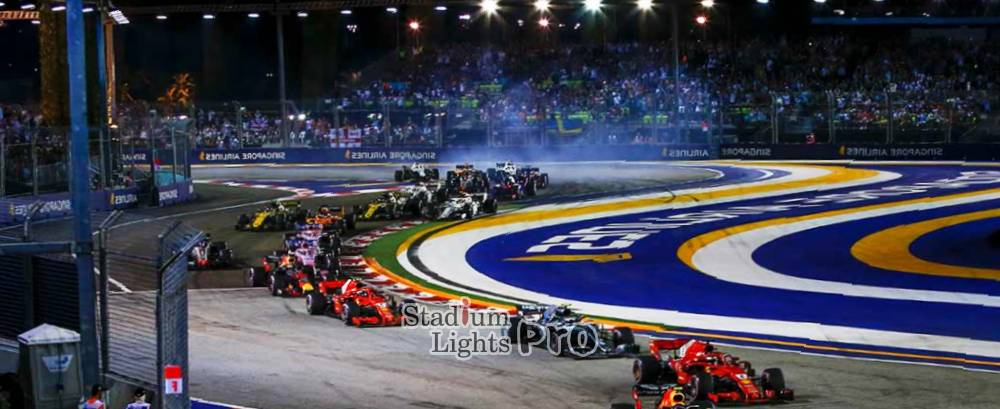
Car racing tracks, especially professional ones like Formula 1, NASCAR, or Le Mans-style endurance circuits, are among the most power-hungry when it comes to lighting. The combination of high speeds (often over 300 km/h), wide track surfaces, and long straightaways means that every meter of the track must be crystal clear under night conditions. Drivers need to spot braking points, curbs, and other vehicles instantly, and spectators need to enjoy a fully illuminated view from the stands or on broadcast.
A full-size FIA-grade car racing circuit can require lighting levels of about 1,200 to 2,000 lux along the main straight and 600–800 lux on the corners and pit areas. To reach this brightness, total installed lighting power can range between 500,000 to 1,000,000 watts, depending on the fixture type and spacing. That’s roughly 500 kilowatts to one megawatt—the equivalent of powering a small neighborhood.
At smaller or semi-professional racing venues, such as drift circuits, time attack courses, or local GT tracks, the wattage demand tends to drop. Here, you might see setups in the range of 150,000 to 300,000 watts using older metal halide systems. But with today’s high-efficiency LED floodlights, the same level of brightness can often be achieved with only 60–70% of that power. For instance, switching from 1,000W metal halide fixtures to 400W LED replacements can save well over 100,000 watts across a medium-sized track. The difference isn’t small—it can mean thousands of dollars in energy savings per month during the racing season.
Horse Racing Tracks
Horse racing tracks have a completely different lighting layout but still need plenty of wattage to ensure safety and visibility. A standard oval track is usually 1,200–2,000 meters long, with lighting poles placed every 25–35 meters along the outer perimeter. Riders need even, glare-free light to judge distances and track surfaces accurately, and spectators in the stands need enough brightness to see the horses clearly at top speed.
For most horse tracks, lighting levels fall around 400–700 lux, depending on the race type. Training tracks or smaller local arenas might go for around 300 lux, while nighttime broadcast events, such as the Kentucky Derby or Hong Kong’s Happy Valley races, can push brightness closer to 700–800 lux to look great on TV.
A typical setup might involve 200W to 600W LED floodlights, spaced to minimize shadowing along the track and inside the curves. In older installations that still rely on metal halide lamps, each fixture can be around 1,000 watts or more, meaning a full track could easily draw 200,000 to 400,000 watts. Modern LED systems can cut that to half—or even less—without sacrificing brightness. Some newly renovated tracks report annual energy savings of up to 65%, just by upgrading the lighting technology.
Go-Kart and Dirt Tracks
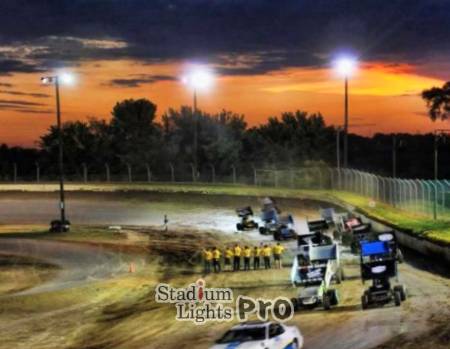 Go-kart circuits and dirt ovals have their own quirks when it comes to lighting design. Since these tracks are smaller and more compact, they don’t require the same massive wattage as professional car or horse tracks—but they still need focused, directional lighting to handle sharp turns and frequent dust.
A typical go-kart track might run around 700–1,000 meters in total length, with floodlights every 10–15 meters along the perimeter. LED lights between 100W and 200W are usually sufficient for small or indoor karting facilities, providing around 300–500 lux of light on the driving surface. That’s bright enough for safe racing without wasting power.
For outdoor dirt or rallycross tracks, where the terrain can scatter and absorb light unevenly, stronger beams are necessary—typically 300W to 400W LED floodlights per fixture. Dust and uneven surfaces tend to “eat” light, so higher lumen output helps maintain visibility. A medium-size dirt track could total 60,000 to 80,000 watts using LED lighting, whereas older halide systems might’ve needed closer to 150,000 watts for the same effect.
Different Light Sources – LED, Metal Halide, and Mercury Vapor
Lighting technology has evolved fast, and it directly affects how much wattage your setup will need for the same brightness. Let’s talk about the main types used in race track lighting.
LED lighting has completely changed the game. A 400W LED can easily outperform a 1,000W metal halide or a 1,200W mercury vapor lamp, delivering the same or better illumination at less than half the power. LEDs also have an average lifespan of 50,000 to 100,000 hours, compared to roughly 10,000–15,000 hours for metal halides. That means fewer replacements, less maintenance downtime, and a more consistent light color throughout their use.
Metal halide lights, once the go-to choice for professional tracks, are still found in some older venues. They produce bright, white light with decent color rendering—perfect for visibility and for capturing fast motion on camera—but they’re not very efficient. They also take 5–10 minutes to reach full brightness, which can be annoying during warm-ups or sudden restarts after power interruptions. A large track using 1,000W metal halide lamps could easily run up a monthly electricity bill in the thousands if lights are used regularly for events.
Mercury vapor lights are even less efficient and gradually fade over time, turning the light dull and bluish. They also have poor color accuracy and take long to ignite, which is why they’re now mostly phased out of professional use. Replacing them with LEDs can immediately reduce total wattage by 60–70%, plus improve color rendering to near daylight quality (5000K–6000K).
For example, a mid-sized racing track that used to run 200 units of 1,000W mercury vapor lamps (totaling 200,000 watts) could switch to 200 units of 400W LEDs (80,000 watts total), saving around 120,000 watts of power while getting brighter and more uniform lighting. That’s a 40% drop in total energy consumption right away.
| Type of Race Track | Typical Track Length | Average Illuminance (Lux) | Common Fixture Wattage (LED) | Older Fixture Wattage (Metal Halide / Mercury Vapor) | Estimated Total Power (LED System) | Estimated Total Power (Older System) |
|---|---|---|---|---|---|---|
| Car Racing Track (F1, NASCAR, Le Mans) | 4–7 km | 1,200–2,000 lux (main straight), 600–800 lux (corners/pits) | 400W–600W | 1,000W–1,200W | 500,000–1,000,000W | 800,000–1,200,000W |
| Semi-Pro / Local Car Circuits (Drift, GT, Time Attack) | 1–3 km | 600–1,000 lux | 300W–500W | 800W–1,000W | 150,000–300,000W | 250,000–400,000W |
| Horse Racing Track | 1.2–2 km (oval) | 400–700 lux (up to 800 for broadcast) | 200W–600W | 1,000W+ | 150,000–200,000W | 200,000–400,000W |
| Go-Kart Track (Indoor/Outdoor) | 0.7–1 km | 300–500 lux | 100W–200W | 400W–600W | 20,000–40,000W | 50,000–80,000W |
| Dirt / Rallycross Track | 0.8–1.5 km | 400–600 lux | 300W–400W | 800W–1,000W | 60,000–80,000W | 120,000–150,000W |
| Lighting Source Comparison | — | — | LED (400W) | Metal Halide (1,000W) / Mercury Vapor (1,200W) | 80,000W (for 200 fixtures) | 200,000W (for 200 fixtures) |
The Balance Between Brightness and Efficiency
When it comes to race track lighting, the trick is to find that sweet spot between enough wattage for top-tier visibility and not wasting power. LEDs now make it possible to maintain professional-grade lighting with much less wattage, but the design and fixture positioning still matter a lot. Tracks that have switched to customized LED systems often see better uniformity and reduced glare—a big deal for both racers and broadcasters.
The Importance of Selecting the Right Wattage
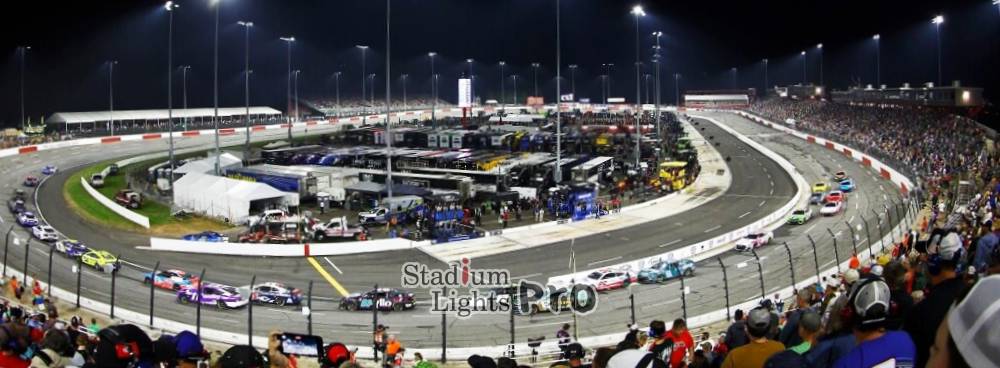
Choosing the right wattage for race track lighting isn’t just some technical checkbox—it’s something that can make or break the whole racing experience. It affects everything from driver performance and spectator comfort to broadcast quality and long-term operating costs. Getting it right means smooth visibility and a clean, dynamic atmosphere; getting it wrong could mean dim corners, glare, or wasted energy.
Striking the Balance Between Too Dim and Too Bright
If the wattage is too low, sections of the track can end up darker than they should be, which is a big problem when you’re dealing with speeds above 200 km/h. At those speeds, even a split-second of poor visibility could lead to misjudged braking or late corner entries. Drivers depend on consistent brightness to read the surface texture, apexes, and braking zones. For example, at an endurance circuit or a drift track with uneven lighting, underlit corners can throw off the drivers’ rhythm and even increase accident risks.
On the flip side, too much wattage isn’t great either. Overly bright lighting can produce glare—light bouncing off the asphalt or helmets—making it harder for drivers to focus. For spectators and camera operators, glare can ruin visibility and create washed-out visuals. It’s also an unnecessary energy drain. A setup that uses 400W lights when 250W LEDs could do the same job is basically throwing money away every time the lights are switched on.
So, it’s about finding that sweet spot—bright enough for clarity and performance, but not so powerful that it becomes harsh or wasteful.
Why Even Light Distribution Matters
For larger race circuits—say, a Formula circuit, MotoGP track, or supercross arena—the goal isn’t just raw brightness but uniformity. The lighting has to be spread evenly across straights, corners, and pit areas. Uneven lighting is one of the biggest issues in older track designs; drivers move from bright zones to dark ones, and that constant change strains their eyes at high speed.
To fix that, designers use photometric simulations before installing anything. These digital models calculate exactly how each fixture will spread its light over the racing surface, so engineers can tweak positions, beam angles, and wattages. For instance, a simulation might show that a 300W fixture needs to be tilted 15 degrees lower to avoid hot spots and cover the inner turn evenly. These small adjustments often make a massive difference once the lights are on.
The Role of Color Temperature in Race Track Lighting
Color temperature is another piece of the puzzle that goes hand-in-hand with wattage. Most race track LEDs use 5000K to 6000K, which looks close to daylight and keeps colors vibrant and natural. It’s the range that gives asphalt a clean gray tone and makes painted curbs or safety barriers pop visually.
If the color temperature is too warm (around 3000K), the track might look yellowish and less sharp. Too cool (above 6500K), and it starts to feel overly blue and harsh on the eyes. When combined with incorrect wattage, that imbalance can make the track appear flat or patchy, especially on high-definition broadcast footage.
So, for both drivers and spectators, that perfect neutral-white lighting tone—combined with just the right wattage—creates a sense of daylight clarity even in the middle of the night.
Thinking Beyond Watts – Focus on Lux
When planning race track lighting, it’s better to focus on lux levels rather than just wattage. Lux measures how much light actually hits the track surface, which is what really matters. Once you know your lux target—for example, 1,200 lux for a car circuit or 500 lux for a horse track—you can then calculate how much total wattage is needed to hit that number using your chosen light source.
A 400W LED might produce 60,000 lumens, while an older 1,000W metal halide might put out 85,000 lumens but lose 30% of that through inefficiency. When you translate lumens to lux, that difference really shows. So, instead of just throwing in higher wattage fixtures, the smarter move is to work backward from the required lux, check how efficient your fixtures are, and plan accordingly.
At the end of the day, the right wattage isn’t a one-size-fits-all figure—it’s the result of careful planning, testing, and knowing your race environment. Get that balance right, and you’ll have lighting that looks great, performs flawlessly, and doesn’t waste a single watt of energy.
How to Reduce Power Consumption in Race Track Lighting
Lighting up a race track is no small task—it takes a lot of power to keep everything bright and safe for night racing. But with the right design choices and a bit of smart planning, it’s totally possible to cut down power consumption without losing brightness or visibility. Let’s take a deeper look at how race tracks can save serious energy while keeping the lights blazing.
Switching to High-Efficiency LED Systems
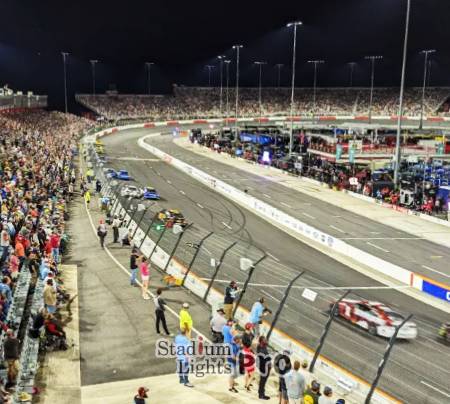 The easiest and most effective step is switching to LED lighting systems. Traditional lighting setups using metal halide or mercury vapor lamps are massive energy hogs. LEDs, on the other hand, can save up to 70% of that power. For example, if a racing venue currently runs 1,000W metal halide fixtures, swapping them for 400W LED floodlights could instantly cut power consumption by more than half while providing similar—or even better—illumination levels.
To put it in perspective, a mid-sized car racing track using 300 metal halide lamps at 1,000W each consumes about 300,000 watts. Switching to 400W LEDs drops that to 120,000 watts—a 180,000-watt reduction every hour those lights are on. Over a full racing season, that translates into tens of thousands of dollars saved on electricity bills. On top of that, LEDs last up to 50,000–100,000 hours, which means less downtime for maintenance and fewer replacements.
Smart Lighting Control Systems
Another effective way to save power is through smart lighting control. Modern LED systems can be integrated with sensors, dimmers, and timers to adjust brightness depending on what’s happening on the track.
For example, during practice sessions or maintenance hours, lights can operate at 50–70% brightness instead of full power. When the race starts or cameras start rolling, the system automatically brings everything back up to 100%. Some tracks also use motion sensors or zone control so that only the active parts of the track stay fully lit while unused areas dim down.
In large venues like Formula circuits or horse racing arenas, this kind of control can save 20–30% more energy on top of the savings from switching to LEDs. It’s also easier on the fixtures themselves—less stress from running at full brightness all the time means longer lifespan and more consistent performance.
Aim the Light, Don’t Waste It
Directional lighting is another trick that’s often overlooked but makes a big impact. Race tracks don’t just need brightness—they need precision lighting. With LEDs, you can aim beams exactly where they’re needed, whether it’s the braking zone, the pit lane, or the grandstand.
By adjusting the mounting angles, beam widths, and reflector designs, you can reduce light spill—the light that escapes into the sky or onto empty areas instead of the track. Every bit of wasted light is wasted energy. A well-aimed LED system can improve efficiency by another 10–15%, simply by making sure all the light hits the right surface.
Many newer racing venues now use asymmetric beam floodlights, which direct light forward in a wider, flatter pattern instead of spreading it evenly in all directions. This setup lights the track perfectly while minimizing glare and wasted output.
Regular Maintenance Makes a Difference
It’s easy to forget, but maintenance has a direct impact on energy use too. Over time, dust and dirt collect on lenses, reflectors, and poles, cutting down light output by as much as 20–30%. When that happens, operators often compensate by increasing brightness or adding more fixtures—both of which waste power unnecessarily.
Simply cleaning the fixtures and checking the alignment every few months can restore lost efficiency. Replacing old or discolored covers, fixing flickering drivers, and re-aiming fixtures after strong winds or weather damage can keep your lighting performing like new. A clean fixture doesn’t just look better—it shines brighter at the same wattage.
Optimize the Power Infrastructure
Finally, the electrical backbone of the lighting system matters more than most people realize. Using high-quality LED drivers, power converters, and voltage regulators ensures that every watt going into the system is used effectively. Poor-quality drivers can leak energy as heat or cause unstable brightness, which shortens fixture lifespan and wastes electricity.
Upgrading to a low-loss wiring system and using surge protection also prevents power fluctuations that can damage equipment over time. For larger race tracks, installing a centralized lighting control cabinet with monitoring software lets you track power use in real time. You can spot inefficiencies quickly and fine-tune the lighting output whenever needed.
Smarter Lighting for a Brighter, Greener Track
Reducing power consumption on a race track doesn’t mean making it darker—it means lighting it smarter. Between high-efficiency LEDs, precise aiming, automated controls, and regular upkeep, tracks can cut their energy use by 40–70% while keeping that stunning, high-speed glow that makes night racing so exciting.
After all, a well-lit track isn’t just about safety or visibility—it’s also about sustainability and long-term savings. With the right setup, the lights stay bright, the races stay thrilling, and the energy bills stay low. That’s a win for both racers and the planet.
| Method | Description | Estimated Power Saving (%) | Example of Energy Reduction |
|---|---|---|---|
| Switching to LED Lighting Systems | Replace old metal halide or mercury vapor lamps with energy-efficient LED floodlights. LEDs provide the same or better brightness at less than half the power and last up to 100,000 hours. | 60–70% | Switching 300 × 1,000W metal halides (300,000W) to 400W LEDs (120,000W) saves 180,000W every hour of operation. |
| Smart Lighting Control Systems | Use sensors, dimmers, and programmable timers to adjust brightness based on activity levels—lower output during practice, higher during races. | 20–30% (additional to LED savings) | Running lights at 60% brightness during non-race hours can reduce consumption by tens of thousands of watts per session. |
| Directional / Aimed Lighting | Aim LED floodlights precisely at the track surface using adjustable mounts and asymmetric beam angles to reduce light spill and glare. | 10–15% | Proper aiming ensures more light hits the track instead of the sky, improving visibility and efficiency. |
| Regular Maintenance | Clean lenses, re-aim fixtures, and replace damaged parts to restore brightness lost to dust or wear, keeping lighting output optimal. | 10–20% | Cleaning and alignment can restore up to 30% of lost brightness without increasing wattage. |
| Optimized Power Infrastructure | Upgrade wiring, use efficient LED drivers, and install voltage regulators or control cabinets to stabilize and monitor power flow. | 5–10% | High-quality electrical components minimize power loss and prevent voltage drops, leading to smoother performance and lower energy waste. |
| Combined Effect (LED + Smart Controls + Aiming + Maintenance) | When used together, these methods compound efficiency gains and drastically cut energy use across large-scale venues. | 40–70% total savings | A large race track could lower overall lighting power from 500,000W to 200,000–300,000W, saving thousands of dollars annually. |
So, How Many Watts Do You Really Need?
Let’s put all of this together with a rough estimate.
A small go-kart track might need somewhere between 20,000 and 50,000 watts total if using LED lighting.
A medium-sized horse racing track could require 100,000–250,000 watts, depending on length and brightness requirements.
A large car racing circuit, such as a professional-grade motorsport venue, could easily reach 500,000 to 1,000,000 watts or more, though that figure can drop significantly when using high-efficiency LED floodlights.
These are ballpark figures, of course. The best way to determine the right wattage for your race track is through a photometric lighting design plan, which calculates the exact number and placement of fixtures needed for even illumination and minimal glare.