


Below is a closer, more down-to-earth look at rugby field lighting, from design basics to costs, layout tips, and the common traps people fall into when upgrading.
Benefits of replacing the lighting to LED in rugby field
Why change when the old lights still turn on?
When people talk about upgrading rugby field lighting, the first reaction is often pretty honest: the old lights still work, so why bother? The answer usually comes down to performance, money, and flexibility. LED lighting is not just a newer version of the same thing. It changes how the field is used, how much it costs to run, and how comfortable it feels for players, refs, and even neighbors nearby.
Older systems like metal halide or high-pressure sodium were designed decades ago. They did their job, but they were never built for today’s expectations, where fields are used more often, energy prices keep rising, and clubs want more control over how their facilities run.
Energy savings that show up fast on the power bill
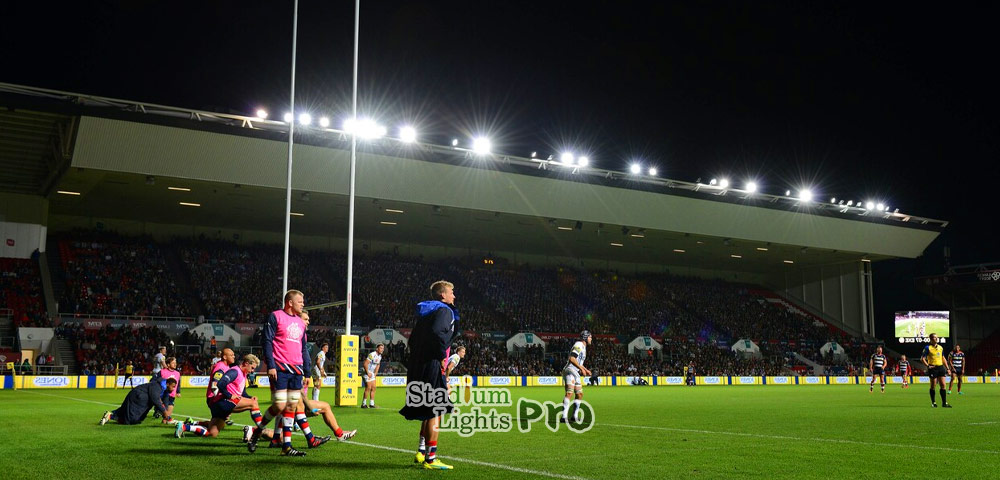
Energy consumption is usually the biggest eye-opener. Traditional rugby floodlights often run at 1,500 to 2,000 watts per fixture, sometimes even higher in stadium setups. Modern LED sports lights can hit the same lighting levels using 600 to 1,000 watts, depending on optics and mounting height.
On a full-size rugby pitch with 40 to 60 fixtures, that difference can mean saving 20,000 to 40,000 kWh per year. If electricity costs around USD 0.12 to 0.18 per kWh, clubs are often looking at USD 3,000 to 7,000 in annual savings just from power consumption alone. For fields that host training four or five nights a week, those numbers climb even faster.
Maintenance drops from a headache to a background task
Maintenance is another area where LEDs quietly change the game. Traditional lamps usually need relamping every 2 to 4 years, and sometimes sooner if they are switched on and off frequently. Each relamping cycle means lifts, labor, and field downtime, which adds up quickly.
LED fixtures are typically rated for 50,000 to 100,000 hours. For a rugby club using lights around 800 to 1,200 hours per year, that translates to 10 to 15 years of usable life before light output drops to around 70 percent. Fewer lamp failures also mean fewer dark spots mid-season, which players definitely notice during evening training sessions.
Light quality players can actually feel on the field
Better lighting is not just about brightness. LEDs provide instant full output, so there is no warm-up time. That matters when training starts right at dusk or when lights need to be turned back on after a brief power interruption.
Color rendering is another upgrade players and referees appreciate. With CRI values often above 80, LED lighting makes jerseys, pitch markings, and the ball look more natural. Tracking a high kick under clean white light feels very different compared to the slightly yellow or uneven glow of older systems. For referees, clearer color separation helps with quick calls during scrums, rucks, and line breaks.
Control and flexibility that fits modern rugby use
One of the biggest practical benefits is control. LED systems can be dimmed, zoned, or scheduled. A field might run at 200 to 300 lux for casual training, then jump to 500 lux or more for match nights. That flexibility reduces wasted energy and extends fixture lifespan. Many clubs find that smart controls alone can cut lighting costs by another 15 to 30 percent on top of energy savings.
What are rugby field lighting consist of
More than lights on poles
Rugby field lighting is often described casually as “floodlights,” but in reality it is a complete system. Each component affects how evenly the pitch is lit, how reliable the setup is, and how easy it is to manage over time.
Lights themselves and sports-specific optics
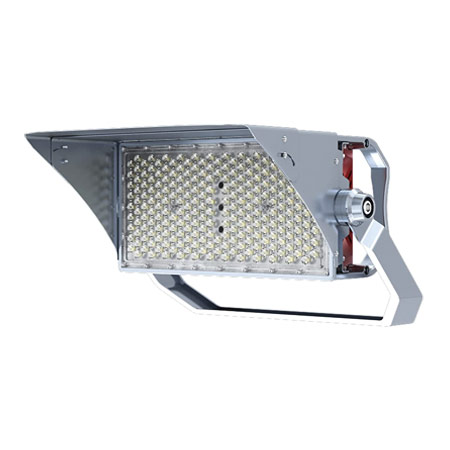
The fixtures are the most obvious part of the system. Modern rugby fields mainly use LED sports floodlights with asymmetric beam patterns. These optics are designed to throw light across a wide playing area while keeping glare under control. Instead of blasting light in all directions, the beam is shaped so more lumens land on the pitch where they are actually needed.
High-quality fixtures are usually rated IP65 or IP66, meaning they can handle heavy rain, dust, and strong winds. That matters for rugby fields exposed to weather year-round. Many fixtures also include surge protection of 10kV or higher, which helps prevent failures during storms.
Poles and mounting structures that define the layout
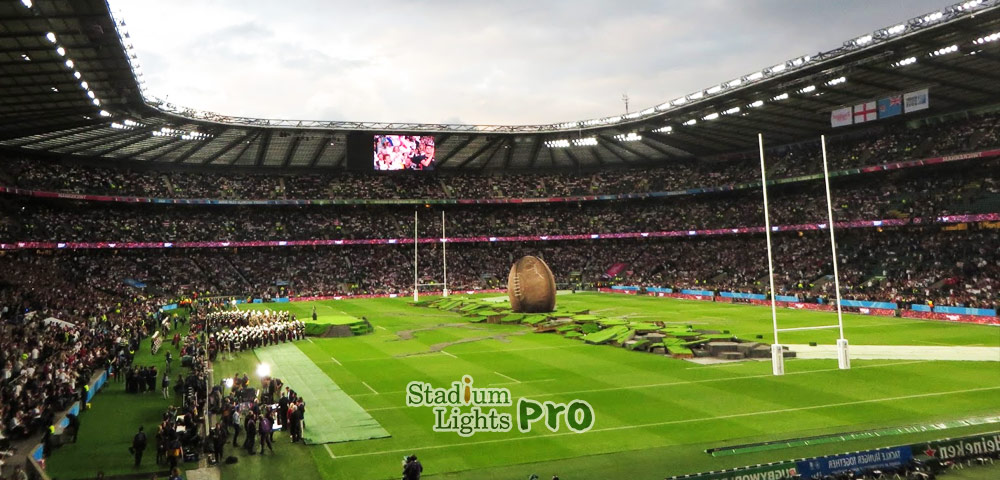
Lighting poles determine how the whole field is lit. Community rugby fields often use poles between 12 and 18 meters high, while competition venues may go up to 25 or even 30 meters. Taller poles allow wider beam angles and better uniformity, especially for high kicks and cross-field passes.
Most poles are made from galvanized steel and designed for wind loads specific to the region. With proper foundations, they can last 25 to 30 years, often outliving the lighting fixtures themselves. Pole placement also affects spill light, so spacing and height need to match both playing needs and local regulations.
Control system that keeps things efficient
Control systems have come a long way. What used to be a simple switch in a shed is now often a programmable lighting controller. These systems allow operators to schedule on and off times, set different lighting scenes, and even monitor energy usage.
For shared facilities, this is a big deal. Schools, rugby clubs, and local leagues can all use the same field without running lights at full output all the time. Fewer forgotten “all-night” light sessions means less wasted power and fewer complaints from nearby residents.
Power supply and cabling behind the scenes
The electrical backbone matters more than people think. Cables, distribution boards, and grounding systems keep everything stable and safe. Older rugby fields sometimes need upgrades because original wiring was designed for fewer fixtures or different load profiles.
The good news is that LEDs usually draw less current, even if total light output increases. After upgrades, many fields find their electrical systems actually run cooler and more reliably. Proper cabling and surge protection also help extend the lifespan of both fixtures and control equipment.
How it all works together on match night
When everything is designed as a system, the difference is obvious. Lights turn on instantly, brightness is even from touchline to touchline, glare is kept in check, and operators have real control over how the field is used. That smooth, predictable lighting experience is what players and officials notice most, even if they never think about the hardware behind it.
Lighting Design Guideline
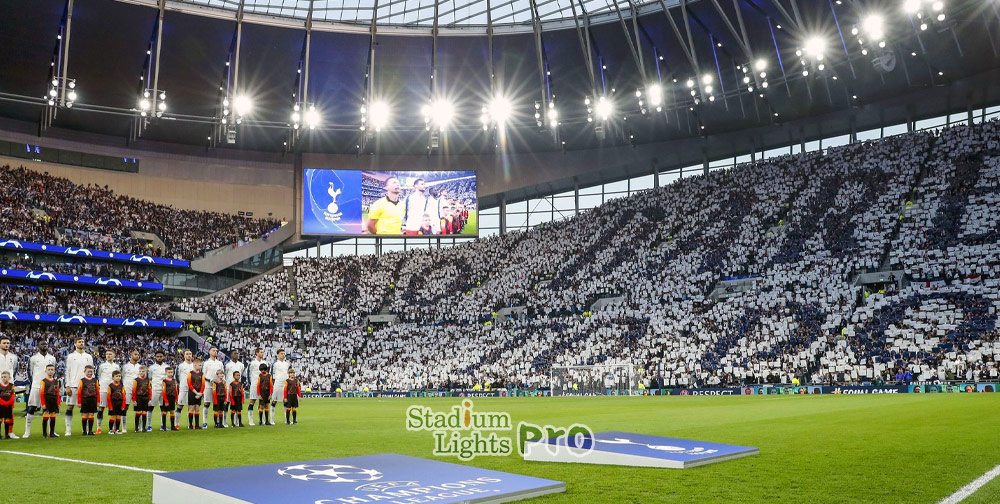
Getting rugby field lighting right isn’t just a matter of cranking up the watts. A well-designed system balances brightness, comfort, and performance so players, referees, and fans all get the best experience. Here’s a closer look at the main design considerations.
| Parameter | Recommended Range |
|---|---|
| Training / Recreational Lux | 200–300 lux |
| Amateur Match Lux | 300–500 lux |
| Professional / Broadcast Lux | 750–1,000 lux |
| Uniformity Ratio | 0.5–0.7 |
| CRI | 70–80+ |
| Color Temperature | 4,000K–5,700K |
Lux and Foot-Candles
The first thing to think about is how much light actually hits the pitch. Illuminance is measured in lux (lumens per square meter) or foot-candles, and the levels vary depending on the type of activity. For casual training or recreational games, 200 to 300 lux usually does the trick. Amateur league matches often aim for 300 to 500 lux, giving enough brightness for fast play without overdoing it.
When you move up to professional competitions or broadcast-level games, lux requirements jump. Many stadiums target 750 to 1,000 lux or more to satisfy TV cameras and high-speed play. At those levels, even small inconsistencies in brightness can be noticeable on TV, which makes uniformity and optics more than just numbers on paper—they directly impact how the game looks on screen.
Uniformity
Uniformity measures how evenly the light spreads across the entire pitch. A uniformity ratio of 0.5 means the dimmest areas still have at least half the brightness of the brightest spots. For rugby, designers usually aim between 0.5 and 0.7, depending on whether the field hosts amateur or professional matches.
Poor uniformity creates shadowy patches that players notice immediately, especially during line-outs or when chasing high kicks. Uneven lighting can make tracking the ball tricky and even increase the chance of minor injuries if players misjudge distances in dimmer zones. Proper pole spacing, aiming angles, and beam selection all contribute to maintaining smooth light distribution.
Color Rendering Index (CRI)
The CRI of a light source affects how natural colors appear under artificial lighting. For casual practice fields, a CRI of 70 is usually fine, but many clubs now aim for 80 or higher. Higher CRI values make it easier to distinguish the ball from the field, see jersey numbers clearly, and even help referees spot infractions faster.
Broadcasted matches benefit especially from a higher CRI, as TV cameras capture colors closer to how the human eye perceives them. Without it, whites can look yellowish, and greens can lose their vibrancy—subtle, but it changes the visual clarity for both viewers and players.
Color Temperature
Color temperature, measured in Kelvins (K), impacts how “warm” or “cool” the light feels. Most rugby pitches land between 4,000K and 5,700K, offering a crisp, slightly cool white light that feels bright and energetic.
Cooler tones tend to enhance contrast, making the ball and lines pop, which suits fast-paced sports like rugby. Some community fields opt for slightly warmer light to reduce glare and avoid annoying nearby residents, especially in suburban areas. Choosing the right temperature is a balance between clarity on the field and comfort for both players and the surrounding neighborhood.
Glare Control
Glare is more than just annoying—it can seriously affect gameplay. Excessive glare can blind players momentarily, make tracking the ball harder, and distract referees during critical moments. Spectators, especially in side stands, can also experience discomfort if the lighting isn’t properly designed.
Controlling glare relies on several factors: high-quality optics, careful aiming, and proper pole height. Cross-aiming fixtures diagonally and using shields on lights help direct illumination onto the pitch while minimizing light spilling into eyes or surrounding areas. A well-lit field doesn’t always mean the brightest field; it’s about delivering light where it’s needed without creating hotspots or glare zones.
Well-thought-out lighting design doesn’t just make games playable at night—it enhances safety, player performance, and spectator experience while keeping energy use and maintenance manageable.
Lighting Layout Tips
Once you’ve nailed the design targets for brightness, uniformity, and glare, the next step is figuring out how to actually place the lights on the pitch. Layout can make a huge difference in how even and comfortable the field feels at night.
| Parameter | Recommended Range / Typical Values |
|---|---|
| Pitch Size | 100m × 70m |
| Poles (Community Fields) | 6–8 poles |
| Poles (Larger / Broadcast Fields) | 10–16 poles |
| Fixtures per Pole | 4–6 fixtures |
| Pole Height | 12–30 meters |
| Fixture Wattage (Training) | ~600 W |
| Fixture Wattage (Competition) | 800–1,200 W |
How many lights and poles
A standard rugby pitch is roughly 100 meters long and 70 meters wide, not counting the in-goal areas. For smaller community or training fields, clubs usually go with 6 to 8 poles, each holding 4 to 6 LED fixtures. That setup typically delivers 200 to 300 lux, enough for casual matches and practice sessions.
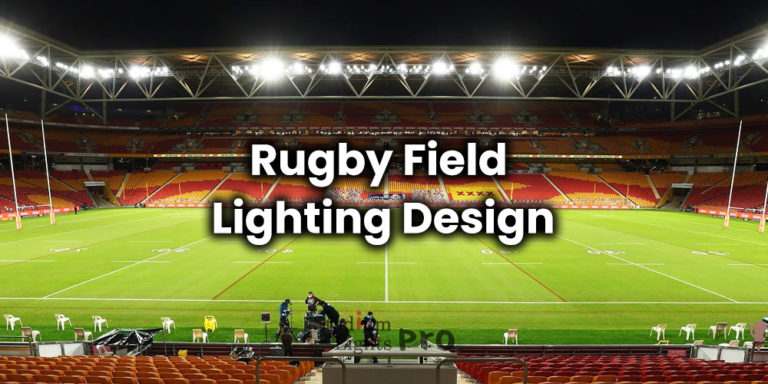
Larger venues, especially those hosting league or broadcast matches, may need 10 to 16 poles or even integrate lighting into the stadium structure. Fewer poles are possible, but that usually means higher mounting heights—sometimes up to 25 or 30 meters—and more powerful fixtures, which can increase costs and create more glare if not carefully aimed. Proper spacing is key to avoiding shadowy spots, especially in goal areas and around the halfway line.
Wattage considerations
Wattage is not just about making the field brighter; it has to match your lux targets, pole layout, and fixture efficiency. For example, a training field aiming for 300 lux might do the job with 600-watt LED fixtures, while a competition-level pitch targeting 500 to 750 lux may need 800 to 1,200 watts per fixture.
Choosing the right wattage also impacts energy bills and heat management. Overpowered fixtures can waste energy and cause glare, while underpowered fixtures leave dark patches. Designers often calculate total lumens per square meter and select fixtures that meet the brightness requirements while staying energy-efficient.
Aiming directions
How you aim each fixture is just as important as how many you install. Lights are usually aimed diagonally across the pitch instead of straight down, which helps reduce shadows and improves uniformity from one end to the other.
Cross-aiming from opposite sides is especially important for rugby, where the ball is often kicked high during line-outs, conversions, or tactical plays. Vertical visibility is critical, and diagonal aiming ensures high balls remain visible without creating hotspots or blinding players at ground level. Adjustable mounting brackets are often used so that angles can be fine-tuned after installation, which is handy if future upgrades or additional fixtures are added.
Planning for flexibility
It’s also smart to design with potential upgrades in mind. If a community field might host higher-level matches later, foundations and pole locations should be capable of supporting extra fixtures without major reconstruction. That forward planning can save tens of thousands in the long run.
Proper layout, wattage planning, and aiming aren’t glamorous parts of rugby field lighting, but they make a huge difference in playability, safety, and energy efficiency. A field that looks great on paper but is unevenly lit or glaring in real life quickly becomes a headache for players, referees, and fans.
Rugby Field Lighting Cost
When it comes to rugby field lighting, cost is usually the first thing clubs think about. Upgrading a field can feel like a big hit to the budget, but there’s more to the story than just the price tag. Looking at the bigger picture—including energy use, maintenance, and lifespan—makes it easier to see why a quality LED system often pays for itself over time.
| Parameter | Typical Values / Range |
|---|---|
| Community Pitch LED System | USD 120,000 – 250,000 |
| Semi-Professional / Regional Stadium | USD 300,000 – 600,000 |
| Large Professional / Broadcast Stadium | USD 1,000,000+ |
| Energy Use Example | 40 fixtures × 1,000 W × 1,000 hours = 40,000 kWh/year |
| Annual Electricity Cost (at USD 0.15/kWh) | ~USD 6,000 |
| Grants & Rebates | 20–40% of project cost |
| Additional Costs (transportation, cranes, commissioning) | +10–20% of budget |
Why cost matters beyond the initial install
It’s easy to focus only on what the system costs on installation day, but rugby lighting has long-term budget impacts. Energy bills, lamp replacements, and control system upkeep all add up over the years. Choosing a cheaper fixture that underperforms or needs frequent relamping can end up costing more over 10 to 15 years than a higher-quality LED setup.
What makes up the total cost
A full rugby field lighting project isn’t just buying lights. The total cost usually includes fixtures, poles, foundations, electrical works, control systems, and design fees. On top of that, practical elements like transportation, cranes, and commissioning often add another 10 to 20 percent to the budget.
For clubs retrofitting existing fields, costs can drop significantly if poles and foundations are already in place. In those cases, you mainly pay for the new fixtures, wiring, and installation labor.
Average costs for different types of fields
The size of the field and the level of play have a huge impact on costs. For a standard community rugby pitch, a complete LED system usually costs USD 120,000 to 250,000, depending on lux targets and layout. Semi-professional venues or regional stadiums can see prices between USD 300,000 and 600,000, while large professional stadiums with broadcast-quality lighting often exceed USD 1 million. Architectural integration and broadcast compliance push costs higher because the system must deliver uniformity, brightness, and CRI standards that meet TV production requirements.
Installation and running cost calculation
One of the biggest advantages of LED systems is lower running costs. Take a field with 40 LED fixtures at 1,000 watts each, running 1,000 hours per year. That adds up to 40,000 kWh annually. At a typical rate of USD 0.15 per kWh, electricity costs would be around USD 6,000 per year.
A comparable metal halide system could easily double that, plus relamping costs of several thousand dollars every few years. Over a decade, LEDs can save clubs tens of thousands of dollars, which quickly offsets the higher upfront investment.
Grants and funding options
For community clubs, schools, and local leagues, funding support can make a huge difference. Many regions offer grants and rebates for energy-efficient upgrades, often covering 20 to 40 percent of project costs. Some utility companies even provide extra incentives for systems with smart controls or dimming capabilities. For schools or youth programs, these grants can help justify a higher-quality system that increases usable hours without putting a strain on budgets.
Planning costs carefully, accounting for energy and maintenance over the years, and exploring grants can make upgrading to LED lighting far more accessible and cost-effective than it first appears.
Common Mistakes to Avoid When Replacing Rugby Stadium Lights
Upgrading rugby stadium lighting is a big investment, and there are a few pitfalls that can make the whole project less effective if you’re not careful. Understanding them can save both money and headaches down the road.
Copying someone else’s design
One of the most common mistakes is simply copying a nearby or well-known stadium’s lighting layout. Every rugby pitch has its own quirks—pole placement, surrounding buildings, spectator stands, and even local wind patterns all affect how light spreads. What works perfectly at one field might create dark spots, glare, or uneven coverage at another. It’s always better to perform a site-specific lighting design, including photometric simulations, rather than assuming one-size-fits-all.
Chasing maximum brightness only
Another trap is thinking that brighter is always better. Pushing lux levels too high not only wastes energy but can actually make the field less comfortable for players. Excessively bright lights reflect off wet grass, muddy patches, and goalposts, creating glare and distracting players during fast breaks or high kicks. A well-balanced system prioritizes uniformity and visual comfort over simply hitting the highest lux numbers.
Skipping control systems
Smart control systems are often seen as optional, but ignoring them is a common mistake. Clubs sometimes try to save upfront costs by leaving out dimming, zoning, or programmable controls. The result? Lights running at full power during casual practice, unnecessary energy bills, and reduced fixture lifespan. Installing a flexible control system can pay for itself within a few years by cutting energy use and making the field easier to manage.
Choosing suppliers based solely on price
Finally, price-shopping without considering quality can backfire. Cheaper fixtures may look fine on paper but often have inferior optics, lower CRI, or shorter warranties. Within a few seasons, you may see uneven light distribution, flickering, or failures that require additional maintenance. Investing in trusted brands and certified installers ensures reliability, reduces downtime, and keeps the pitch looking professional for years.
Where things tend to land
Rugby field lighting has come a long way from the buzzing floodlights of the past. With LED systems, clubs and stadiums have more control over brightness, energy use, and playing experience than ever before. When design guidelines, layout choices, and costs are looked at together, the result is a field that feels welcoming on a rainy Tuesday night and polished on match day.
Good lighting does not shout for attention. It simply lets the game breathe, run, and unfold under a clean, even glow. For rugby, that quiet reliability is exactly what keeps players focused and fans coming back.