Night skiing offers a unique experience, allowing ski resorts to extend their operating hours and give visitors more opportunities to enjoy the slopes. However, creating a comfortable and safe nighttime skiing environment requires more than installing powerful floodlights around the mountain. Poorly designed lighting can produce excessive glare, making it difficult for skiers to distinguish changes in terrain, recognize obstacles, and maintain clear visibility while moving downhill. The problem can become particularly noticeable on snow-covered slopes, where reflected light adds another layer of visual brightness.
Fortunately, there are several practical ways to reduce glare without sacrificing the illumination required for nighttime skiing. By selecting suitable LED floodlights, optimizing installation angles, incorporating anti-glare accessories, and improving overall lighting distribution, ski resorts can create a more comfortable visual environment. Understanding how these solutions work can also help operators make better decisions when installing a new lighting system or upgrading existing floodlights.
Understanding Light Glare in Ski Slope Lighting
Before selecting anti-glare equipment or adjusting existing floodlights, it is useful to understand what glare actually means and why it occurs. Not all bright lighting produces uncomfortable glare, and reducing glare does not necessarily require lowering the overall illumination level. The real objective is to control how light is distributed, where it travels, and how much of it reaches a skier’s eyes directly or indirectly.
What Is Glare from Ski Slope Floodlights?
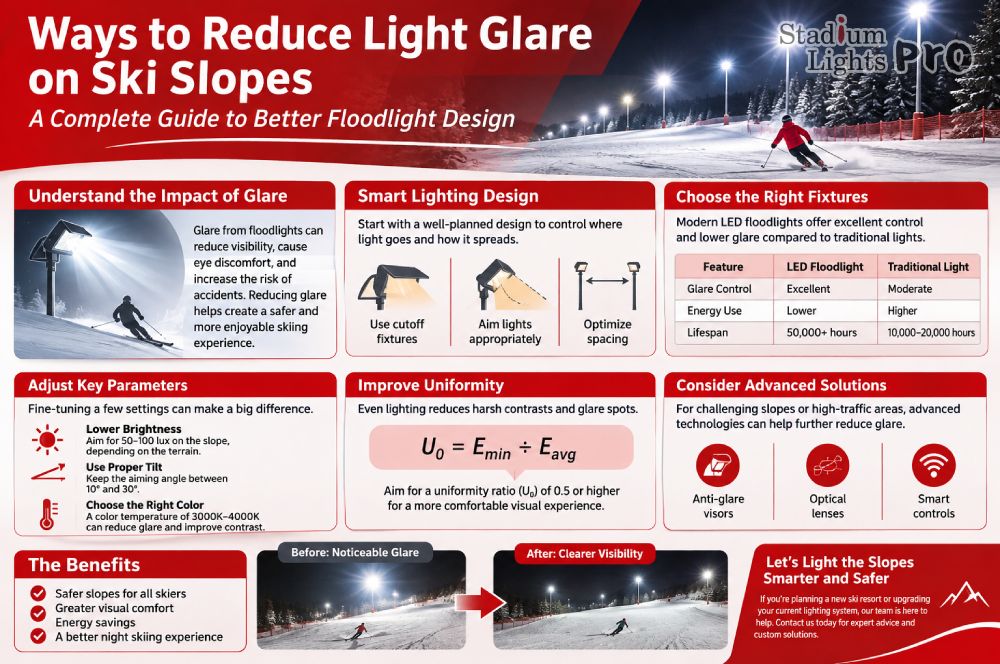
Glare occurs when a bright light source or an excessive brightness contrast within the field of vision causes discomfort or reduces the ability to see clearly. In ski resorts, it commonly comes from powerful LED floodlights installed on lighting poles, towers, buildings, or other elevated structures. When these fixtures are positioned incorrectly or produce excessively concentrated light, their brightness can interfere with the visual experience of people using the slope.
For example, imagine skiing downhill at night and looking toward the next section of the run. If a powerful floodlight is positioned directly within your line of sight, its brightness may make it difficult to distinguish the surrounding terrain clearly. Even if the snow receives sufficient illumination, direct light entering your eyes can reduce visual performance and make nearby objects appear less distinct. This can be particularly uncomfortable when skiers repeatedly move between brightly illuminated and relatively dark areas.
There are two main types of glare to consider when designing ski slope lighting. Discomfort glare refers to the unpleasant sensation caused by excessive brightness, which may cause skiers to squint, look away from the light source, or experience visual fatigue. Disability glare, on the other hand, occurs when light scattered within the eye reduces visual performance, making it harder to recognize objects, distinguish surface details, and identify differences in brightness.
Both types can affect nighttime skiing, although disability glare deserves particular attention because it can reduce visibility even when the overall lighting level appears sufficient. For ski resort operators, this means that simply increasing the number of lumens or installing higher-wattage floodlights does not necessarily produce a better lighting environment. Proper optical design and glare control are equally relevant to achieving comfortable and effective illumination.
Why Snow Makes Light Glare More Noticeable
Snow creates a distinctive challenge for outdoor lighting designers because its reflective properties differ considerably from those of ordinary ground surfaces. Unlike dark asphalt or soil, clean snow can reflect a substantial proportion of incoming visible light. The exact reflectance depends on factors such as snow age, grain size, moisture content, surface condition, impurities, and the angle at which light reaches the surface.
Fresh, clean snow generally has high visible reflectance, meaning that a considerable amount of light directed toward the ground can return to the surrounding environment. This reflection is not always mirror-like. Snow typically produces a combination of diffuse and directional scattering, depending on its physical characteristics and the lighting geometry. As a result, the illuminated environment can appear particularly bright, especially when several floodlights cover the same section of a slope.
The problem may become more noticeable when skiers look toward illuminated areas or move through sections where multiple floodlight beams overlap. Reflected brightness can also interact with direct light from the fixtures, increasing visual discomfort. Snow conditions change throughout the skiing season, so a lighting arrangement that feels comfortable under fresh powder may produce a different visual experience when the surface becomes compacted, wet, or icy.
For this reason, ski slope lighting should be evaluated under actual nighttime operating conditions rather than relying entirely on daytime inspections or computer simulations. Understanding how snow interacts with artificial lighting allows designers to develop more appropriate illumination strategies and avoid unnecessary increases in floodlight output.
Direct Glare, Reflected Glare, and Spill Light
Although direct glare, reflected glare, and spill light are related, they describe different lighting problems and require different corrective measures. Direct glare generally comes from a bright LED source that is visible within a skier’s field of vision, while reflected glare occurs when light is scattered or reflected by snow and other surrounding surfaces. Spill light refers to illumination extending beyond the intended target area, where it provides little practical benefit and may affect nearby buildings, landscapes, or other areas of the resort.
Understanding these differences helps lighting designers identify the actual source of discomfort instead of attempting to solve every problem by lowering floodlight brightness. For example, adding a glare shield may reduce direct exposure to the LED source, but it may not correct uneven illumination across the slope. Similarly, reducing the output of every fixture may lower overall brightness without addressing poor beam distribution or excessive light spill.
| Lighting problem | Main cause | Typical effect | Possible solution |
|---|---|---|---|
| Direct glare | Bright LED source visible to skiers | Visual discomfort and reduced visibility | Shielding and improved aiming |
| Reflected glare | Light reflected from snow and surrounding surfaces | Excessive brightness and visual fatigue | Better light distribution and intensity control |
| Spill light | Light extending beyond the intended area | Unnecessary illumination outside the slope | Asymmetric optics and shielding |
| Uneven illumination | Poor fixture layout or excessive beam overlap | Bright spots and dark areas | Lighting simulation and layout optimization |
A successful low-glare lighting design should address these factors together. By considering the fixture’s optical performance, installation position, brightness, and interaction with the snow surface, ski resorts can achieve a more balanced lighting environment without compromising the visibility required for nighttime activities.
How to Reduce Glare from Ski Slope Floodlights
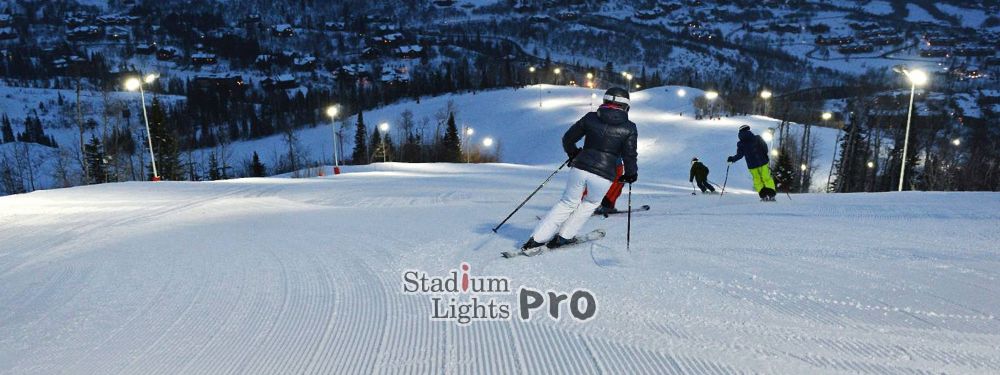
Reducing glare begins with understanding the relationship between the lighting fixture, its installation position, and the skier’s viewing direction. A high-output floodlight can provide comfortable illumination when its optics and orientation are properly selected, while a less powerful fixture can still produce uncomfortable glare if it is installed incorrectly. The following methods can be used individually or combined when designing a new ski slope lighting system or improving an existing installation.
Optimize Floodlight Installation Angles
The installation angle of an LED floodlight has a direct influence on glare because it determines where the light is directed and whether the bright emitting surface becomes visible to people using the slope. When a fixture points too far toward the horizon, its LED modules may enter the normal viewing direction of skiers, creating direct glare even when the snow receives an appropriate amount of illumination.
One way to address this problem is to adjust the fixture’s aiming direction so that more light reaches the intended skiing area and less enters the viewing direction of people moving along the run. For example, floodlights installed on towers along the sides of a slope can often be aimed toward the central skiing area rather than directly across the slope at eye level. Depending on the slope geometry, several fixtures can also be arranged to illuminate different sections from different directions, helping distribute light more evenly.
However, there is no single installation angle that works for every ski resort because the appropriate tilt depends on mounting height, horizontal distance, beam distribution, slope gradient, and the position of the target area. A fixture installed at a height of 15 meters, for example, will have different aiming requirements from one installed at 25 meters. The distance between the lighting pole and the illuminated section also changes the relationship between the fixture’s orientation and the resulting light distribution.
Designers should therefore evaluate fixture positioning using photometric data and actual site geometry rather than relying on a universal recommended angle. It is also worth checking the installation after the lighting system has been operating because snow accumulation, wind exposure, maintenance work, and accidental movement can gradually change the original aiming direction. Regular inspections help ensure that the fixtures continue to illuminate the intended areas without introducing unnecessary glare.
Choose LED Floodlights with Anti-Glare Optical Designs
The optical design of an LED floodlight determines how light leaves the fixture and spreads across the target area. It is one of the most useful factors to consider when selecting equipment for ski slope applications because an unsuitable beam pattern can create excessive brightness in certain directions while leaving other sections insufficiently illuminated.
Conventional floodlights may distribute light over a relatively broad area, which can be suitable for some outdoor applications but is not automatically appropriate for ski slopes. A poorly matched beam pattern may send excessive light toward the surrounding environment or create bright areas that are uncomfortable for skiers. Modern LED floodlights can incorporate different optical technologies to improve light control and provide more precise illumination.
Asymmetric Light Distribution
Asymmetric optics distribute light unevenly in different directions according to the requirements of the illuminated area. Instead of producing a symmetrical beam around the fixture, the optical system directs more light toward a specific section of the slope. This arrangement can be particularly useful when lighting long or wide ski runs from poles positioned along the sides.
For example, a floodlight with a suitable asymmetric distribution can direct light farther across the slope while limiting unnecessary illumination behind the pole or toward the surrounding landscape. This improves control over where the available light goes and can reduce the need to compensate for unsuitable beam patterns by installing higher-wattage fixtures. The result is a more targeted lighting arrangement that can support both visual comfort and energy efficiency.
Recessed LED Modules
Some LED floodlights use recessed light sources, where the LED modules sit behind a protective front structure rather than being completely exposed. This arrangement can reduce direct visibility of the light-emitting surfaces from certain viewing directions. When combined with suitable reflectors or lenses, recessed structures can contribute to better glare control, particularly in applications where fixtures are installed within the normal field of vision of users.
However, recessed LEDs alone do not guarantee low-glare performance. The overall optical design, fixture brightness, installation angle, and viewing geometry still determine the final result. Buyers should therefore evaluate the complete fixture rather than assuming that a recessed structure automatically makes a floodlight suitable for ski slope applications.
Precision Lenses and Reflectors
Precision optical components help control beam shape and reduce unwanted light distribution. Different lenses and reflectors can create narrow, medium, wide, or asymmetric beams, allowing designers to select a distribution that matches the dimensions of the slope and the height and position of the lighting poles.
When evaluating an LED floodlight, buyers should look beyond wattage and lumen output. They should also request the photometric distribution files, typically provided in IES or LDT format, so lighting designers can assess the actual beam characteristics. These files provide useful information about how light is distributed at different angles and allow designers to compare fixtures using professional lighting simulation software.
Install Anti-Glare Shields, Visors, and Louvers
Anti-glare accessories provide another practical way to control unwanted light from ski slope floodlights. They can be particularly useful when existing lighting fixtures produce uncomfortable direct glare and replacing the entire lighting system is not immediately practical. Depending on the fixture design, external shields, visors, and louvers can limit light emission toward selected directions while allowing the intended illumination to reach the skiing area.
Glare Shields and Visors
A glare shield is designed to block light from selected viewing directions. It can be attached to the front or sides of a floodlight to prevent direct visibility of the LED source from areas where people are likely to look toward the fixture. For ski slopes, shields can be particularly useful when lighting poles are positioned near the edges of a run, where skiers may frequently encounter the fixtures within their field of vision.
Visors can also help control upward and sideways light emission, making them useful for reducing unnecessary light spill toward nearby buildings, mountain landscapes, and other surrounding areas. Their shape and dimensions should be matched to the floodlight’s optical distribution because an incorrectly designed shield may block too much useful light, create uneven illumination, or increase heat accumulation around the fixture. Compatibility with the manufacturer’s housing and mounting structure should also be checked before installation.
Anti-Glare Louvers
Louvers use a series of internal or external structures to limit the angles from which a light source is visible. They can be effective when the main objective is to reduce direct glare from particular viewing directions while maintaining illumination toward the target area. For example, a louver may restrict high-angle visibility of an LED module while allowing most of the intended downward illumination to reach the snow.
However, louvers should not be selected based on appearance alone. Their spacing, depth, orientation, and compatibility with the fixture’s beam pattern all influence performance. A poorly matched louver may reduce the useful light output or create an uneven distribution, so it is advisable to evaluate the accessory through photometric calculations or a representative installation test.
The following table provides a general comparison of different glare-control accessories and their potential applications.
| Accessory | Main function | Suitable application |
|---|---|---|
| Glare shield | Blocks unwanted direct light | Floodlights visible from skier positions |
| Visor | Controls selected light directions | Reducing sideways or upward spill |
| Louver | Restricts source visibility from certain angles | Fixtures requiring directional glare control |
| Recessed optical structure | Limits direct exposure of LEDs | New low-glare floodlight installations |
Before adding accessories to an existing fixture, operators should check whether the manufacturer offers compatible options. Custom modifications can affect thermal performance, wind loading, waterproofing, and product warranty coverage, so any changes should be reviewed by a qualified lighting professional.
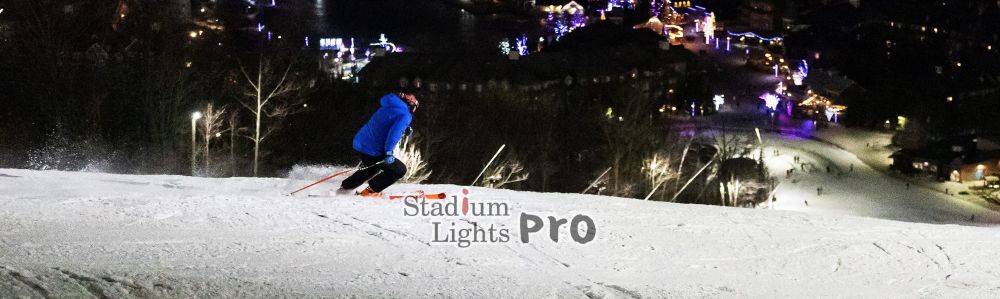
Optimize Floodlight Brightness and Illumination Levels
Excessive brightness is one of the most obvious contributors to visual discomfort, but simply reducing the power of every floodlight is not always the right solution. A ski slope needs sufficient illumination for users to identify the terrain, maintain spatial awareness, and recognize potential hazards. Reducing output too aggressively can create dark areas and make it harder to distinguish changes in the snow surface.
The better approach is to match illumination levels to the actual requirements of each section of the slope. A beginner run may have different lighting requirements from a steep advanced slope, while a recreational ski area may not need the same lighting performance as a competition venue. Designers should consider the intended activity, slope geometry, operating conditions, and applicable sports lighting standards before establishing the target illumination levels.
Understand Illuminance and Luminance
Illuminance measures the amount of light falling on a surface, and its unit is lux (lx). One lux equals one lumen per square meter, making it a useful measurement for evaluating how much light reaches the snow. Luminance, on the other hand, describes the brightness of a surface or light source as perceived from a particular direction and is measured in candelas per square meter (cd/m²).
For example, two areas may receive the same illuminance but appear different in brightness because their surface reflectance differs. This distinction is particularly relevant to ski slopes because snow can reflect a considerable amount of incoming light. Consequently, a relatively modest illuminance level may still produce a visually bright environment, depending on the snow conditions and surrounding visual field.
A well-designed lighting system should therefore consider both the amount of light reaching the snow and the brightness distribution within the skier’s field of vision. This helps designers avoid situations where the slope receives sufficient illumination but still feels uncomfortable because of excessive brightness or poor contrast.
Avoid Excessive Lighting Output
Installing higher-wattage floodlights does not automatically improve nighttime visibility. If a ski slope already receives sufficient illumination, increasing output may create unnecessary bright spots, increase reflected light, and make the overall environment less comfortable. The additional electricity consumption may also increase operating costs without providing a meaningful improvement in visual performance.
Instead, operators should measure existing lighting conditions and compare them with the design requirements for the intended skiing activity. The appropriate lighting level varies according to factors such as slope classification, skiing speed, terrain complexity, operating conditions, and applicable sports lighting standards. The design should also consider vertical illumination, not just horizontal illuminance on the snow, because vertical visibility helps skiers recognize people, objects, and changes in the terrain ahead.
Use Dimmable LED Floodlights
Dimmable LED floodlights allow operators to adjust output without switching off entire sections of the lighting system. For example, a resort may use different output settings during peak evening hours, quieter operating periods, maintenance activities, and slope closures. This provides greater flexibility than a conventional system in which every fixture operates at a fixed output throughout the evening.
However, dimming should be implemented carefully because some LED drivers may experience changes in efficiency, flicker behavior, or control performance at low output levels. It is worth confirming the dimming range, driver compatibility, control protocol, and minimum stable output before specifying a system. A properly configured dimming system can reduce unnecessary lighting while maintaining the visibility required for the conditions at hand.
Improve Floodlight Layout and Lighting Distribution
Even high-quality LED floodlights can produce uncomfortable glare when they are installed in an unsuitable arrangement. The number of fixtures, spacing between poles, mounting height, and direction of illumination all influence the final lighting result. A well-planned layout distributes light across the slope without creating unnecessary concentrations of brightness or leaving certain sections poorly illuminated.
Select Suitable Lighting Pole Positions
Lighting poles are commonly installed along the sides of ski slopes, near the boundaries of individual runs, or at elevated positions overlooking the skiing area. The exact arrangement depends on the slope’s width, length, gradient, and surrounding terrain. For a relatively narrow run, lighting from both sides may provide sufficient coverage, while wider slopes may require additional lighting positions or carefully selected fixtures with broader distributions.
The goal is to illuminate the intended area while keeping the brightest parts of the fixtures away from the normal viewing directions of skiers. Pole placement should also account for trees, buildings, safety barriers, ski lifts, and other structures that may obstruct the light. Taking these factors into consideration during the planning stage can reduce the need for expensive adjustments after installation.
Avoid Excessive Beam Overlap
Overlapping beams are sometimes necessary to achieve uniform illumination, but excessive overlap can create localized bright areas. Consider a slope illuminated by several floodlights installed along one side. If every fixture uses a wide beam and points toward the same central section, the area where the beams intersect may receive substantially more light than the surrounding snow.
This can create brightness differences that are uncomfortable when skiers move between illuminated sections. The solution is not necessarily to reduce the number of fixtures because doing so may introduce dark areas elsewhere. Instead, designers should adjust beam distributions, aiming directions, mounting positions, and output levels to create a more balanced result.
Reduce Reflected Glare from Snow Surfaces
Reflected light is one of the distinctive challenges of ski slope illumination. Even when floodlights are correctly positioned, the snow itself can contribute to excessive brightness. This means glare control should not focus exclusively on LED fixtures because the interaction between the lighting system and the snow-covered surface also deserves attention.
Understand Snow Reflectance
Snow reflectance varies according to several physical characteristics, including grain size, surface condition, moisture content, impurities, and the angle of incoming light. Fresh snow can have very high visible reflectance, while older or dirtier snow may reflect less light. Wet or icy surfaces can also produce different reflection patterns, making the visual environment change throughout the skiing season.
For this reason, it is difficult to establish one fixed reflectance value for every ski slope. During lighting design, snow conditions should be treated as a variable rather than assuming that the surface behaves like ordinary pavement. A lighting simulation can provide a useful starting point, but actual nighttime measurements should also be performed after the system is installed.
Control the Direction of Incoming Light
One practical approach to reducing uncomfortable reflections is to control how floodlights illuminate the snow. When fixtures are aimed appropriately, their light distribution can be adjusted to reduce unnecessary brightness in directions that are likely to affect skiers. This is particularly relevant when lighting poles are positioned close to the normal viewing direction of people moving downhill.
For example, a floodlight positioned too close to a skier’s line of sight may produce an uncomfortable combination of direct and reflected brightness. Adjusting the fixture’s orientation or using a different optical distribution may help reduce this effect while maintaining sufficient illumination across the target area. It is also useful to evaluate the slope from several viewing positions because a lighting arrangement that looks comfortable from the bottom of the run may create a different experience for someone skiing downhill or standing near the upper section.
Avoid Overlighting Snow-Covered Areas
Because snow can reflect substantial amounts of visible light, adding more illumination does not always improve visibility. Excessive lighting may increase the brightness of the entire scene without producing a corresponding improvement in the ability to distinguish surface details. This is particularly relevant when the slope already receives sufficient illumination for its intended use.
Rather than increasing output to compensate for poor visibility, operators should investigate whether the underlying problem comes from uneven distribution, direct glare, insufficient contrast, or unsuitable fixture positioning. Correcting the actual cause is generally more effective than simply installing brighter floodlights.
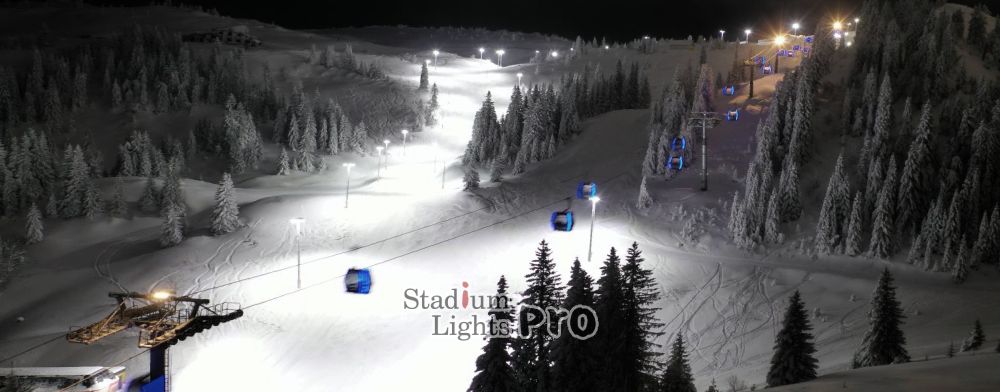
Select an Appropriate LED Color Temperature
Color temperature is another factor worth considering when designing comfortable nighttime lighting. Measured in kelvin (K), it describes the visual appearance of a light source, ranging from warm white to neutral and cool white. LED floodlights for outdoor applications are commonly available in several color-temperature options, including 3000K, 4000K, and 5000K.
Warm White, Neutral White, and Cool White
Different color temperatures create different visual impressions, although color temperature alone does not determine glare. A 3000K LED floodlight generally produces a warmer appearance, while a 5000K fixture looks cooler and more bluish-white. A 4000K fixture sits between these options and provides a neutral white appearance that is often considered for outdoor sports lighting.
| Color temperature | Appearance | General considerations |
|---|---|---|
| 3000K | Warm white | Softer visual appearance; may suit certain recreational environments |
| 4000K | Neutral white | Balanced appearance for many outdoor applications |
| 5000K | Cool white | Crisp appearance; commonly considered for sports and large outdoor areas |
For ski slope applications, 4000K is often a reasonable starting point for evaluating visual comfort and snow visibility, but it should not be treated as a universal requirement. The best choice depends on the application, surrounding environment, optical performance, color rendering, and the preferences of the ski resort operator. Where the resort is located near environmentally sensitive areas, the potential effects of the light spectrum on the surrounding environment should also be considered.
Does a Higher Color Temperature Create More Glare?
Not necessarily, because glare depends on several factors, including the apparent brightness of the source, its angular position, the background brightness, and the observer’s viewing direction. A 5000K floodlight does not automatically produce more glare than a 3000K floodlight with the same optical distribution and comparable operating conditions.
Nevertheless, spectral characteristics can influence visual perception, particularly in environments with highly reflective snow and dark surroundings. When selecting LED floodlights, operators should consider color temperature alongside luminous efficacy, color rendering, optical design, and the overall lighting layout rather than using color temperature as the only indicator of visual comfort.
Consider Color Rendering
Color rendering describes how accurately a light source reveals the colors of objects compared with a reference light source. A suitable color rendering index (CRI) can help users distinguish colored objects, clothing, signs, and equipment. For recreational ski slopes, color rendering should be considered as part of the overall lighting specification, particularly where identifying people and objects quickly is necessary.
However, higher CRI does not automatically mean lower glare. These are separate lighting performance characteristics and should be evaluated independently. A suitable floodlight should provide the required color appearance and recognition performance while also offering appropriate beam distribution and glare control.
Lighting Design Considerations for Different Types of Ski Slopes
Not every ski slope has the same lighting requirements. A wide recreational run, a narrow beginner trail, and a steep advanced slope present different challenges for floodlight placement and glare control. A lighting arrangement that works well in one area may not provide satisfactory results elsewhere, so ski resort operators should consider the characteristics of each slope before selecting fixtures or deciding where to install lighting poles.
Beginner Ski Slopes
Beginner slopes are generally designed for slower skiing speeds and easier terrain, but good visibility remains necessary because inexperienced skiers may have difficulty recognizing changes in the snow surface or judging their surroundings under artificial lighting. For these areas, designers should focus on consistent illumination, comfortable brightness, and minimizing strong contrasts between adjacent sections.
Floodlights should be positioned to avoid shining directly into the eyes of skiers moving downhill. Excessively bright areas should also be avoided, particularly near turning points and sections where beginners frequently stop. A combination of appropriately distributed floodlights and suitable output levels can provide a comfortable lighting environment without unnecessary glare. It is also worth considering the lighting around beginner areas, where instructors and groups of learners may remain stationary for longer periods.
Intermediate and Advanced Ski Runs
Intermediate and advanced slopes often involve greater skiing speeds, more complex terrain, and steeper gradients. These characteristics make lighting design more demanding because skiers need sufficient visibility to recognize surface changes, other people, and potential obstacles while moving at different speeds.
In these areas, designers should pay particular attention to vertical illumination and lighting distribution along the direction of travel. The position of floodlights should also be assessed from multiple viewing angles because a fixture that appears well-positioned when viewed from the bottom of a run may create direct glare when approached from above. For longer and wider runs, multiple lighting towers with carefully coordinated beam distributions may provide more balanced coverage than relying on a small number of extremely powerful fixtures.
Ski Training and Competition Areas
Training and competition areas may require more demanding lighting performance because skiers need to identify course markings, gates, other competitors, and terrain features clearly. Depending on the activity, the project may also need to satisfy requirements for spectators, officials, photography, or video recording. These additional requirements can influence the lighting levels, uniformity, color rendering, and fixture arrangement.
In these environments, lighting design should consider both horizontal and vertical illuminance, uniformity, glare, and color rendering. The applicable sports lighting requirements should be established before equipment selection because a recreational lighting design should not automatically be assumed to meet the requirements of a competition venue. Where television or professional video recording is involved, additional technical specifications may also apply.
Ski Lifts and Access Routes
Ski lifts, unloading areas, loading platforms, and access routes also require carefully designed lighting. Unlike the main ski run, these areas may involve people standing still, moving slowly, or looking toward the surrounding infrastructure, which can make direct glare from nearby floodlights particularly noticeable.
Lighting fixtures should therefore be positioned to provide adequate visibility without directing bright light toward lift users, operators, or pedestrians. It is also worth considering the transition between different lighting zones because moving from a very bright lift station into a comparatively dark section of a slope can make visual adaptation more difficult. Consistent and well-planned lighting transitions help create a more comfortable nighttime environment throughout the resort.
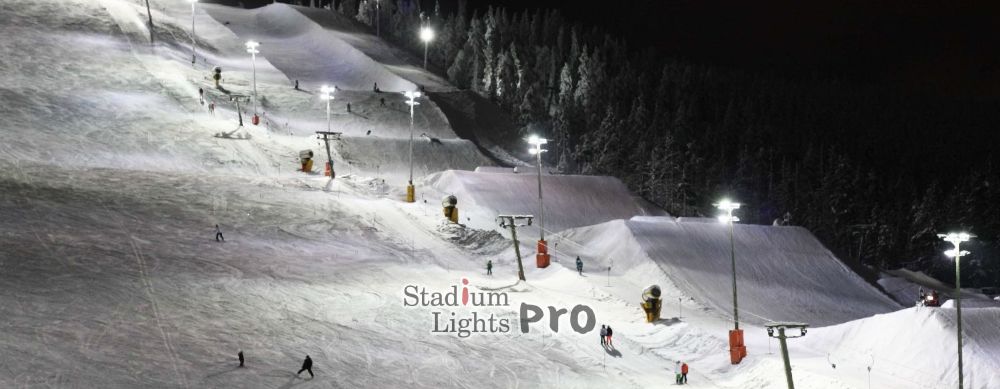
Cost of Reducing Glare in Ski Slope Lighting Projects
The cost of improving ski slope lighting depends on the size of the resort, existing infrastructure, number of fixtures, mounting heights, and the extent of the required modifications. In some cases, glare can be reduced through relatively simple adjustments to existing fixtures, while other projects may require new LED floodlights, additional lighting poles, control systems, or a complete redesign.
Understanding the different cost components helps resort operators select a solution that addresses the actual problem without spending unnecessarily on equipment. Before preparing a budget, it is useful to determine whether the existing system can be improved through adjustment and shielding or whether its optical performance is fundamentally unsuitable for the application.
Cost of Adjusting Existing Floodlights
If the existing fixtures have suitable optical characteristics but are installed at inappropriate angles, repositioning them may be one of the least expensive ways to improve the lighting. The work may involve adjusting the tilt angle, changing the aiming direction, tightening mounting brackets, or checking the alignment of individual fixtures. These changes can sometimes improve glare conditions without requiring the purchase of replacement equipment.
The actual cost depends on access conditions and equipment requirements. For floodlights installed on tall poles or towers, maintenance teams may need lifting equipment, specialist technicians, and temporary access restrictions. These expenses should be considered even when no new lighting equipment is required, particularly when work must be completed during a limited maintenance period.
Cost of Anti-Glare Accessories
Adding glare shields, visors, or louvers can be a practical alternative to replacing an entire lighting system. The price varies according to fixture dimensions, accessory materials, manufacturing requirements, and whether the component is a standard product or a custom design. A manufacturer-compatible accessory is generally easier to integrate because its dimensions and installation requirements have been developed for the corresponding fixture.
However, operators should also consider installation labor and the possibility that shielding may reduce useful light output, requiring additional adjustments. Before ordering accessories for every floodlight, it may be sensible to test them on a representative fixture and compare the resulting illumination and glare performance.
Cost of Replacing Existing Floodlights
When existing fixtures have unsuitable optical designs, poor efficiency, or limited control capabilities, replacing them with modern LED floodlights may provide a more comprehensive improvement. The total project budget can include the cost of floodlights and accessories, lighting poles and mounting brackets, electrical cables, installation labor, lifting equipment, lighting design, control systems, and nighttime testing.
The cost of the floodlights themselves is only one part of the project. For example, a replacement project involving 20 floodlights may have a substantially different total cost depending on whether existing poles, cables, and electrical infrastructure can be reused. A project that requires new foundations, upgraded distribution equipment, or extensive access work will naturally have a different budget from one that only involves replacing the fixtures.
Example Project Budget Structure
The following table illustrates how a ski resort might organize the budget for a glare-reduction project. The actual amounts should be established through supplier quotations and a site assessment because the scope of work can vary considerably between installations.
| Cost category | What it covers | Budget considerations |
|---|---|---|
| Lighting equipment | LED floodlights and optics | Fixture quantity and specifications |
| Anti-glare accessories | Shields, visors, and louvers | Compatibility and customization |
| Installation | Labor and lifting equipment | Pole height and site access |
| Lighting design | Simulation and calculations | Project size and design complexity |
| Control system | Dimming and smart controls | Driver and protocol compatibility |
| Testing | Measurements and commissioning | Site conditions and assessment scope |
There is no reliable universal price for reducing ski slope glare because the scope of work varies so widely. A small project involving fixture adjustments may have a relatively simple cost structure, while a large resort-wide upgrade involving new poles, electrical infrastructure, and intelligent controls will require a much more detailed quotation. The best approach is to begin with a site assessment and identify which modifications are actually necessary before committing to a large equipment budget.
Common Mistakes to Avoid When Reducing Floodlight Glare
Many glare problems occur because lighting systems are selected or installed based on incomplete information. Avoiding a few common mistakes can help ski resorts achieve better lighting performance while reducing unnecessary costs. It also helps operators distinguish between problems that can be corrected through simple adjustments and those that require more substantial changes to the lighting system.
Reducing Wattage Without Checking Visibility
One common mistake is lowering floodlight power whenever skiers complain about glare. Although this may reduce the apparent brightness of the lighting system, it can also create dark areas and compromise visibility. If the actual problem comes from direct exposure to LED sources, poor beam distribution, or incorrect aiming, reducing the output of every fixture may not solve it.
The better approach is to identify the source of glare first and then select an appropriate corrective measure. For example, changing the aiming direction or installing a suitable glare shield may address direct glare more effectively than lowering the output of every floodlight. Lighting measurements should also be taken after any adjustment to confirm that the slope still receives adequate illumination.
Choosing Floodlights Based Only on Lumen Output
A fixture with a high lumen rating may appear attractive because it promises substantial light output, but total luminous flux does not indicate how efficiently the light reaches the target area. Two floodlights with similar lumen outputs can produce very different lighting distributions, depending on their optical design and beam characteristics.
One fixture may provide concentrated illumination with considerable spill, while another may distribute light more evenly across the intended skiing area. Photometric data should therefore be reviewed before making a purchasing decision, and the selected fixture should be evaluated using the actual geometry of the project rather than its headline lumen rating alone.
Ignoring the Position of Skiers
Some lighting designs focus mainly on how the slope looks from the ground or from resort buildings, overlooking the actual experience of people skiing on the run. A floodlight may appear well-positioned when viewed from the side of the slope but become uncomfortable when seen from a downhill approach. This can happen because the skier’s viewing direction changes continuously while moving through the illuminated area.
Testing the system from representative skier positions helps reveal these problems. Designers should consider the upper, middle, and lower sections of the slope, together with the directions in which users are likely to look. This makes it easier to identify fixtures that require repositioning or additional shielding.
Installing Shields Without Checking Their Effects
Anti-glare accessories can improve source shielding, but they may also reduce useful light output. An excessively deep visor or poorly designed louver can block part of the intended beam and create uneven illumination, particularly when several fixtures are used to cover the same area.
Before installing accessories across an entire resort, it is sensible to test them on a representative fixture and compare the results. The evaluation should consider not only whether direct glare has been reduced but also whether the snow still receives the required illumination. Compatibility with the fixture’s thermal and mechanical design should also be checked.
Overlooking Snow Conditions
Lighting performance should not be assessed only under one set of surface conditions because fresh snow, compacted snow, and icy areas can produce different reflected-light patterns. A lighting arrangement that appears comfortable during one inspection may feel different under other snow conditions, particularly when surface moisture or reflectance changes.
If possible, the lighting system should be evaluated under more than one representative condition during its operating season. This provides a better understanding of how the system performs in the actual environment and helps operators determine whether additional adjustments are needed.
Failing to Maintain Lighting Equipment
A well-designed system can gradually become less effective if fixtures are not maintained. Accumulated dirt, damaged lenses, loose brackets, aging seals, and changes in fixture orientation can all influence performance. These problems may reduce useful illumination or cause light to travel in directions that were not intended in the original design.
Regular inspections help maintain the original beam distribution and reduce the likelihood of unexpected glare problems. Maintenance teams should also keep records of fixture replacements, aiming adjustments, control settings, and lighting measurements so that changes in performance can be identified more easily.
Creating a More Comfortable Nighttime Skiing Environment Through Better Lighting Design
Reducing glare from ski slope floodlights requires more than choosing a lower-wattage fixture or installing an anti-glare accessory. It involves understanding how light interacts with the terrain, snow surfaces, lighting equipment, and the people using the slope. Proper floodlight positioning, suitable asymmetric optics, effective shielding, balanced illumination levels, and intelligent dimming can all contribute to a more comfortable nighttime environment.
At the same time, glare reduction should never come at the expense of visibility. Skiers still need sufficient illumination to recognize terrain changes, other people, and potential obstacles. A successful lighting system balances these requirements through professional calculations, suitable equipment selection, and real-world testing. By considering the entire lighting environment rather than focusing on individual fixtures, ski resort operators can make improvements that benefit both visual comfort and operational performance.
For ski resort operators planning a new installation or looking to improve an existing lighting system, starting with a professional assessment can help identify the actual causes of glare and avoid unnecessary equipment replacement. Our team can help you explore suitable LED floodlighting solutions for ski slopes, including fixture selection, optical distribution, anti-glare accessories, lighting layouts, and project-specific recommendations. If you are planning a ski resort lighting project or experiencing glare problems with your existing floodlights, feel free to contact our company for a professional consultation. We would be happy to discuss your project requirements and help you develop a lighting solution that provides comfortable illumination, reliable performance, and a better nighttime skiing experience.