Walk into a sports dome and the first thing you notice is rarely the ceiling height or the structure itself. It is the light. If the lighting feels flat, uneven, or harsh, players notice it right away, and so do coaches, referees, and spectators. Sports dome lighting is not just about seeing the ball. It affects performance, safety, comfort, and even how a game looks on camera.
Because sports domes host everything from casual training sessions to televised competitions, lighting requirements can shift a lot. Brightness levels, uniformity, color quality, and glare control all come into play. Getting these elements right takes more than adding powerful fixtures. It requires understanding how people actually use the space and what different sports demand.
What Are the Lighting Requirement and Importance to Sports Dome Users
How Lighting Directly Affects Player Performance and Safety
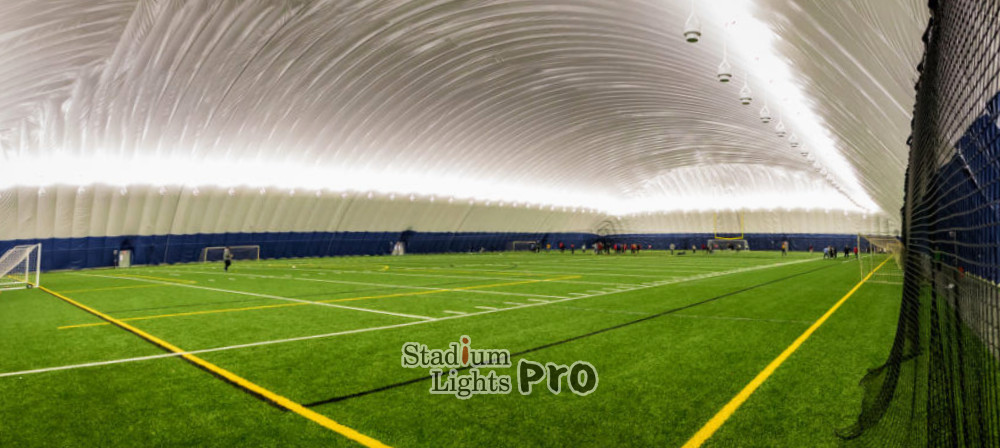
Step onto a court or field inside a sports dome, and lighting becomes part of the game whether people realize it or not. Players depend on clear, stable visibility to judge distance, speed, and trajectory, especially in fast-paced sports like basketball, futsal, or badminton. When a ball is moving at 60 to 80 km/h, even a short moment of visual loss caused by shadows or uneven lighting can throw off timing.
In most indoor sports domes, recommended horizontal illuminance during regular play sits around 300 to 750 lux, depending on the sport and level of use. If lighting drops below that range or fluctuates too much across the playing surface, players start compensating without realizing it. Reaction time slows, depth perception gets fuzzy, and the risk of collisions or awkward landings goes up. Good lighting does not just help players see the ball, it helps them move with confidence and stay focused through long sessions.
Why Coaches and Referees Care About Lighting Quality
For coaches and referees, lighting quality shapes how accurately they read the game. Referees need consistent brightness to track fouls, foot placement, and boundary lines. Uneven illuminance or glare can make a legal play look questionable, or hide contact entirely. In competitive matches, where decisions happen in fractions of a second, lighting clarity supports fairness.
Coaches also rely on proper lighting when analyzing movement and technique. In domes with poor vertical illuminance, it becomes harder to see body positioning, hand placement, or ball spin, especially during aerial plays. Many competition-level domes aim for vertical illuminance levels of 500 lux or higher, precisely because it makes player movements easier to read from the sidelines.
The Viewing Experience for Spectators and Media
Spectators may not talk about lux levels or uniformity ratios, but they feel the results immediately. When lighting is balanced and comfortable, games feel smoother and easier to follow. Eyes do not strain as much, and people stay engaged longer. In contrast, harsh glare or patchy brightness makes watching tiring, even during short matches.
For domes that host local leagues or school tournaments, lighting also affects how games look in photos and videos. Smartphones and basic cameras struggle under inconsistent lighting, leading to dark faces or washed-out highlights. With even illumination and proper color rendering, jerseys look true to color, and action shots feel more lively. That visual quality helps teams promote themselves and makes events feel more polished.
Operational Benefits for Sports Dome Owners and Managers
From a facility perspective, lighting ties directly into how usable a sports dome really is. Well-designed systems allow domes to operate from early morning until late at night without sacrificing visual comfort. Adjustable lighting levels mean the same space can shift from casual training at 300 to 400 lux to competitive matches at 750 lux or more with just a control change.
A dome that delivers consistent lighting across different activities is easier to schedule and more appealing to renters. Clubs, schools, and event organizers tend to favor venues where lighting already meets recognized sports lighting standards, because it reduces complaints and last-minute adjustments. Over time, lighting quality becomes part of a dome’s reputation, shaping whether it feels professional or temporary, reliable or frustrating.
Brightness Level Requirement
What Are Horizontal and Vertical Illuminance
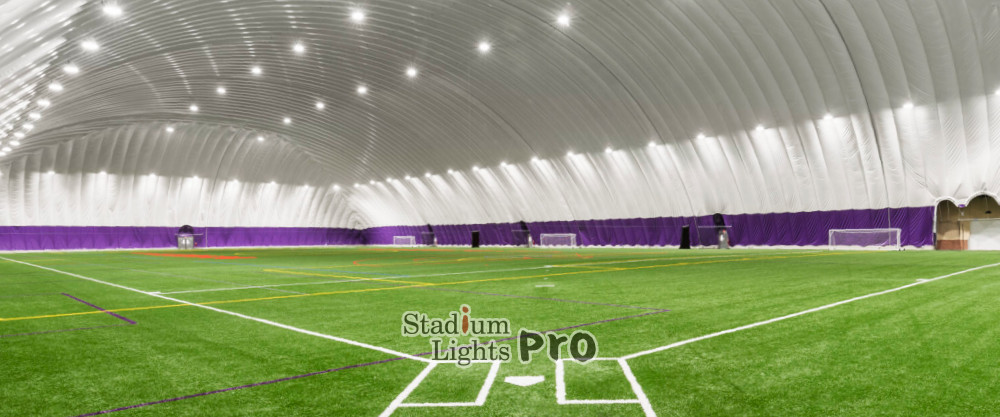
When people talk about brightness in a sports dome, they are usually talking about illuminance, which is measured in lux or foot-candles. Lux is more common internationally, while foot-candles are still used in some regions. Either way, both describe how much light actually reaches a surface, not how bright a fixture looks when you stare at it.
Horizontal illuminance refers to the light level on the playing surface, such as the court, turf, or floor. This is what helps players clearly see boundary lines, court markings, and the ball when it is on or near the ground. For sports with fast footwork like basketball or futsal, consistent horizontal lighting makes it easier to judge spacing and react quickly.
Vertical illuminance, on the other hand, measures light on upright surfaces. This includes players’ bodies, faces, goal frames, nets, and balls in the air. Vertical lighting becomes especially noticeable in sports that involve frequent aerial movement, such as volleyball, badminton, or indoor soccer. Without enough vertical light, a ball can visually fade against the background, even if the floor itself looks bright.
One common problem in older or budget-focused domes is putting almost all the attention on horizontal illuminance. The floor may measure 700 lux, but players still complain that the ball disappears mid-flight. That usually means vertical illuminance is too low or uneven. Balanced lighting design treats horizontal and vertical illuminance as a pair, creating a playing environment that feels stable and predictable rather than visually tiring.
Recommended Lux and Foot-Candle Levels for Different Sports and Different Types of Sports Dome
Not all sports ask the same thing from lighting, and that is where brightness recommendations start to vary. In a recreational badminton or table tennis dome, lighting levels around 300 to 500 lux, roughly 30 to 50 foot-candles, are often enough for comfortable play. These sports rely on quick reactions but usually take place in smaller courts with closer viewing distances.
Basketball and volleyball generally need more brightness because of faster movement, jumping, and frequent ball tracking above eye level. Many facilities aim for 500 to 750 lux for regular use, especially in domes that host leagues or school competitions. Indoor tennis and soccer often fall into a similar range, though ceiling height plays a big role. A dome with a 12-meter ceiling will need more powerful fixtures or tighter beam control than one with an 8-meter ceiling to achieve the same light level on the court.
Multi-purpose sports domes that host formal competitions usually push brightness higher. 750 to 1000 lux is common for competition-ready setups, especially when spectators are present. Large domes designed for regional or national events may go beyond 1200 lux, mainly to support video recording, photography, and media coverage. At that level, fixture placement and glare control become just as important as raw output.
| Sports/Dome Type | Horizontal Illuminance (lux) |
|---|---|
| Recreational Badminton/TT | 300 – 500 |
| Basketball/Volleyball | 500 – 750 |
| Indoor Tennis/Soccer | 500 – 750 |
| Competition (Multi-purpose) | 750 – 1000 |
| Regional/National Events | 1200+ |
Training vs Competition Lighting Standards
Training and competition do not need to look the same, and lighting does not have to be locked at one level all the time. During training sessions, players are often focused on drills, technique, and repetition. Lighting levels around 300 to 500 lux, paired with good uniformity, usually feel comfortable and reduce unnecessary energy use.
Competition lighting is a different story. Faster gameplay, more intense focus, and the presence of referees and spectators all raise expectations. Competitive matches often call for 750 lux or higher, along with tighter control over uniformity and glare. Players need to track the ball instantly, referees need visual clarity for decisions, and spectators expect a clean, professional look.
Many modern sports domes solve this by using adjustable or zoned lighting systems. These allow operators to switch between training mode and competition mode without running the lights at full power all day. Over time, this flexibility helps manage operating costs while still meeting higher lighting requirements when it counts.
International Lighting Standards and Why They Matter
International lighting standards exist to keep expectations clear and consistent across different venues. Organizations such as the Illuminating Engineering Society and various international sports federations publish guidelines covering illuminance levels, uniformity ratios, glare limits, and color quality.
For indoor sports, these standards often specify minimum horizontal illuminance values and acceptable ratios between minimum and average brightness, such as a uniformity ratio of 0.6 or higher for competition use. They may also recommend minimum vertical illuminance levels to support player visibility and media needs.
Even though these standards are not always legally required, they are widely used for tournament approval, insurance assessments, and facility benchmarking. Following recognized guidelines also gives dome owners room to grow. A facility designed around international standards today is far more likely to handle higher-level events in the future without major lighting upgrades.
Lighting Uniformity Standards
What Is Light Uniformity and Why Players Notice It Right Away
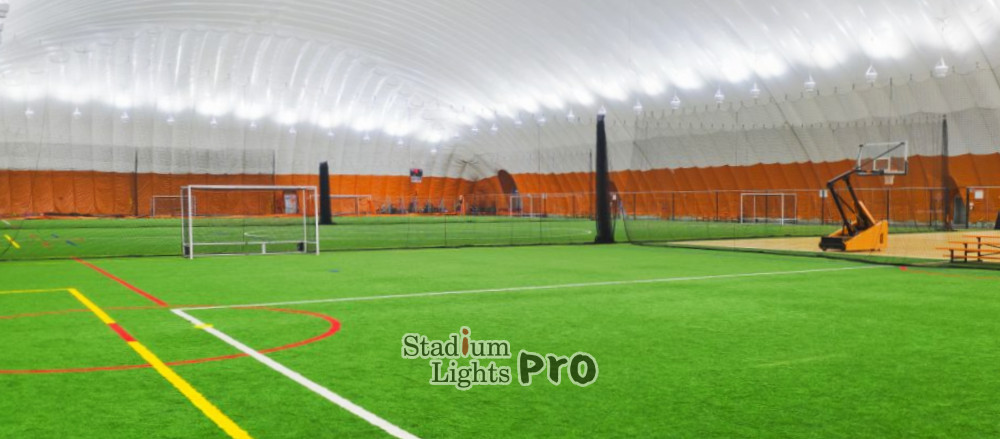
Light uniformity is all about how evenly light spreads across the playing area, not just how bright the dome looks overall. A sports dome can easily hit an average of 700 lux and still feel uncomfortable if one corner sits at 300 lux while another is pushing past 900. Players notice these changes instantly, even if they cannot explain why the space feels “off.”
When athletes move repeatedly between bright and dim zones, their eyes are forced to adjust over and over again. That constant adjustment leads to eye fatigue, slower reaction times, and missed cues, especially in fast sports like volleyball, basketball, or futsal. In extreme cases, uneven lighting can even affect balance and depth judgment, which increases the chance of missteps or collisions.
Uniformity is usually expressed as a ratio between minimum illuminance and average illuminance across the playing surface. The closer these two numbers are, the smoother the visual experience feels. In competition-ready sports domes, a uniformity ratio of 0.6 or higher is commonly targeted. Training-only facilities may accept ratios closer to 0.5, but anything lower tends to feel patchy once games speed up.
| Aspect | Standard/Recommendation |
|---|---|
| Uniformity Ratio (Competition) | 0.6 or higher |
| Uniformity Ratio (Training) | 0.5 (acceptable) |
| Glare Control | Keep glare ratings within controlled limits, avoid direct line-of-sight fixtures |
| Fixture Spacing & Layout | Even spacing with overlapping light patterns, avoid dark spots |
| Maintenance | Regular checks for dust and damaged components (up to 20% light loss over time) |
Suggested Uniformity Ratio and Glare Control Standards
Uniform lighting and glare control are closely connected. A dome may technically have even light levels, but if a few fixtures are much brighter than the rest and sit directly in a player’s line of sight, discomfort quickly follows. Glare reduces contrast, makes it harder to track the ball, and can momentarily blind players during jumps or quick turns.
Most sports lighting guidelines recommend keeping glare ratings within controlled limits and positioning luminaires outside common viewing angles. In practical terms, that means avoiding fixtures directly above center courts or goal areas unless they are properly shielded. Good glare control is about smart direction, not lowering brightness.
Modern sports luminaires use advanced optics, diffusers, and cutoff angles to spread light evenly while keeping the source itself less visible. When done right, players experience bright courts without ever feeling like they are staring into a spotlight. Spectators benefit too, as balanced lighting makes games easier and more comfortable to watch for extended periods.
Practical Ways to Avoid Dark Spots in Sports Domes
Dark spots rarely happen by accident. They usually come from rushed layouts, poor spacing, or ignoring how the dome’s structure affects light distribution. Beams, ventilation ducts, scoreboards, and fabric seams can all block or redirect light if they are not accounted for during the design phase.
A well-planned layout spaces fixtures evenly and uses overlapping light patterns instead of isolated pools of brightness. Overlap ensures that if one fixture underperforms slightly, surrounding lights help fill the gap. This approach is especially useful in large domes where mounting heights can exceed 10 or 12 meters.
Modern LED systems make adjustments much easier than older metal halide setups. Adjustable beam angles and precise aiming allow lighting designers to fine-tune uniformity after installation. Regular maintenance also plays a quiet but meaningful role. Dust accumulation can reduce light output by 10 to 20 percent over time, and a single failed driver can create a noticeable dark patch if left unchecked.
Color Temperature and CRI Standards
Color quality shapes how a sports dome feels the moment someone walks in. Color temperature, measured in Kelvin, describes whether light looks warm or cool. Most sports domes lean toward neutral or cool white light, typically between 4000K and 5700K. This range feels clean and energetic, helping players stay alert without making the space feel harsh or clinical.
Color Rendering Index, or CRI, measures how accurately colors appear under a light source. Higher CRI values make it easier to distinguish between similar jersey colors, spot boundary lines, and track the ball against different backgrounds. For general recreational play, a CRI of 70 or above is usually acceptable. Competitive domes and broadcast-ready facilities often aim for CRI 80 or higher, where colors appear more natural and vivid on camera.
Together, color temperature and CRI influence long-term comfort. Lighting that is too cool can feel tiring over time, while poor color rendering makes everything look flat and dull. A dome with balanced color quality feels more natural to the eyes, supports longer sessions, and creates an atmosphere that players and spectators want to come back to again and again.
Special Consideration for Broadcasting
Why Broadcast Lighting Is a Different Game
Once cameras enter a sports dome, lighting expectations change fast. The human eye is forgiving. Cameras are not. Broadcast equipment needs much stronger and more consistent vertical illuminance to clearly capture facial expressions, jersey numbers, and fast-moving action. In many broadcast-ready indoor venues, vertical illuminance targets rise to 1000 lux or higher, especially for professional or semi-professional events.
This becomes especially noticeable in sports with a lot of vertical movement, such as volleyball, basketball, or badminton. Without enough vertical light, players’ faces look flat or shadowed on screen, even if the court surface itself appears bright. For broadcasters, that lack of depth makes the footage feel dull and low quality, regardless of how exciting the match actually is.
Flicker Control and High-Speed Cameras
Flicker is another issue that only shows up once cameras are involved. Many spectators never notice it, but high-speed and slow-motion cameras pick up flicker instantly. What looks smooth in real life can turn into visible banding or pulsing on video.
That is why broadcast-oriented sports domes rely on professional LED drivers with high flicker-free performance. In technical terms, this often means flicker percentages below 1 percent and high-frequency drivers that remain stable even when dimmed. This matters most during replay shots, slow-motion sequences, and highlight clips, which are now standard in most sports coverage.
A dome that ignores flicker control may still host games, but it quickly becomes unsuitable for televised events, streaming platforms, or even basic recording by media teams.
Color Consistency and Camera-Friendly Lighting
Broadcasting also demands consistent color temperature and color rendering across the entire playing area. Cameras exaggerate differences that the human eye tends to ignore. If one side of the court sits at 5000K and another drifts closer to 4200K, the footage can look patchy and unbalanced.
For this reason, broadcast lighting designs often lock fixtures into tight color tolerances and avoid mixing different luminaire models. Even small shifts in color can create noticeable problems during live cuts between camera angles. In many professional setups, lighting design starts with camera needs first, then adapts to player comfort and operational efficiency afterward.
Tips to Fulfil Sports Dome Lighting Standards
Plan for How the Dome Will Be Used Over Time
Meeting sports dome lighting standards becomes much easier when planning starts early. A dome built only for casual training today may need to host league matches or tournaments within a few years. Designing lighting systems with future flexibility avoids expensive retrofits later on.
For example, installing fixtures capable of delivering 1000 lux but operating them at 400 lux during training gives operators room to grow. With proper controls, the same system can support youth practice sessions, competitive matches, and special events without hardware changes.
Work With Sports Lighting Specialists
Sports lighting is a niche of its own. Working with professionals who understand indoor sports environments helps prevent common mistakes. They can model illuminance levels, test uniformity ratios, and predict glare issues before anything is installed.
Lighting simulations allow designers to see how light behaves at different mounting heights and beam angles. This is especially useful in domes with curved roofs or fabric structures, where reflections and shadows behave differently than in traditional buildings. Good planning on paper saves years of frustration on the court.
Use Smart Controls to Match Real Usage
Modern LED lighting systems are not just about brightness. Smart controls allow operators to adjust light levels, zones, and sometimes even color temperature based on activity. Training sessions can run at 300 to 500 lux, while competitions jump to 750 lux or more with a preset scene.
This kind of flexibility improves user comfort and reduces wear on the system. It also helps manage energy costs, especially in domes that operate 12 to 16 hours a day.
Maintain Lighting Performance Over Time
Even the best lighting system slowly changes if it is not maintained. Dust buildup can reduce output by 10 to 20 percent over a few years. Aging drivers may affect uniformity or flicker performance. Regular checks help catch these issues early.
Measuring actual lux levels every few years ensures the dome still meets its intended lighting standard. Cleaning fixtures, replacing failing components, and recalibrating aiming angles all help keep performance consistent and predictable.
Where Good Lighting Leaves a Sports Dome
When lighting is done well, a sports dome feels effortless to use. Players move with confidence, referees see clearly, and spectators stay engaged. The space adapts smoothly from weekday training to weekend competitions without visual compromises.
Sports dome lighting is a blend of science, design, and real-world experience. By paying attention to brightness, uniformity, color quality, and future needs, facilities create environments that feel welcoming, professional, and ready for every game played under the roof.